
Suggested Crossover for Ellipticor D8404/552000 to Revelator D2908/714000
Pairing the Scan-Speak Ellipticor D8404/552000 dome midrange with the Revelator D2908/714000 beryllium tweeter is a dream combination for serious DIY speaker builders. But getting the crossover right? That’s where most people struggle.
This guide cuts through the confusion. I’ll show you exactly what crossover frequency to use, which slopes work best, and how to avoid the mistakes that ruin otherwise excellent builds.
Quick Answer: What Crossover Should You Use?
If you just want the short version:
- Crossover frequency: 3.5 kHz (sweet spot range: 3 kHz to 4 kHz)
- Crossover slope: 24 dB/octave (4th order Linkwitz-Riley)
- Tweeter polarity: Inverted (reversed)
- Impedance compensation: Required due to 4Ω midrange / 8Ω tweeter mismatch
Now, let’s get into why these settings work so well together.
Understanding Your Drivers
Before we talk crossover design, you need to understand what these drivers can actually do. Their specifications tell us where they excel and where they start falling apart.
Ellipticor D8404/552000: The Dome Midrange
The D8404/552000 isn’t just another dome midrange. It’s arguably the finest dedicated midrange driver money can buy.
What makes it special is the elliptical voice coil. While traditional drivers use circular voice coils that create predictable breakup modes, the oval shape of the Ellipticor voice coil distributes resonances across many frequencies. This results in dramatically lower distortion and a more natural sound.
Key Specifications:
| Parameter | Value |
|---|---|
| Dome Size | 84mm × 66mm (elliptical) |
| Impedance | 4 Ω nominal |
| Sensitivity | 92 dB (2.83V/1m) |
| Resonant Frequency (Fs) | 280 Hz |
| Manufacturer’s Crossover Range | 300 Hz – 5 kHz |
| Power Handling | 150W RMS |
What the measurements tell us: Independent testing by Vance Dickason at Voice Coil magazine showed the D8404 measures within ±2.3 dB from 344 Hz to 9 kHz without any breakup anomalies. However, off-axis response suggests crossing between 3.5 kHz and 4 kHz maintains the smoothest directivity.
Revelator D2908/714000: The Beryllium Tweeter
The D2908/714000 is Scan-Speak’s flagship 1-inch beryllium dome tweeter. Beryllium is one of the stiffest, lightest materials available for transducers. This means faster transient response and a breakup mode pushed well above audible frequencies.
Key Specifications:
| Parameter | Value |
|---|---|
| Dome Size | 30mm (1 inch) |
| Impedance | 8 Ω nominal |
| Sensitivity | 92 dB (2.83V/1m) |
| Resonant Frequency (Fs) | 534 Hz |
| Manufacturer’s Min. Crossover | 2.5 kHz (12 dB/octave) |
| Breakup Mode | 32.8 kHz (well above audible) |
| Power Handling | 130W RMS |
What the measurements tell us: Test Bench measurements show the D2908 achieves a remarkably flat response of ±1.8 dB from 2 kHz to 12.8 kHz. The off-axis performance is also excellent, making it forgiving of listener positioning.
Why These Drivers Work So Well Together
On paper, the D8404 and D2908/714000 look like they were made for each other. Here’s the breakdown:
Perfect Sensitivity Match
Both drivers have 92 dB sensitivity. This is rare and valuable. When sensitivities don’t match, you need resistors in the crossover to pad down the louder driver. Resistors waste power and can introduce thermal compression at high volumes. With matched sensitivity, you avoid these problems entirely.
Overlapping Frequency Range
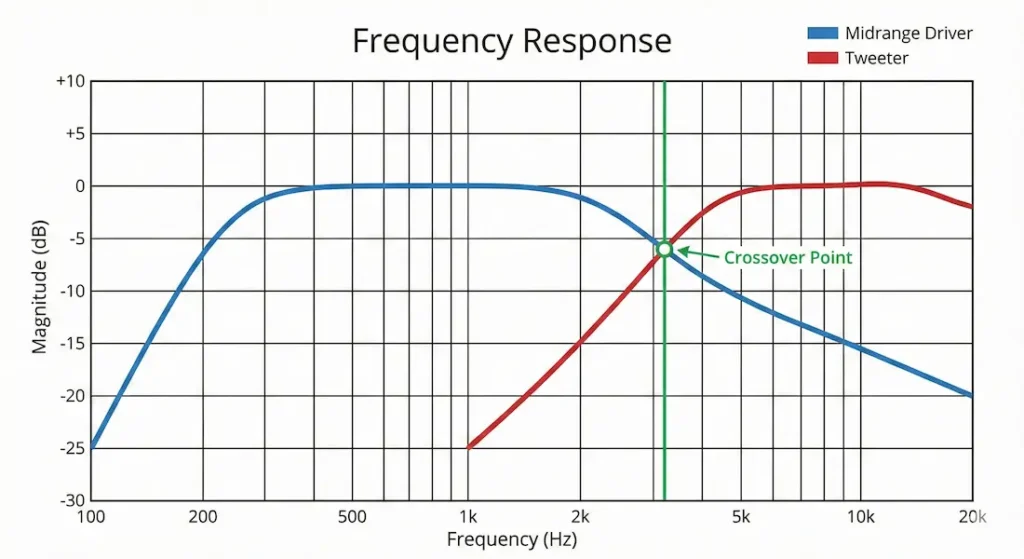
The D8404 performs well up to 5 kHz. The D2908/714000 can be crossed as low as 2.5 kHz. This gives you a comfortable 2.5 kHz to 5 kHz overlap zone where both drivers work cleanly. Having overlap means you can choose a crossover point that works best for other factors like directivity matching.
Compatible Dispersion Characteristics
The 84mm dome midrange and 30mm beryllium tweeter have similar directivity at 3.5 kHz to 4 kHz. This means the sound doesn’t change character as it hands off from midrange to tweeter. Listeners off-axis hear essentially the same tonal balance as those seated in the sweet spot.
Choosing the Right Crossover Frequency
The 3.5 kHz Sweet Spot
After analyzing both drivers’ specifications and independent measurements, 3.5 kHz emerges as the ideal crossover point. Here’s the reasoning:
- Midrange headroom: At 3.5 kHz, the D8404 is still operating well within its linear range. Its response is smooth without any breakup modes getting close.
- Tweeter safety: The D2908/714000’s resonance is at 534 Hz. At 3.5 kHz, you’re more than 2.5 octaves above resonance. That’s plenty of margin for safe operation.
- Directivity matching: The off-axis response of both drivers aligns well at this frequency, ensuring consistent sound throughout your listening room.
- Lobing minimization: With typical driver spacing, 3.5 kHz keeps the main lobe well-controlled without significant interference patterns.
Why Not 2.5 kHz or 5 kHz?
Going lower (2.5 kHz): While the tweeter can technically handle it, you’re pushing closer to its resonance. Power handling decreases, distortion increases, and you gain nothing since the midrange performs beautifully at these frequencies anyway.
Going higher (5 kHz): The midrange can extend this high, but its dispersion narrows. You’d hear a more directional sound with noticeable changes in tonality off-axis. The midrange-to-tweeter transition becomes audible.
Crossover Slope: Why 24 dB/Octave Works Best
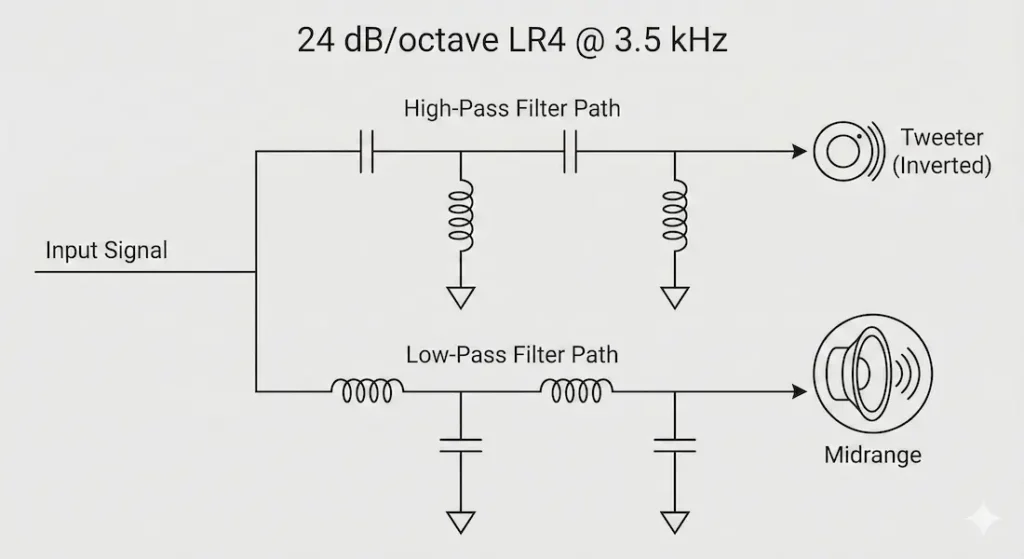
Crossover slope determines how quickly the filter attenuates frequencies outside its passband. Common options are 6 dB, 12 dB, 18 dB, and 24 dB per octave.
For this driver combination, a 24 dB/octave (4th order) Linkwitz-Riley filter is recommended.
Benefits of Linkwitz-Riley 24 dB/Octave
- Flat summed response: Both drivers are -6 dB at crossover and sum to flat. No boost or dip at the transition.
- Better driver protection: Steeper slopes keep the tweeter further from damaging low frequencies and prevent the midrange from contributing distortion above its usable range.
- Improved power handling: Each driver handles only its intended frequency band, increasing system power capacity.
- In-phase alignment: Linkwitz-Riley filters maintain acoustic phase alignment when drivers are physically aligned (or with inverted tweeter polarity).
Dealing with Impedance Differences
The D8404 is 4Ω while the D2908/714000 is 8Ω. This mismatch affects crossover calculations.
For Passive Crossovers
Calculate your crossover components using each driver’s actual impedance at the crossover frequency, not its nominal rating. At 3.5 kHz, both drivers will show impedance values different from their DC resistance. Measure with an impedance analyzer or use manufacturer curves.
Consider adding a Zobel network to flatten impedance rise in the midrange at higher frequencies. This stabilizes the crossover’s behavior.
For Active Crossovers
Active crossovers eliminate impedance-related issues because filtering happens before amplification. Each driver gets its own amplifier channel. This is the cleaner solution if you’re comfortable with active systems.
Use a DSP-based crossover like a miniDSP unit. You can set precise slopes, frequencies, and even add time alignment to account for any physical offset between drivers.
How to Build Your Crossover
Step 1: Measure your drivers
Even premium drivers have unit-to-unit variation. Measure the impedance curve of your actual drivers. Compare to published data. Note any significant deviations.
Step 2: Simulate before building
Use software like VituixCAD, XSim, or similar to model the crossover. Import your measured data. Verify the predicted response before spending money on components.
Step 3: Start with the recommended values
Begin with a 3.5 kHz crossover using 24 dB/octave Linkwitz-Riley slopes. Reverse the tweeter polarity. This gives you a solid starting point.
Step 4: Measure and adjust
After building, measure the actual acoustic response. Look for a smooth summed response through the crossover region. Minor tweaks to component values may be needed.
Step 5: Listen critically
Measurements tell part of the story. Extended listening reveals issues measurements might miss. Pay attention to vocals, cymbals, and acoustic instruments that span the crossover region.
Common Problems and Solutions
Problem: Harsh or aggressive treble
Solution: The beryllium tweeter can reveal issues in upstream equipment. Check that your source and amplifier aren’t adding brightness. If the problem persists, try lowering the tweeter level by 0.5-1 dB using an L-pad or DSP.
Problem: Dip or peak at crossover
Solution: Usually indicates phase or time alignment issues. Verify tweeter polarity is inverted. Check physical alignment of drivers. If using DSP, add delay to the closer driver.
Problem: Vocals sound thin or recessed
Solution: May indicate the crossover frequency is too low for the midrange, causing interference. Try raising the crossover to 4 kHz. Also check baffle step compensation.
Problem: Uneven off-axis response
Solution: Directivity mismatch between drivers. This pairing should be good at 3.5 kHz, but verify with measurements. You may need to adjust the crossover frequency slightly or add a shallow waveguide to the tweeter.
Recommended Crossover Components
With drivers at this quality level, don’t skimp on crossover components. Here’s what to consider:
Capacitors
Use film capacitors. Polypropylene at minimum. Brands like Mundorf, Jantzen, or ClarityCap offer excellent options. For the tweeter high-pass, consider premium capacitors since any distortion or coloration will be directly audible.
Inductors
Air-core inductors are preferred for midrange and tweeter circuits to avoid saturation. For larger values on the midrange low-pass, high-quality laminated steel or ferrite cores can work if properly sized. Keep DC resistance low. Under 0.3Ω for critical positions.
Resistors
Non-inductive wire-wound resistors rated for appropriate power. Mills, Mundorf, or Ohmite are popular choices. Calculate power dissipation based on your expected playback levels.
Final Recommendations
Here’s what you need to build an excellent crossover for the Ellipticor D8404/552000 and Revelator D2908/714000:
| Parameter | Recommendation |
|---|---|
| Crossover Frequency | 3.5 kHz (acceptable range: 3-4 kHz) |
| Filter Topology | 24 dB/octave Linkwitz-Riley |
| Tweeter Polarity | Inverted (reversed) |
| Level Matching | Not needed (both 92 dB) |
| Impedance Compensation | Zobel network on midrange |
| Alternative Approach | Active DSP crossover (miniDSP, etc.) |
The Ellipticor D8404/552000 and Revelator D2908/714000 represent some of the finest drivers available for DIY speaker building. Getting the crossover right is essential to hearing what they can do. Follow this guide, take measurements, and trust your ears. The results will speak for themselves.
Build with confidence. Listen with joy.