Rising Inflation Budget 2026: 7 Steps That Actually Work
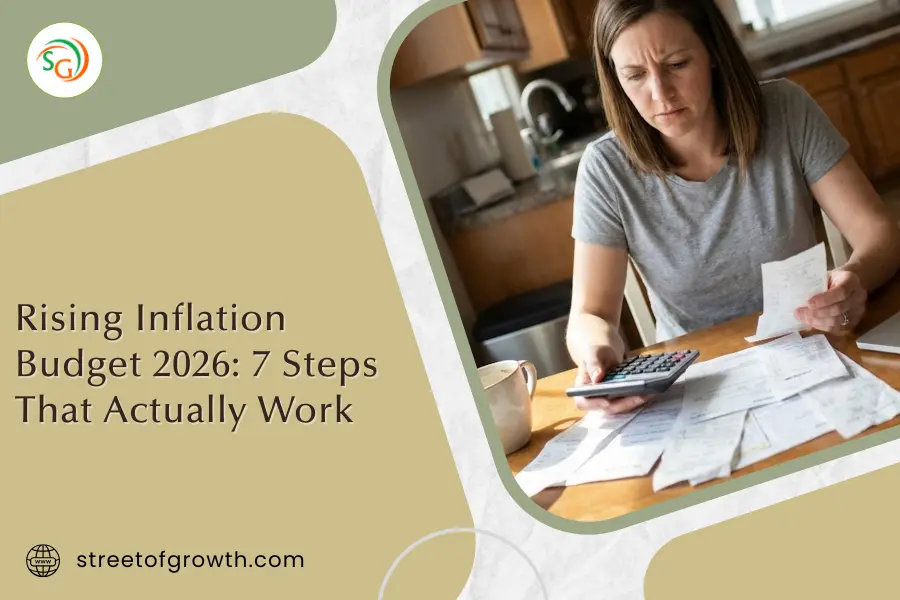
Sarah stared at her grocery receipt in disbelief. The same cart of food that cost $127 last January now rang up at $148. Her rent hadn’t changed, but somehow, her paycheck felt smaller every month. She wasn’t spending recklessly. She wasn’t buying luxuries. Yet her savings account kept shrinking.
If this sounds familiar, you’re not alone. And more importantly, you’re not failing at money management.
The economy in 2026 looks different than what many experts predicted. Instead of inflation cooling down to the Federal Reserve’s 2% target, it’s stubbornly hanging around 3% or higher for most of the year. Economists call this “stagflation lite,” a fancy term that basically means prices keep climbing while economic growth stays sluggish. For regular people, it means your money doesn’t stretch as far, and traditional budgeting advice doesn’t quite cut it anymore.
But there’s good news: You can still take control. This guide will show you exactly how to build a budget that works for 2026’s unique economic reality. Not the economy we wish we had, but the one we’re actually living in.
Why 2026 Is Different (And Why Your Old Budget Isn’t Working)
We need to talk about what’s actually happening with your money this year.
First, inflation isn’t going away as quickly as anyone hoped. Experts originally thought prices would settle down, but several factors are keeping them elevated. New tariffs on imported goods are adding about 1% to overall inflation. Housing costs continue climbing because there simply aren’t enough homes available. And wages, while growing, aren’t keeping pace with how much everything costs.
What makes 2026 particularly tough: If you’re a middle-income household (earning somewhere between $50,000 and $120,000 a year) you’re feeling the squeeze more than anyone else. Wealthier families have investment income and bigger financial cushions. Lower-income families often qualify for government assistance programs that adjust with inflation. But middle-income families? They’re stuck in the middle, dealing with the full brunt of price increases without much help.
The average family has lost about 23% of their purchasing power since 2021. That means what $10,000 bought you three years ago now costs about $12,315. Your salary might have gone up a bit, but probably not that much.
Understanding this isn’t about doom and gloom. It’s about recognizing that if your budget feels broken, it’s not because you’re doing something wrong. The rules of the game changed. Now we need to play smarter.

The 7-Step System to Budget Through Rising Inflation
Forget everything you’ve heard about “just cut your spending” or “make coffee at home.” Those tips aren’t wrong, but they’re incomplete. What follows is a complete system designed specifically for 2026’s economic reality.
Step 1: Do a Brutal Budget Reality Check
Most people skip this step because it’s uncomfortable. Don’t skip it.
Open your bank statements from the last three months. Not what you think you spent. What you actually spent. Use a simple notebook or a free app, and write down every single expense by category: housing, utilities, groceries, gas, insurance, subscriptions, dining out, entertainment, and everything else.
Now compare those numbers to the same months last year. You’ll probably notice certain categories have exploded. For most people in 2026, it’s groceries (up 20 to 25%), utilities (up 10 to 15%), and car-related costs (insurance and gas up 15 to 20%). These aren’t things you can easily cut. They’re necessities.
This reality check serves a purpose: You need to know exactly where inflation is hitting you hardest. You can’t fix what you can’t see.
Step 2: Separate “Fixed Inflation” from “Choice Inflation”
Most budgeting articles miss this concept: Not all inflation hits you the same way.
Fixed Inflation includes costs you can’t easily control:
- Rent or mortgage
- Utilities (electricity, water, gas)
- Car insurance
- Health insurance
- Property taxes
Choice Inflation includes areas where you still have some control:
- Groceries (you can change what and how you buy)
- Dining out and takeout
- Entertainment subscriptions
- Shopping and personal items
- Gas (you can adjust driving habits)
The point isn’t that “choice” expenses are bad or that you should eliminate them. The point is knowing where you have leverage. When money gets tight, you have zero control over your landlord raising rent, but you have 100% control over whether you order takeout twice a week or once a week.
Step 3: Build an “Inflation Buffer” Into Your Budget
This is what most people miss, and it changes everything.
Traditional budgeting advice tells you to make income minus expenses equal zero. That works fine when prices are stable. But in 2026, prices aren’t stable. They’re creeping up month after month.
Instead of a zero-based budget, build in a 3 to 5% buffer for your most volatile expense categories. What that looks like in practice:
Say you typically spend $600 a month on groceries. Instead of budgeting exactly $600, budget $620 to $630. That extra $20 to $30 acts as your inflation cushion. When a gallon of milk jumps from $3.50 to $4.00, you’re not scrambling to find money elsewhere. Your budget already accounted for it.
Do this for groceries, gas, utilities, and any other category where prices bounce around. Yes, this means you’ll need to trim somewhere else to create that buffer. But trust me, having this cushion prevents the budget from falling apart when prices spike unexpectedly.
Step 4: Attack Groceries Strategically (Not Desperately)
Everyone says “meal plan and buy generic.” That’s fine, but we need to get more specific about what actually works in 2026.
The Smart Substitution Strategy: Don’t think about cutting entire meals or going hungry. Think about strategic swaps. If beef is $8 per pound, chicken thighs at $3 per pound give you the same protein. If fresh berries cost $6, frozen berries at $3 taste nearly identical in smoothies. Brand-name cereal at $5.50? The store brand at $2.50 is made in the same factory.
The Buy-Low, Stock-Up Rule: When staples you use regularly go on sale (pasta, rice, canned tomatoes, peanut butter, coffee) buy extras. Not hoarding levels, just enough to last a few weeks. This prevents you from paying peak prices when you run out.
The High-Volume, Low-Cost Principle: Base your meals around inexpensive, filling ingredients. Rice, beans, potatoes, eggs, oats, and seasonal vegetables give you maximum nutrition for minimum cost. Build meals around these, then add smaller amounts of pricier items like meat or cheese for flavor.
One family I know cut their grocery bill from $900 to $650 a month using just these three strategies. Same people, same amount of food, better planning.
Step 5: Demolish Subscription Creep
This one’s quick but powerful.
Pull up your bank and credit card statements right now. Count every single recurring charge. Streaming services, apps, software, magazines, gym memberships, subscription boxes. All of it.
Most people discover they’re spending $40 to $80 per month on subscriptions they barely use. That’s $480 to $960 a year. In 2026’s economy, that money matters.
Cancel anything you haven’t used in the past month. Keep only the one or two services that genuinely add value to your life. Rotate services instead of keeping them all. Watch Netflix for two months, cancel it, switch to another service for two months. You’ll barely notice the difference, but your wallet will.
Step 6: Find New Income Streams (Even Small Ones Matter)
When expenses keep rising and your regular paycheck stays flat, there’s only one solution: Earn more money.
I know that sounds obvious, but hear me out. I’m not talking about working yourself to exhaustion. I’m talking about finding relatively easy ways to add $200 to $500 a month to your income.
Sell stuff you don’t use. That exercise bike collecting dust? The kitchen gadgets you never touch? The clothes that don’t fit? Sell them. One weekend of focused selling can bring in $300 to $600. That’s immediate relief for your budget.
Pick up a flexible side gig. Food delivery, grocery shopping services, freelance work in your field, tutoring kids online, pet sitting. These aren’t glamorous, but they let you work on your schedule and earn extra money when you need it. Even adding $200 a month creates breathing room.
Ask for a raise strategically. Most people either never ask or ask wrong. The right way in 2026: Document how inflation has impacted you (use real numbers), show the value you’ve added to your company, and ask for a cost-of-living adjustment of 5 to 8%. Many employers are willing to negotiate if you demonstrate why it’s deserved and fair.
Step 7: Protect Your Future (Don’t Sacrifice Everything for Today)
Most inflation budgeting advice fails at this point: It tells you to cut everything, including retirement savings and emergency funds. That’s short-term thinking that causes long-term damage.
Your emergency fund matters more in 2026, not less. Unexpected expenses don’t stop happening just because inflation is high. If anything, they hit harder. Try to keep at least $1,000 to $2,000 saved for true emergencies. If you need to temporarily reduce your emergency fund contributions to survive, that’s okay. But don’t eliminate them completely.
The same goes for retirement. If you’re getting an employer match on your 401(k), contribute at least enough to get that free money. That’s an instant 50 to 100% return on your money. You can’t get that anywhere else. If you’re struggling that much, reduce your contribution to the match level, but don’t drop below it.
Inflation is temporary. The retirement years you’re saving for aren’t.

A Budget Comparison: Before and After
What does this actually look like in practice? Take a look at a typical middle-income household budget for 2026:
Traditional Budget (Before) – Monthly
| Category | Amount |
|---|---|
| Take-home income | $5,200 |
| Rent | $1,500 |
| Utilities | $200 |
| Groceries | $700 |
| Transportation (gas, insurance, car payment) | $550 |
| Health insurance | $350 |
| Subscriptions & entertainment | $180 |
| Dining out | $250 |
| Shopping & miscellaneous | $300 |
| Debt payments (credit cards, student loans) | $500 |
| Retirement contribution | $300 |
| Savings | $200 |
| Left over | $170 |
This looks fine on paper. But when grocery prices spike, or the car needs new tires, or utilities jump in summer, that $170 cushion evaporates fast. Then debt starts piling up.
Inflation-Resistant Budget (After) – Monthly
| Category | Amount | Strategy Applied |
|---|---|---|
| Take-home income | $5,400 | Added $200 from side gig |
| Rent | $1,500 | Fixed cost, no change |
| Utilities | $200 | Using energy-saving habits |
| Groceries | $520 | Strategic shopping, meal planning |
| Transportation | $500 | Shopped insurance, reduced unnecessary driving |
| Health insurance | $350 | Fixed cost, no change |
| Subscriptions & entertainment | $45 | Cut from 4 services to 1 |
| Dining out | $120 | Reduced frequency, not eliminated |
| Shopping & miscellaneous | $200 | More intentional purchases |
| Debt payments | $600 | Aggressively paying high-interest debt |
| Retirement contribution | $300 | Maintained employer match |
| Emergency fund | $200 | Protected from cuts |
| Inflation buffer | $100 | Built-in cushion for price spikes |
| Left over | $765 |
Same household. Different strategy. Nearly $600 more breathing room every month.
That’s the difference between constantly stressed about money and actually feeling in control.
The Mental Game: How to Stay Sane When Prices Keep Rising
Being honest for a second: Budgeting during persistent inflation is mentally exhausting. Every trip to the store feels like a punch in the gut. Every bill seems higher than it should be. The stress is real.
Ways to protect your mental health while protecting your wallet:
Celebrate small wins. Did you come in under budget on groceries this week? That’s a win. Found a way to save $20 on your phone bill? That’s a win. Acknowledge these victories instead of only focusing on how much everything costs.
Stop comparing yourself to others. Social media makes it look like everyone else is thriving. They’re not. Most people are struggling with the same money pressures you are. They just don’t post about it.
Focus on what you can control. You can’t control inflation rates or Federal Reserve policy. You can control whether you buy the name-brand pasta or the store brand. You can control whether you drive across town for one item or combine errands. Put your energy into the things you actually have power over.
Give yourself permission to adjust. Your budget won’t be perfect every month. Some months you’ll nail it. Some months unexpected expenses will blow it up. That’s normal. The goal isn’t perfection. It’s progress.
Tools and Resources That Actually Help
You don’t need expensive software to budget through inflation. Free tools that work:
Mint or YNAB (You Need A Budget): Both let you track spending, set budget categories, and get alerts when you’re close to limits. YNAB costs money but many people swear by its zero-based budgeting approach.
Your bank’s app: Most banks now show spending by category automatically. This is often enough for basic tracking without downloading anything new.
A simple spreadsheet: Sometimes the old ways work best. Google Sheets is free and lets you customize exactly how you want to track money.
Grocery store apps: Download apps for the stores you shop at most. They often have digital coupons and special member deals that can save you 10 to 15% per trip.
GasBuddy: Shows you which gas stations near you have the cheapest prices. Driving an extra mile to save 20 cents per gallon adds up when you’re filling up weekly.
The best tool is the one you’ll actually use consistently. Pick one and commit to checking it at least once a week.
Frequently Asked Questions
How long will high inflation last in 2026?
Most economic forecasts suggest inflation will stay above 3% for the majority of 2026, potentially not returning to the Federal Reserve’s 2% target until 2027. This is due to ongoing tariff impacts, housing cost pressures, and supply chain adjustments. Build a budget that can handle sustained higher prices, not one that waits for prices to drop back to 2022 levels (which likely won’t happen).
Should I stop saving for retirement to pay bills?
If you’re truly at a breaking point, temporarily reducing retirement contributions is better than taking on high-interest credit card debt. However, try to maintain at least the minimum to get your employer match. That’s free money you can’t recapture later. Once your budget stabilizes, increase contributions again. Remember, compound interest lost in your 30s and 40s can cost you tens of thousands in retirement.
Is it better to pay off debt or build savings during inflation?
It depends on the interest rate. Credit card debt at 18 to 24% APR should be your top priority. That interest is destroying your finances faster than inflation. Car loans under 5% or student loans under 6% can wait while you build a small emergency fund of $1,000 to $2,000 first. Once you have that safety net, attack high-interest debt aggressively, then build savings further.
What if I’ve already cut everything I can cut?
If you’ve truly eliminated all discretionary spending and you’re still short, you have three options: (1) Increase income through a side gig, overtime, or job change, (2) Reduce fixed costs by finding a roommate, moving to a cheaper place when your lease ends, or refinancing high-interest debt, or (3) Seek community resources like food banks, utility assistance programs, or free financial counseling from the CFPB. There’s no shame in using resources designed to help people during tough economic times.
Should I use credit cards to cover gaps in my budget?
Only as an absolute last resort for true emergencies (like a car repair needed to get to work). Credit card interest rates in 2026 average 22 to 28%, which means borrowing $1,000 today could cost you $1,200 or more if you only make minimum payments. If you must use credit cards, have a concrete plan to pay them off within 3 to 6 months. Never use credit cards to maintain a lifestyle you can’t afford. That’s a debt spiral that’s extremely hard to escape.
Your Action Plan for This Week
Reading about budgeting doesn’t change anything. Taking action does. What to do in the next seven days:
Monday: Pull your last three months of bank statements. Calculate exactly what you spent in each major category.
Tuesday: Identify the three categories where inflation has hit you hardest. Be specific with numbers.
Wednesday: Choose one expense-cutting strategy from this guide and implement it. Just one. (I recommend starting with subscriptions because it’s quick and has immediate impact.)
Thursday: Build your inflation buffer into your budget. Add 3 to 5% extra to your most volatile expense categories.
Friday: Look for one way to add extra income, even if it’s just $100 to $200 this month. List items to sell, research side gigs, or schedule a meeting to discuss a raise.
Weekend: Meal plan for next week and do one strategic grocery shop using the substitution strategy. Track how much you save compared to last week.
One week. Seven actions. That’s how you take control back from inflation.
The Bottom Line
Inflation in 2026 is frustrating, exhausting, and unfair. But it doesn’t have to break you.
The families who are thriving right now aren’t the ones who make the most money. They’re the ones who adapted their budget to match economic reality. They stopped doing what used to work and started doing what works now.
You can do this too. Not by making some radical life change or living like you’re broke. But by making smart, strategic adjustments that let your money stretch further without sacrificing what matters most.
Sarah, the woman from the beginning of this article? She implemented these exact strategies. Three months later, she had $600 more in her bank account than when she started. Same job. Same income. Different approach.
Start today. Your future self will thank you.