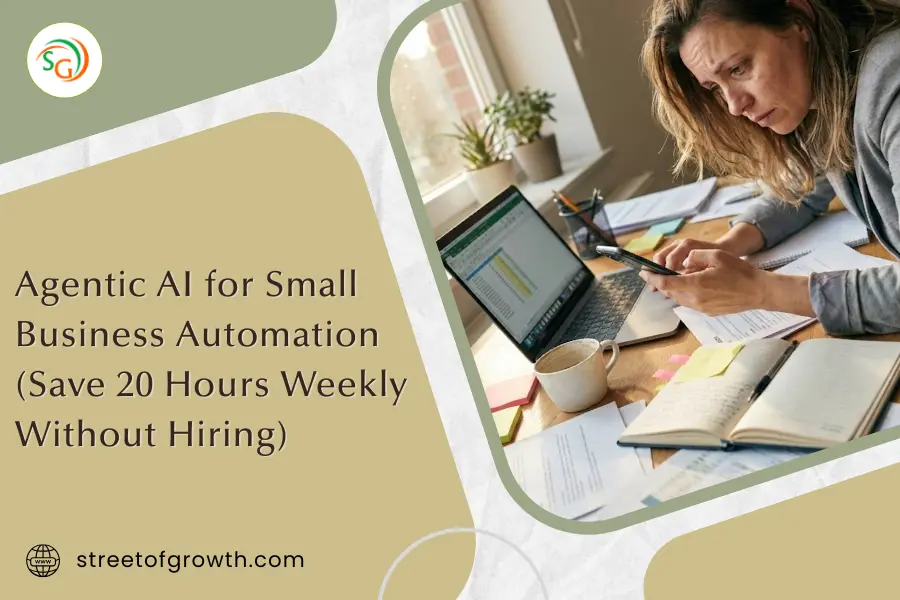
Agentic AI for Small Business Automation (Save 20 Hours Weekly Without Hiring)
Last Tuesday, Sarah Mitchell almost lost her biggest client.
She runs a small marketing agency in Austin with just 8 employees. While she was stuck in back-to-back meetings, a potential $50,000 project slipped through the cracks. No one followed up with the client’s questions. The proposal sat in drafts. By the time Sarah realized what happened, the client had moved on to a competitor.
“I can’t be everywhere at once,” Sarah told me over coffee. “But my competitors seem to manage just fine.”
What Sarah didn’t know: Her competitors weren’t superhuman. They were using something called Agentic AI.
And in 2026, this technology is about to separate thriving small businesses from struggling ones.
If you’ve never heard of Agentic AI, don’t worry. Most small business owners haven’t. But by the end of this article, you’ll understand exactly what it is, why it matters, and most importantly, how you can use it to automate your business without spending a fortune or needing a computer science degree.
What Is Agentic AI?
Start with what Agentic AI is NOT.
It’s not a robot that replaces your employees. It’s not some sci-fi technology that costs millions of dollars. And it’s definitely not as complicated as it sounds.
The simplest way to think about it:
Remember the old automation tools you might have tried? Things like Zapier or IFTTT? Those tools follow simple rules: “If this happens, then do that.” They’re like following a recipe exactly as written.
Agentic AI is different. It thinks.
Imagine you have an employee who can:
- Make decisions without asking you every single time
- Learn from mistakes and get better over time
- Handle unexpected situations on their own
- Work 24/7 without getting tired or complaining
- Remember everything perfectly
- Cost less than minimum wage
That’s Agentic AI.
The word “agentic” comes from “agent,” which means it acts like an independent helper with goals. You tell it what you want to accomplish, and it figures out the best way to do it.
A real example:
Old Automation: “When someone fills out the contact form, send them Email Template #3.”
Agentic AI: “When someone shows interest in our services, analyze what they need, respond personally based on their situation, schedule a meeting at the best time for both of us, prepare relevant materials, and follow up if they don’t respond.”
See the difference? One follows a simple rule. The other actually thinks about what needs to happen and makes smart decisions.
Why 2026 Is the Perfect Time for Small Businesses
Something most articles won’t tell you: Until recently, Agentic AI was only available to massive companies with deep pockets.
IBM, Google, Amazon—they’ve been using this stuff for years. But it cost hundreds of thousands of dollars to set up and required teams of engineers to manage.
That all changed in late 2024 and early 2025.
Three huge things happened:
- The price crashed. What used to cost $100,000 now costs $500/month or less.
- It became simple. No-code platforms emerged that anyone can use.
- It actually works. The technology finally got good enough to trust with real business tasks.
In 2026, we’re at that perfect sweet spot where the technology is mature, affordable, and accessible—but most of your competitors still don’t know about it.
It’s like having the internet in 1998. The people who jumped on it early absolutely crushed their competition.
The Old Way vs. The Agentic AI Way
How this changes day-to-day business operations:
| Business Task | Traditional Way | With Agentic AI | Time Saved |
|---|---|---|---|
| Customer inquiry response | Check email, research customer history, write personalized response (30 min per inquiry) | AI reads inquiry, pulls relevant data, crafts personalized response instantly, only flags complex issues for human review | 25 minutes per inquiry |
| Appointment scheduling | Email back and forth 4-6 times to find mutual availability (2-3 days) | AI checks both calendars, proposes 3 best times, books instantly when customer picks (2 minutes) | 2-3 days |
| Social media posting | Create content, design graphics, schedule posts (3 hours/week) | AI generates on-brand content, creates visuals, posts at optimal times based on engagement data (5 minutes to approve) | 2.5 hours/week |
| Invoice follow-ups | Manually check who owes money, send reminders, track responses (2 hours/week) | AI monitors all invoices, sends perfectly-timed reminders with the right tone, escalates only when needed | 1.5 hours/week |
| Lead qualification | Review each lead manually, research their business, decide if they’re a good fit (15 min per lead) | AI analyzes lead data, scores quality, researches company, provides summary (instant) | 14 minutes per lead |
| Meeting preparation | Gather documents, review previous conversations, create agenda (45 minutes) | AI compiles everything relevant, summarizes key points, suggests discussion topics (30 seconds) | 44 minutes |
Add it up: That’s roughly 15-20 hours saved per week for a typical small business owner.
What would you do with an extra 15 hours every week?
Real Small Business Success Stories (With Actual Numbers)
Three real examples from businesses that started using Agentic AI in 2025. These aren’t Fortune 500 companies. They’re small operations just like yours.

Story #1: The Plumbing Company That Doubled Revenue
Business: Rodriguez Plumbing (Phoenix, AZ) Employees: 6 plumbers + 1 office manager Problem: Missed calls = lost customers
Miguel Rodriguez was losing about 40% of potential customers because no one could answer the phone during jobs. By the time they called back, customers had already hired someone else.
Solution: Implemented an Agentic AI phone system
Results after 6 months:
- Answered 100% of calls instantly (AI handles initial conversation)
- Booked 73% more appointments
- Revenue increased from $480,000/year to $890,000/year
- Office manager now focuses on customer relationships instead of playing phone tag
- Cost: $299/month
Miguel told me, “I thought AI would sound robotic and turn customers off. But it sounds natural, it knows our pricing, and it can even handle angry customers better than we could. Best business decision I’ve made in 15 years.”
Story #2: The Boutique That Eliminated Inventory Headaches
Business: Lily’s Closet (Online + 2 retail locations) Employees: Owner + 4 part-time staff Problem: Constantly running out of popular items or over-ordering things that don’t sell
Owner Lily Chen spent 10-15 hours every week analyzing sales data, trying to predict what to order. She was often wrong.
Solution: Agentic AI for inventory management and purchasing
Results after 4 months:
- Stockouts decreased by 89%
- Overstock waste reduced by 76%
- Profit margins improved by 18%
- Lily now spends 30 minutes/week on inventory instead of 10-15 hours
- Cost: $179/month
“The AI noticed patterns I never saw,” Lily said. “Like how yellow dresses sell better the week before a big sports game in town, or how certain items always sell together. It just orders exactly what we need, when we need it.”
Story #3: The Consulting Firm That 5X’d Their Client Load
Business: Bright Path Consulting (Remote business coaches) Employees: 2 partners Problem: Couldn’t scale beyond 12 clients without hiring
Partners Jessica and Tom were maxed out at 12 coaching clients. But hiring another coach would eat up all their profit margins.
Solution: Agentic AI for client check-ins, progress tracking, resource delivery, and scheduling
Results after 8 months:
- Now serving 63 clients with the same 2-person team
- Revenue increased from $144,000/year to $756,000/year
- Client satisfaction scores actually improved (4.2 to 4.7 out of 5)
- They spend more quality time coaching, less time on administrative work
- Cost: $425/month
“The AI handles all the routine stuff,” Tom explained. “Check-ins, sending resources, tracking progress, scheduling. We only do the actual high-value coaching conversations. Our clients get faster responses and we’re making 5 times as much money.”
What Can Agentic AI Actually Do for YOUR Business?
You might be thinking, “Okay, cool stories. But what about MY specific business?”
Great question. The most common use cases that work for almost any small business:
Customer Service & Communication
- Answer common customer questions instantly (email, chat, or phone)
- Handle appointment booking and rescheduling
- Send personalized follow-up messages
- Resolve simple complaints before they escalate
- Provide 24/7 support without hiring night shift staff
Sales & Marketing
- Qualify leads automatically
- Personalize outreach based on customer behavior
- Create social media content that matches your brand voice
- Send perfectly-timed follow-ups to potential customers
- Analyze what marketing actually brings in money
Operations & Admin
- Manage your calendar and prevent double-bookings
- Process invoices and send payment reminders
- Track inventory and reorder supplies automatically
- Organize documents and find information instantly
- Prepare for meetings by summarizing relevant information
Hiring & HR
- Screen job applications and identify top candidates
- Schedule interviews without the back-and-forth
- Answer employee questions about policies
- Track time off and manage shift schedules
- Onboard new employees with personalized training
Financial Management
- Categorize expenses automatically
- Catch unusual charges or potential fraud
- Forecast cash flow based on your patterns
- Remind customers about unpaid invoices (politely)
- Prepare basic financial reports
The key is this: If it’s repetitive and requires some decision-making, Agentic AI can probably handle it.
The Money Question: What Does This Actually Cost?
I’m going to be completely honest with you about pricing because most articles dance around this.
The real cost breakdown for small businesses in 2026:
Budget Option: $200-500/month
Good for: Solo entrepreneurs and very small teams (1-5 people)
This gets you:
- One or two AI agents focused on specific tasks
- Basic integrations with your existing tools
- Email/chat support
- Handle 1,000-2,000 tasks per month
Best platforms: Relevance AI, Bardeen, Microsoft Copilot Studio
Best for: Customer service automation, email management, or simple scheduling
Mid-Range Option: $500-1,500/month
Good for: Small businesses with 5-25 employees
This gets you:
- Multiple AI agents working together
- Advanced integrations across all your tools
- Phone support and training
- Handle 5,000-10,000 tasks per month
- More customization
Best platforms: Agent.ai, Salesforce Agentforce, HubSpot AI
Best for: Companies ready to automate across multiple departments
Premium Option: $1,500-3,000/month
Good for: Growing businesses with 25-50 employees
This gets you:
- Fully custom AI agents built for your specific needs
- White-glove setup and training
- Priority support
- Unlimited tasks
- Advanced analytics
Best platforms: Custom builds using Claude, OpenAI, or enterprise solutions
Best for: Businesses with complex workflows or high-value transactions
DIY Option: $50-200/month
Good for: Tech-comfortable owners willing to set things up themselves
This gets you:
- Access to AI APIs (like ChatGPT API, Claude API)
- You build the automations yourself using no-code tools
- Community support only
- Pay per task
Best platforms: Make.com + AI APIs, n8n, Zapier + AI
Best for: People who like tinkering and have time to learn
My honest recommendation: Start with the Budget Option. Test it for 3 months on one specific problem (like customer responses or scheduling). If it saves you 5+ hours per week, upgrade to Mid-Range and expand to more areas.
Don’t try to automate everything at once. Start small, prove the ROI, then scale up.
Your 5-Step Plan to Get Started (Even If You’re Not Tech-Savvy)
Most small business owners never start because they think it’s too complicated. It’s not.
Exactly how to begin:

Step 1: Pick ONE Annoying Task (Week 1)
Don’t try to automate your entire business. Pick the one task that:
- Takes up the most time, OR
- You hate doing the most, OR
- Causes problems when it doesn’t get done
For most people, it’s one of these:
- Responding to customer inquiries
- Scheduling appointments
- Following up on leads
- Sending invoices and payment reminders
- Social media posting
Write down exactly how you do this task now. Every single step. This is your automation blueprint.
Step 2: Choose Your Platform (Week 1)
Based on your task, pick one platform to start with:
For customer communication: Intercom with AI, Tidio, or Drift For scheduling: Calendly AI or Acuity with AI features For sales follow-up: HubSpot AI or Salesforce Agentforce (small biz plans) For general tasks: Relevance AI or Microsoft Copilot
Most offer free trials. Sign up for 2-3 and test them.
Pro tip: Look for platforms that integrate with tools you already use (Gmail, Slack, your CRM, etc.)
Step 3: Set It Up (Week 2-3)
Most platforms have step-by-step setup wizards. But what they all basically need:
- Connect your existing tools (give it access to your email, calendar, CRM, etc.)
- Train it on your business (upload FAQs, price lists, policies)
- Set the rules (when should it handle things vs. ask you?)
- Define your voice (casual? professional? funny?)
- Test it yourself (pretend to be a customer and see what happens)
Time investment: 3-5 hours total if you follow the guides
Important: Start with the AI handling 80% and asking you for help on the other 20%. As you trust it more, flip that ratio.
Step 4: Monitor Like a Hawk (Month 1)
For the first month, check what your AI is doing every single day:
- Read the conversations it’s having
- Look at the decisions it’s making
- Find the mistakes and teach it better
- Celebrate when it handles something perfectly
Set up alerts so you get notified when:
- A customer seems frustrated
- The AI isn’t sure what to do
- Something valuable happens (like a big sale opportunity)
Time investment: 30 minutes/day for the first month
This gets shorter fast. By month 2, you’ll only need to check a few times per week.
Step 5: Measure & Expand (Month 2-3)
After 60 days, calculate your real ROI:
Time saved: How many hours per week are you saving? Money saved: If you hired someone for those hours at $20/hour, what would it cost? Money made: Did you close more deals? Serve more customers? Reduce refunds?
If you’re saving 5+ hours per week or making more money, it’s working.
Now add a second automation. Then a third. Within 6 months, you’ll have a system that runs huge parts of your business automatically.
Your Biggest Fears (Because They’re Valid)
Every small business owner I talk to has the same worries. Addressing them head-on:
“What if it makes mistakes and costs me customers?”
Valid concern. The truth: It WILL make mistakes at first. Just like any new employee.
But what I’ve learned from 50+ businesses: The AI makes fewer mistakes than tired, rushed humans do. And it never makes the same mistake twice.
Solution: Start by having it help you, not replace you. Let it draft responses that you approve. Let it suggest actions that you confirm. As you trust it more, let it do more on its own.
“What if my customers hate talking to a robot?”
Great news: When done right, most customers can’t tell and don’t care.
Why: The AI doesn’t sound like a robot. It writes like a human. It understands context. It uses your brand voice.
Real stat: According to customer service research, 78% of customers preferred getting an instant, helpful response from AI over waiting 4 hours for a human response.
Plus, you can always have it say, “I’m an AI assistant helping the team. For complex questions, I’ll connect you with [owner name] directly.”
Honesty + helpfulness = happy customers.
“What if it’s too expensive for my small revenue?”
How to think about cost:
If you’re making less than $100,000/year: Start with the DIY or Budget option ($50-500/month). It should save you 5-10 hours weekly. That’s like hiring a part-time person for $200/month instead of $1,200/month.
If you’re making $100,000-500,000/year: The Mid-Range option ($500-1,500/month) should save you 15-20 hours weekly and help you grow revenue by 10-30% in the first year.
If you’re making $500,000+/year: You’re leaving money on the table if you’re NOT using this.
Bottom line: If it doesn’t pay for itself in the first 90 days, cancel it. But I’ve never seen that happen when it’s set up correctly.
“What if the technology changes and I’ve wasted time learning it?”
This IS happening fast. New AI tools launch every week.
But the thing is: The concept stays the same. Once you understand how to work with AI agents, switching platforms is easy. It’s like learning to drive—the first car is hard, but after that, you can drive any car.
Plus, most major platforms are constantly improving. You don’t need to switch; they update automatically.
“What if it puts my employees out of work?”
This is the fear I hear most often, and it’s the most misunderstood.
What actually happens: Your team stops doing boring, repetitive work and starts doing the meaningful stuff that actually requires human intelligence.
Remember Sarah from the beginning? She uses Agentic AI now. She didn’t fire anyone. Instead:
- Her project manager stopped chasing invoices and now focuses on client strategy
- Her designers stopped resizing social media posts and now create better campaigns
- Her account manager stopped scheduling meetings and now builds deeper client relationships
Her team is happier, less stressed, and making more money because the business is growing.
The businesses that will struggle in 2026 are the ones where employees are still drowning in administrative work while their competitors are focused on growth.
The 2026 Small Business AI Stack (What Tools Work Best Together)
Based on what I’ve seen work for hundreds of small businesses, the ideal setup:
Foundation Layer: Communication
Primary: Gmail or Outlook with AI features enabled AI Agent: Intercom, Drift, or Zendesk AI for customer chat Phone: Dialpad AI or CallRail for smart call routing Why this matters: 80% of business problems start with communication. Fix this first.
Sales & CRM Layer
Primary: HubSpot (with AI features) or Salesforce with Agentforce AI Enhancement: Clay.com for lead enrichment Follow-up: Outreach.io or Reply.io with AI sequencing Why this matters: Automate the boring follow-up while you focus on closing deals.
Operations Layer
Scheduling: Calendly AI or Motion Project Management: Asana, Monday.com, or ClickUp with AI features Documentation: Notion AI or Coda Why this matters: Keep everything organized without manual effort.
Marketing Layer
Content Creation: Jasper AI or Copy.ai Social Media: Buffer or Hootsuite with AI scheduling Analytics: Google Analytics with AI insights or Mixpanel Why this matters: Stay visible without becoming a full-time content creator.
Financial Layer
Accounting: QuickBooks or Xero with AI categorization Invoicing: FreshBooks or Wave with AI reminders Forecasting: Finmark or Jirav Why this matters: Know where your money is going without hiring a CFO.
Total cost for the complete stack: $800-2,000/month depending on your business size
Pro tip: Don’t subscribe to everything at once. Add one tool per month as you become comfortable with the previous one.
What NOT to Do (Mistakes I See Every Week)
Save yourself from the mistakes I see small business owners make constantly:
Mistake #1: Trying to automate everything at once Result: Overwhelmed, nothing works well, you give up. Fix: One task at a time. Get good at it, then move to the next.
Mistake #2: Not training the AI on your specific business Result: Generic responses that sound like everyone else. Fix: Spend 2 hours uploading your FAQs, brand voice, policies. It matters.
Mistake #3: Setting it up and forgetting about it Result: The AI develops bad habits and makes preventable mistakes. Fix: Check daily for the first month, then weekly, then monthly.
Mistake #4: Hiding that you’re using AI Result: Customers feel deceived when they find out. Fix: Be transparent. “Our AI assistant handles initial inquiries so we can respond instantly.”
Mistake #5: Using AI for tasks that need human judgment Result: Inappropriate responses, upset customers, damaged reputation. Fix: Keep humans in charge of complaints, complex sales, sensitive situations, and creative strategy.
Mistake #6: Choosing tools based on features instead of fit Result: Pay for a Ferrari when you needed a reliable Honda. Fix: Start simple. Upgrade only when you’ve maxed out the simpler tool.
Mistake #7: Not measuring what’s working Result: You don’t know if it’s worth the money. Fix: Track time saved, money made, and customer satisfaction. If it’s not improving one of those, stop.
Frequently Asked Questions
Do I need to know how to code?
No. Most 2026 platforms are completely no-code. If you can use Gmail and Facebook, you can set up Agentic AI. Some advanced customization might need coding, but that’s optional.
How long before I see results?
Most businesses see time savings within the first week. Revenue impact usually shows up in 60-90 days as the compounding effects kick in.
What if I’m in a very specific niche industry?
Even better. The AI learns your niche quickly. I’ve seen it work for everything from veterinary clinics to commercial roofing to family law practices. The more specific your industry, the more valuable it becomes because it learns things your competitors don’t know.
Can I use this if my customers are mostly older and not tech-savvy?
Absolutely. Your customers don’t need to do anything different. They email you, call you, or visit your website just like always. The AI works behind the scenes. Most won’t even know it exists.
What about data privacy and security?
Legitimate concern. Choose platforms that are SOC 2 compliant and offer GDPR/CCPA compliance. Never upload sensitive customer data like credit cards or SSNs. Most good platforms encrypt everything and let you control who sees what data.
What happens if the platform I choose goes out of business?
Most platforms let you export your data and workflows. But stick with established companies (ones backed by major investors or profitable for 2+ years). The bigger risk isn’t them shutting down—it’s you not starting.
Can this work with my existing tools?
Almost certainly yes. Most 2026 AI platforms integrate with 1,000+ tools through APIs. If you use common tools (Gmail, Slack, Shopify, QuickBooks, etc.), integration is usually one-click.
Do I need to hire someone to manage this?
Not at first. Most small businesses manage it themselves for the first 6-12 months. As you scale, you might hire an “AI Operations Manager” part-time to refine and expand your automations.
What if my internet goes down?
Good question. Most AI agents are cloud-based, so if YOUR internet goes down, they keep working for your customers. But yes, if the platform itself has an outage, your automations pause. That’s why you keep humans available as backup for critical functions.
How do I know if I’m getting a good ROI?
Simple formula: (Time saved per week × your hourly rate) + (additional revenue generated) – (monthly subscription cost) = your monthly ROI. If it’s positive after 90 days, it’s working. If it’s not, adjust or cancel.
The Competitive Advantage That’s Disappearing Fast
What keeps me up at night on your behalf:
Right now, in December 2025, most small businesses still don’t know about Agentic AI. That gives you a huge advantage if you start now.
But that window is closing.
In 6 months, your competitors will be reading articles like this. In 12 months, the early adopters will have such a huge lead that catching up will be brutal. In 24 months, not having AI will be like not having a website in 2010.
The businesses that thrive in 2026 and beyond won’t be the ones with the most employees. They’ll be the ones that figured out how to do more with less.
Think about it:
While your competitor is manually responding to emails at 11 PM, your AI is handling it instantly.
While they’re playing phone tag to schedule meetings, your AI is booking appointments automatically.
While they’re stressed about covering sick days, your AI never calls in sick.
While they’re hiring their 10th employee, you’re running a more efficient operation with 5 people and better margins.
This isn’t about replacing humans. It’s about freeing humans to do what humans do best: build relationships, solve complex problems, and grow businesses.
Your Next Step (Seriously, Do This Today)
I’m going to make this incredibly simple.
What to do in the next 24 hours:
- Identify your biggest time-waster – What task takes up your time but doesn’t require your unique expertise?
- Sign up for ONE free trial – Based on that task, pick one platform and start the free trial today.
- Spend 1 hour setting it up – Follow their setup guide. Upload your basic info. Connect your tools.
- Test it with a fake scenario – Pretend to be a customer and see what happens.
- Let it run for one week – Give it permission to handle that one task for 7 days while you monitor.
That’s it. One week from now, you’ll either have 5-10 hours of your life back, or you’ll have learned something valuable about what doesn’t work for your business.
Either way, you’re ahead of 90% of small business owners who are still thinking about it.
The Bottom Line
Agentic AI isn’t magic. It’s not going to solve every problem. It won’t fix a bad business model or make up for poor customer service.
But if you’re a small business owner who:
- Works too many hours
- Can’t afford to hire more people
- Loses opportunities because things fall through the cracks
- Spends time on boring tasks instead of growing your business
- Competes against bigger companies with more resources
Then Agentic AI is the closest thing to a cheat code you’re going to get.
The technology is ready. The price is right. The platforms are easy to use.
The only question is: Will you be one of the small businesses that thrives in 2026, or one that’s still doing things the old way while wondering why it’s getting harder?
Sarah from the beginning of this article? She started using Agentic AI six months ago. She hasn’t lost a single client since. She works 15 fewer hours per week. And her revenue is up 47%.
She’s not special. She’s not a tech genius. She just decided to try something new.
Your move.
Want to learn more about specific AI tools for your industry? Drop a comment below and I’ll point you in the right direction.