AI Diagnostics for Furnace Repair: How It Works, What It Costs, and Is It Worth It?
AI diagnostics for furnace repair (also called AI HVAC diagnostics, smart furnace monitoring, or predictive furnace maintenance) is a technology that uses artificial intelligence and smart sensors to watch your furnace around the clock and catch problems before they cause breakdowns. Manufacturers claim it cuts repair costs by up to 40%, lowers energy bills by 15 to 21%, and adds 3 to 5 years to a furnace’s life.
Imagine this. It is the coldest night of January. You are in bed. And suddenly… no heat. Your furnace just quit.
You call every HVAC company in town. Nobody is available until tomorrow. The emergency repair? $350 just for someone to show up. And that is before they even fix anything.
Now picture a different scenario. Two weeks earlier, your phone buzzes with a simple alert: “Your furnace blower motor is showing unusual wear. Schedule a service visit soon.”
You book a quick appointment. The technician replaces a small part for $85. Done. No emergency. No frozen pipes. No stress.
That second scenario is AI diagnostics for furnace repair in action. It is not science fiction. It is happening right now in thousands of homes with affordable technology you can set up this weekend.
What Is AI Diagnostics for Furnace Repair?
AI diagnostics for furnace repair is when your heating system uses artificial intelligence (a smart computer program) to monitor your furnace 24 hours a day, 7 days a week. It reads data from sensors inside your furnace, learns what “normal” looks like for your specific system, and alerts you when something goes wrong, often weeks before a breakdown would happen.
Think of it like this:
A regular furnace is like a car without a dashboard. It runs until it doesn’t. You have no clue what is going on under the hood.
A furnace with AI diagnostics is like a car with a smart dashboard that says, “Hey, your oil is getting low. Let’s change it this weekend before the engine gets damaged.”
What Does AI Monitor Inside Your Furnace?
The AI reads data from small sensors that track five key areas:
- Temperature changes: Is the furnace heating your home evenly?
- Airflow: Is air moving through the system the way it should?
- Energy consumption: Is the furnace working harder than normal?
- Cycle length: Is the furnace turning on and off too often?
- Vibrations and sounds: Are there unusual patterns that suggest a worn part?
The AI collects this data, compares it to your furnace’s normal behavior, and sends you a phone notification when something does not match up. No magic. Just smart monitoring that protects your furnace and your wallet.
How Does AI Furnace Diagnostics Work?
AI furnace diagnostics works in five steps: sensors collect data from your furnace, that data is sent to an AI program through your WiFi, the AI learns your furnace’s normal behavior over 2 to 4 weeks, it then spots tiny changes that suggest a problem, and finally it sends you an alert on your phone so you can fix the issue early.
Step 1: Sensors Collect Data
Small sensors inside your HVAC system measure temperature, pressure, vibrations, and energy use. Modern furnaces (made after roughly 2018) often have these sensors already inside them. Older systems can be upgraded with add-on sensor kits that cost $50 to $150.
Step 2: Data Goes to the AI
All that sensor data gets sent to an AI program through your home WiFi connection. This program runs on powerful computers in the cloud, not on your phone.
Step 3: The AI Learns What Is “Normal”
During the first 2 to 4 weeks, the AI just watches your furnace. It learns your home’s specific patterns. How long does the furnace usually run? What temperature does it reach? How much energy does it normally use? This is called machine learning, and it means the AI teaches itself what healthy behavior looks like for your specific furnace.
Step 4: It Spots Problems Early
Once the AI knows what “normal” looks like, it can catch the tiniest changes. Maybe your furnace is using 12% more energy than last week. Maybe the blower motor’s vibration pattern shifted slightly. These are clues a human would never notice. The AI is built to catch them, and suppliers put its accuracy at up to 95%.
Step 5: You Get an Alert
When the AI finds something concerning, it sends you a notification through your smart thermostat app (like the Google Nest or Ecobee app), an email, or a text message from your HVAC company’s monitoring service.
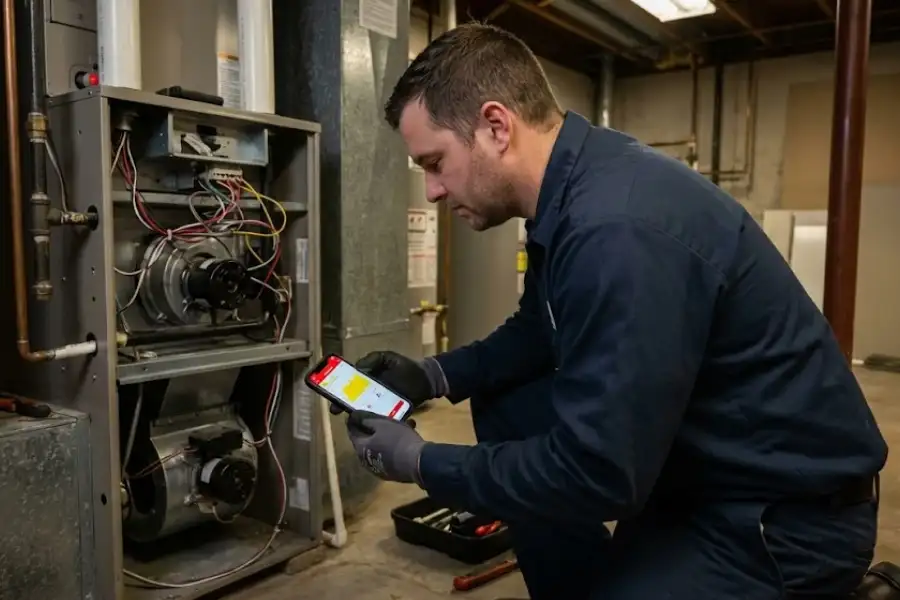
Some newer systems even tell the technician exactly what is wrong before they come to your house. That means they show up with the right parts and fix things on the first visit.
Good to Know: AI diagnostics does more than find broken parts. It also helps your furnace run more efficiently. Many homeowners see their energy bills drop 15 to 21% just from the AI fine-tuning their system’s performance over time.
What Furnace Problems Can AI Catch Before They Get Worse?
AI diagnostic systems commonly catch seven types of furnace problems early: dirty filters, blower motor wear, ignition issues, refrigerant leaks, thermostat malfunctions, ductwork blockages, and heat exchanger cracks. Catching these problems early rather than late saves homeowners anywhere from $100 to $2,500 per issue.
Dirty or clogged filter: The AI notices longer run times and reduced airflow. If missed, this causes overheating and system shutdown. Early repair costs $5 to $20 versus $150 to $400 if caught late.
Blower motor wearing out: The AI detects changed vibration patterns and higher energy use. If missed, the blower fails completely and you get no heat. Early repair costs $85 to $150 versus $400 to $700 late.
Ignition system issues: The AI spots longer startup times and failed ignition attempts. If missed, the furnace will not start at all. Early repair costs $100 to $200 versus $300 to $600 late.
Refrigerant leak (heat pumps): The AI picks up subtle pressure and temperature shifts. If missed, the system breaks down and needs an expensive refill. Early repair costs $150 to $300 versus $500 to $1,500 late.
Thermostat malfunction: The AI finds a mismatch between the set temperature and the measured temperature. If missed, you get uneven heating and wasted energy. Early repair costs $50 to $100 versus $200 to $350 late.
Ductwork blockage: The AI detects airflow inconsistency across zones. If missed, rooms will not heat and the system strains. Early repair costs $75 to $200 versus $300 to $800 late.
Heat exchanger cracks: The AI spots temperature anomalies and unusual cycling patterns. If missed, there is a carbon monoxide risk and you may need a full replacement. Early repair costs $300 to $500 versus $1,500 to $3,000 or more late.
Safety Warning: A cracked heat exchanger can leak carbon monoxide, an odorless and dangerous gas. Catching this early is about more than saving money. It can save lives. Always have a CO detector in your home as a backup, even with AI monitoring.
How Much Money Can AI Furnace Diagnostics Save You?
Working from the manufacturers’ own savings claims, up to 40% off repair costs and 15 to 21% off energy bills, the arithmetic below comes out at roughly $595 a year for an average household. Since the inputs are supplier figures, treat the total the same way.
Here is what the data from HVAC industry reports and the U.S. Department of Energy shows:
- Up to 40% lower repair costs because you fix small problems before they become big, expensive ones
- 15 to 21% lower energy bills because the AI adjusts when and how long your furnace runs (consistent with ENERGY STAR data on smart thermostat savings)
- 3 to 5 years longer furnace life because less stress on the system means it lasts longer
- 40% fewer emergency service calls because problems are caught weeks before breakdowns
- 5 to 20% insurance discounts from some insurers who offer lower rates for homes with smart prevention devices
What Does the Math Look Like for a Typical Homeowner?
Without AI diagnostics:
- Heating energy bill: $1,200 per year
- Average repair costs: $450 per year
- Emergency call (every 2 years): $175 per year average
- Total annual cost: $1,825
With AI diagnostics:
- Heating energy bill: $960 (20% savings)
- Average repair costs: $270 (40% savings)
- Emergency calls: $0
- Total annual cost: $1,230
- Your annual savings: $595
A smart thermostat costs $130 to $250. So in most cases, the investment pays for itself within the first 4 to 5 months.
Real Example: Global Hotel Chain Cuts HVAC Costs
A global hotel chain installed AI fault detection across their properties. Within 6 months, the system found over 230 small problems before they caused breakdowns. HVAC energy use dropped by 18%, emergency maintenance calls went down by 40%, and the expected lifespan of their heating equipment increased by 3 to 5 years. Those same results, scaled down to a single home, show the kind of value AI diagnostics brings to ordinary homeowners.
Which Smart Thermostat Has the Best AI for Furnace Diagnostics?
For most homeowners, the Google Nest Learning Thermostat offers the best AI furnace diagnostics thanks to its “Furnace Heads-Up” alert feature. If your home has hot and cold spots, the Ecobee Premium is better because it includes extra room sensors. For homes with Carrier HVAC equipment, the Carrier Infinity gives the deepest diagnostics.
Google Nest Learning Thermostat ($180 to $250)
- AI learns your schedule automatically
- “Furnace Heads-Up” alert feature for early warnings
- No air quality monitor
- Remote diagnostics through the Google Home app
- DIY installation
- Best for: Most homeowners
Ecobee Premium ($220 to $250)
- AI with room sensors for multi-zone monitoring
- Runtime history and custom alerts
- Air quality monitor included
- Remote diagnostics through the Ecobee app
- DIY installation
- Best for: Homes with hot and cold spots
Honeywell ElitePRO ($180 to $230)
- Pro-IQ AI platform
- Pro-IQ diagnostic alerts
- No air quality monitor
- Remote diagnostics through the Resideo app
- DIY installation
- Best for: Tech-savvy users
Carrier Infinity ($300 to $400, professional install)
- AI autopilot mode
- Technician-level diagnostic alerts
- No air quality monitor
- Remote diagnostics for certified technicians
- Professional installation required
- Best for: Carrier system owners
Our Recommendation: If you want the easiest setup, go with Google Nest. Its “Furnace Heads-Up” alert was made specifically for furnace monitoring. If you have uneven heating, choose the Ecobee Premium with its extra room sensors. Both work with most furnace brands and can be installed in under an hour.
How Do You Set Up AI Diagnostics on Your Furnace?
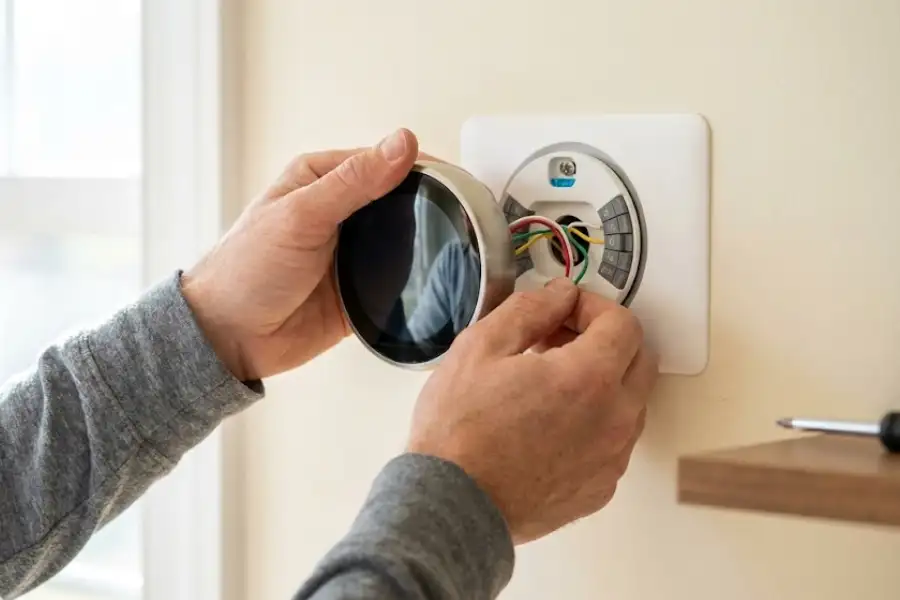
Setting up AI diagnostics on your furnace takes about 30 to 60 minutes. You need a compatible smart thermostat ($130 to $250), a WiFi connection, and the thermostat’s smartphone app. Most homeowners can do it themselves without hiring a technician.
- Check your furnace’s age. Look at the label on the front panel and find the manufacture date. Furnaces made after 2018 usually have sensors inside them that work with smart thermostats. Older furnaces may need an add-on sensor kit ($50 to $150).
- Pick a smart thermostat. Based on the comparison above, choose one that fits your budget. For most homes, Google Nest ($180 to $250) or Ecobee Premium ($220 to $250) are the best starting points.
- Install the thermostat. Follow the step-by-step guide in the box. Most brands also have video tutorials. If you prefer professional installation, it usually costs $75 to $150.
- Connect it to your WiFi. The thermostat walks you through connecting to your home WiFi during setup. Once connected, download the companion app on your phone.
- Turn on diagnostic alerts. In the app settings, look for options like “system alerts,” “diagnostic notifications,” or “Furnace Heads-Up” (on Nest). Turn all of them on.
- Let the AI learn. For the first 2 to 4 weeks, just let the system run. The AI watches, learns, and builds a profile of your furnace’s normal behavior. After that initial period, it starts sending accurate, personalized diagnostic alerts.
Key Takeaway: You do not need a brand-new furnace to use AI diagnostics. A $200 smart thermostat on an older furnace can still track runtime, energy use, and heating patterns. It will not be as detailed as a modern system with sensors already inside, but it catches the biggest problems early and pays for itself within months.
What Are the Pros and Cons of AI Furnace Diagnostics?
The biggest pros of AI furnace diagnostics are early problem detection, weeks before a breakdown, plus the supplier-quoted savings of up to 40% on repair costs and 15 to 21% on energy bills. The biggest cons are the upfront cost ($130 to $400), the 2 to 4 week learning period, and the need for a reliable WiFi connection.
The Pros
- Catches problems weeks before a breakdown happens
- Repair costs down by up to 40%, per manufacturer claims
- Energy bills down 15 to 21%, per manufacturer claims
- Extends furnace lifespan by 3 to 5 years
- Sends alerts straight to your phone
- Helps technicians fix things on the first visit (right parts, right diagnosis)
- Easy to set up with a smart thermostat
- Up to 95% accuracy in detecting common faults
The Cons
- Cannot physically fix anything. You still need a human technician
- Upfront cost of $130 to $400 for equipment
- Needs 2 to 4 weeks to learn your system (no instant results)
- Older furnaces may need extra sensor hardware
- Depends on WiFi. No internet means no monitoring
- Collects data about your heating habits (privacy concerns)
- “Black box” issue: AI does not always explain its reasoning
- Occasional false alarms can happen (not 100% accurate)
Is AI Furnace Monitoring Safe for Your Privacy?
AI furnace monitoring collects data about your heating patterns, which can reveal when you are home and when you are not. Major brands like Google Nest and Ecobee follow strict data protection rules. You can protect yourself by enabling two-factor authentication, reviewing app permissions, and keeping your firmware updated.
When you install AI diagnostics, your heating system sends data to the cloud. That data includes when you are home and when you are away, what temperature you set at different times, your daily heating habits, and how much energy you use.
5 Ways to Protect Your Privacy With a Smart Thermostat
- Choose reputable brands. Google, Ecobee, and Honeywell follow strict data protection standards. Lesser-known brands may not.
- Enable two-factor authentication. This adds an extra security step when logging into your thermostat app.
- Read the privacy policy. Look for what data they collect, who they share it with, and how long they keep it.
- Keep firmware updated. Turn on auto-updates in your app so you always have the latest security patches.
- Review app permissions. If the thermostat app asks for access to your contacts or camera, deny it. It does not need those.
Did You Know? A large number of homeowners have no idea how much data their smart thermostat collects about their daily routines. Take 10 minutes to check your app settings and privacy preferences. Knowledge is your best defense.
How Is AI Diagnostics Different From Traditional Furnace Repair?
The biggest difference is timing. Traditional furnace repair happens after something breaks. AI diagnostics catches problems before they cause a breakdown, often weeks in advance. AI also monitors your furnace around the clock, while a traditional technician only checks it during scheduled visits.
When problems are found: Traditional repair finds them after the furnace breaks down. AI finds them before it breaks, often weeks early.
How problems are found: Traditional repair uses manual inspection by a technician. AI uses around-the-clock sensor monitoring and analysis.
Accuracy: Traditional repair depends on the technician’s experience. Vendors put AI accuracy at up to 95% for common issues.
Speed of diagnosis: Traditional repair takes hours (waiting plus inspection). AI takes seconds to minutes (instant alert).
Cost per year: Traditional repair costs $150 to $500 or more per service call. AI costs $130 to $250 one-time plus small monthly fees.
Energy tuning: Traditional repair offers basic seasonal tune-ups. AI makes continuous adjustments in real time.
Needs a technician? Traditional repair requires one for everything. AI handles the detective work, but you still need a technician for physical repairs.
Available 24/7? Traditional repair is limited to office hours or costly after-hours rates. AI never sleeps.
The bottom line: AI does not replace your HVAC technician. It makes their job easier and your life cheaper. Think of AI as the detective that finds the clues, and the technician as the one who solves the case.
Cooling season brings the mirror image of these faults, laid out in troubleshooting AC units. Fixing the same furnace twice a winter is what predictive maintenance for HVAC is meant to stop.
Frequently Asked Questions
What is AI diagnostics for furnace repair?
AI diagnostics for furnace repair uses artificial intelligence and smart sensors to monitor your furnace around the clock. It tracks temperature, airflow, energy use, and vibrations. When something seems wrong, the AI spots the issue early and sends you an alert so you can get it fixed before a breakdown happens.
How much does AI furnace diagnostics cost?
A smart thermostat with AI diagnostic features (like Google Nest or Ecobee) costs between $130 and $250. Professional AI monitoring services from HVAC companies typically run $15 to $40 per month. Most homeowners save more than they spend within the first year through lower repair costs and energy bills.
Can AI completely replace an HVAC technician?
No, and it is not trying to. AI is a powerful diagnostic tool, but it cannot physically repair your furnace. Think of it like a doctor’s blood test. It finds the problem, but you still need the doctor to treat it. AI helps technicians work faster by telling them what is wrong before they arrive.
Does my furnace need special equipment for AI diagnostics?
It depends on your furnace’s age. Newer furnaces (made after 2018) usually have sensors already inside them that work with smart thermostats. Older furnaces may need an add-on sensor kit costing $50 to $150. Even without extra hardware, a smart thermostat can give you basic monitoring like runtime tracking and filter change alerts.
Is my data safe with AI furnace monitoring?
Major brands like Google Nest and Ecobee follow strict data protection standards. Your smart thermostat does collect data about your heating patterns, which can show when you are home and when you are not. Stay safe by choosing reputable brands, enabling two-factor authentication, and keeping your firmware updated.
How accurate is AI at diagnosing furnace problems?
Suppliers report that modern AI diagnostic systems detect furnace faults with up to 95% accuracy, especially for common problems like airflow restrictions, motor wear and unusual energy spikes. No independent testing of that figure is published. Accuracy improves over time as the AI learns your specific furnace. In the first few weeks, it may not be as precise because it is still learning.
Will AI diagnostics work with my old furnace?
Yes, to a degree. You will not get the full range of sensor data that newer furnaces provide. But a smart thermostat installed on an older furnace can still track runtime, energy use, and heating efficiency. For deeper monitoring, adding a $50 to $150 sensor kit can close the gap.
What happens if my WiFi goes down?
AI monitoring relies on WiFi to send data and alerts. If your internet goes down, the thermostat still controls your furnace normally. You just will not receive diagnostic alerts until the connection comes back. If you live in an area with unreliable internet, consider a WiFi backup system.
How long does it take for AI diagnostics to start working?
The AI needs about 2 to 4 weeks to learn your furnace’s normal behavior patterns. During this time, it watches how your system runs, how much energy it uses, and how long each heating cycle lasts. After that learning period, it begins sending accurate and personalized alerts.
Is AI diagnostics for furnace repair worth the money?
For most homeowners, yes. On the manufacturers’ own numbers a $200 smart thermostat works out at roughly $595 a year through lower repair costs, lower energy bills and fewer emergency calls. The system typically pays for itself in the first 4 to 5 months. It is not perfect, but the savings far outweigh the cost for most homes.
Is AI Diagnostics for Furnace Repair Worth the Money?
For most homeowners, yes. A smart thermostat with AI diagnostics costs $130 to $250 and, on supplier figures, works out at roughly $595 a year. The system typically pays for itself in the first 4 to 5 months through lower repair bills, lower energy costs, and by eliminating emergency service calls.
AI diagnostics for furnace repair is no longer a luxury. It is becoming the standard way homeowners protect their heating systems and their budgets.
For about the cost of one emergency repair call ($200 or so), you can install a smart thermostat that watches your furnace around the clock, catches problems weeks early, cuts your energy bills, and helps you avoid those dreaded 2 AM breakdowns.
Is it perfect? No. It cannot fix your furnace. It needs WiFi. It takes a few weeks to get smart. And there are real privacy questions worth thinking about.
But is it worth it? For most homeowners, absolutely yes.
The real question is not whether you can afford AI diagnostics. The real question is whether you can afford to keep paying for emergency repairs, high energy bills, and a furnace that is quietly wearing itself out with no one watching.
Your Next Step: If you want to start with AI furnace diagnostics today, here is your simplest move: Pick up a Google Nest or Ecobee smart thermostat, install it, turn on diagnostic alerts, and let the AI do the rest. Within a month, you will have a smart system watching over your furnace 24/7, and you will wonder why you did not do it sooner.
About the numbers in this article. The savings percentages here, including the figures for lower repair costs, lower energy bills and diagnostic accuracy, come from manufacturers and HVAC trade sources rather than from independent testing. We could not trace them to published trials, and where a supplier says “up to”, that is a ceiling measured under favourable conditions rather than a typical result. The best-sourced saving in this area is the thermostat setback, which the US Department of Energy puts at up to 10% a year for turning the thermostat back 7 to 10°F for eight hours a day. Your savings will vary depending on your furnace type, local energy prices, climate, and usage patterns. Always consult a licensed HVAC professional before making major changes to your heating system.