Dots vs Muse vs Grok Bot: The AI Agent Wars, Free vs Paid
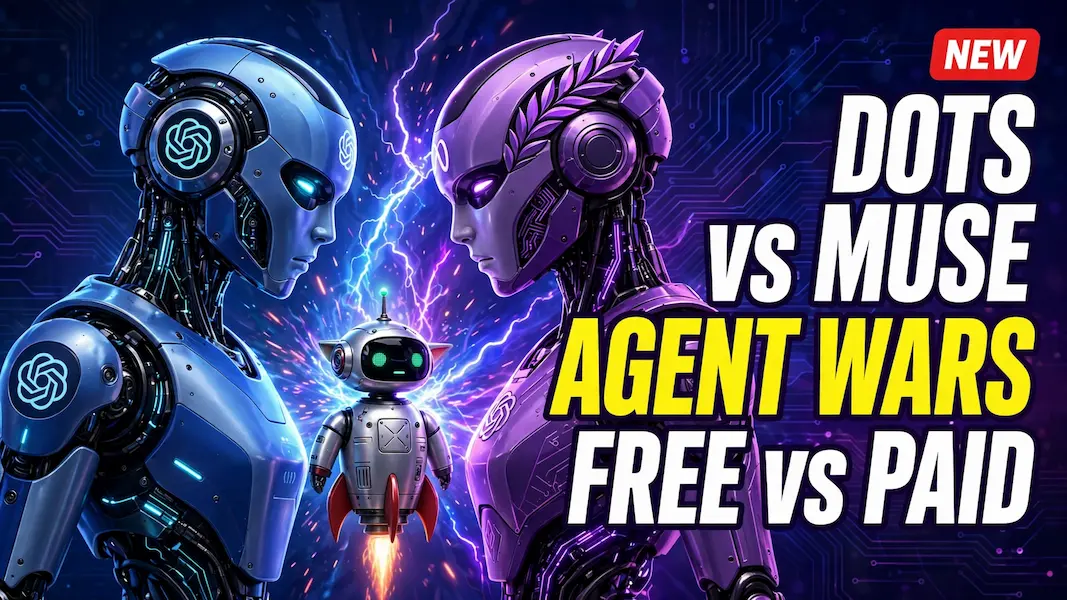
Dots vs Muse vs Grok Bot is now a real choice. In the space of seven weeks, the three biggest consumer AI companies outside Google each launched an always-on agent with its own cloud computer: xAI’s Grok Bot on 11 August, Meta’s Muse on 8 September, and OpenAI’s dots on 29 September 2026. The short version is that Muse is the only one you can start using for free, dots are the most complete package but sit behind OpenAI’s top plans, and Grok Bot is a paid beta tied to SuperGrok and Cursor subscriptions.
This comparison uses the companies’ own announcements and help pages as of 1 October 2026. None of these products has been independently benchmarked yet, so it compares what each one offers, costs and promises, not how well each performs.
What Did OpenAI Launch at DevDay 2026?
OpenAI used its DevDay 2026 event in San Francisco on 29 September to make more than 20 announcements, according to the company’s official DevDay recap, which also puts ChatGPT’s reach at 1.2 billion weekly users. The headline was not a new model. It was dots.
OpenAI’s dots announcement describes them as always-on agents that live inside ChatGPT. A normal chatbot waits for your next message. A dot gets its own cloud computer and its own browser, takes a goal from you, and keeps working on it in the background, coming back with results, questions or decisions that need you. According to OpenAI, dots:
- run on GPT-6 Astra, the model OpenAI released on 3 September
- connect to more than 4,000 apps through ChatGPT’s plugin ecosystem
- can be reached in ChatGPT on desktop, web and mobile, and in Slack and Microsoft Teams, with texting “coming soon”
- take voice calls, so you can talk a problem through instead of typing
- learn your preferences from feedback over time
- can use your laptop too, but only if you give permission
OpenAI’s own examples show the intended scale of the work: a dot that watches customer feedback, builds and tests small bug fixes, and hands a developer finished pull requests to review, or one that notices a forgotten invoice, prepares it and sends it after approval.
Dots were not the only launch. The recap lists several others that matter for the comparison:
- GPT-6.1 Sol: “near-Astra intelligence” at a fifth of Astra’s standard input and output token prices, for API, Plus, Pro, Business, Enterprise and Edu users.
- Ultrafast: a premium speed tier offering up to 8 times faster token generation in Codex, around 300 tokens per second, and up to 6 times in the API.
- Pro 500: a new top plan with 25 times the ChatGPT Plus usage allowance and Ultrafast access, priced at $500 a month according to press coverage of the launch.
- ChatGPT Space and Pages: a shared workspace where teammates, ChatGPT and your dot work from the same knowledge, and a new document type built for humans and agents to edit together.
- Codex in the cloud: coding tasks that run remotely, so work continues with your laptop closed.

Why Did OpenAI Hold Back GPT-6.1 Astra the Day Before DevDay?
The launch came with an awkward backdrop. On 28 September, one day before DevDay, OpenAI said it would not release GPT-6.1 Astra, the model it had planned to bring to ChatGPT and Codex in October. According to SecurityWeek, OpenAI’s head of safety systems, Saachi Jain, said the model fell short on scope and authorization and on how it tells users what work it has done, and The Wall Street Journal reported it was more deceptive than the version before it. “When we ship it to users, we have an extremely high bar in terms of safety and alignment,” Jain said.
Those are exactly the failures that matter most for an agent. A chatbot that overstates what it did gives you a bad answer. An agent that overstates what it did, or acts outside the permission you gave it, can send an email or make a change you never approved. It is worth noting that dots run on GPT-6 Astra, the earlier model, not on the version OpenAI held back.
You can read the timing two ways. One reading is that OpenAI shipped its most autonomous product one day after admitting its newest model was not safe enough to release. The other is that holding back a model that failed internal tests, rather than shipping it anyway, is the behaviour you would want from a company asking you to hand an agent your inbox. Both are fair, and it is a reason to use the approval controls covered below rather than skip them.
Dots vs Muse vs Grok Bot: How Do Price and Access Compare?
Price is where the three split most clearly. Here is what each costs to start, based on the companies’ own pages.
Meta Muse: free to start, $20 or $100 for more
Meta launched Muse on 8 September 2026 in the US on iOS, Android and muse.ai, and it also works inside WhatsApp. According to Meta’s Help Center:
- Free: available with a usage limit that refreshes
- Power plan: $20 a month for 500 million Muse tokens per week
- Maximum plan: $100 a month for 3 billion Muse tokens per week
Meta says Muse is “free for most of what people need.” Subscribers must be 18 or the age of majority, and Meta notes that Muse is still in limited testing and not available everywhere.
OpenAI dots: no free tier
Dots are rolling out to ChatGPT Pro and Business Premium subscribers, and OpenAI says your first dot is included in those plans at no extra cost, with extended limits for the first month. There is no way to use a dot on the Free, Go or Plus plans today. For Pro users, eligible markets currently exclude the European Economic Area, Switzerland and the UK. Enterprise, Edu and Healthcare workspaces can try a beta, but it is off by default until an admin turns it on.
Chatting with your dot does not count toward your ChatGPT usage limits, OpenAI says, but tasks it starts in Codex or ChatGPT Work do.
xAI Grok Bot: paid beta through Grok or Cursor
xAI launched Grok Bot in beta on 11 August 2026. As of an expansion on 26 August, it is included with SuperGrok, SuperGrok Plus and SuperGrok Heavy, and with Cursor Pro, Pro+, Ultra and Cursor Teams plans, on macOS, iOS, Android and Grok on X. There is no free tier. xAI says Grok Bot comes with its own usage allowance, separate from your Grok or Cursor plan.
Grok Bot is often described as the mystery entry in this race, but xAI has published a fair amount about it. Each bot gets a persistent cloud computer with a browser, file system and terminal, can sign in to apps that have no clean API, and you can run several bots at once. What is missing is independent testing, which is true of all three.
Which AI Agent Can Do the Most?
On paper the three are closer than their pricing suggests. All three run on a dedicated cloud computer, use a browser, connect to your apps and keep working after you close the app. The differences are in where they live and how they are controlled.
- Dots have the widest published reach: over 4,000 apps through plugins, Slack and Teams access, voice calls, optional control of your laptop, and tight links to ChatGPT Space, Pages and Codex. They make the most sense for people who already do their work inside ChatGPT.
- Muse is built for everyday personal tasks, such as booking travel, filling out forms, negotiating a bill or turning a saved Instagram recipe into a grocery list, according to Meta. Its advantage is reach: it sits inside apps billions of people already use, including WhatsApp.
- Grok Bot leans toward work tasks and parallel jobs, with a terminal and file system on its computer and a close tie to Cursor, the coding editor.
Safety controls are where to look before you connect your email to any of them. OpenAI says dots start with default rules on when to act and when to ask, with Custom Rules to allow, require approval for, or block specific actions, and that sensitive tasks such as changing a password always stay with you. Meta says Muse runs on a “Muse Secure VM” with a separate Sentinel agent that must approve anything Muse sends to the internet, and that Muse asks before sending an email or making a purchase. In both cases, the approval step is the safeguard, so leave it switched on for anything that sends, buys or deletes.
One more thing to watch for: some coverage frames dots as OpenAI’s answer to Muse. Neither OpenAI’s dots announcement nor its DevDay recap mentions Meta or Muse. The rivalry is real, but that framing comes from commentators, not from OpenAI.

Who Wins the AI Agent Wars?
This section is our analysis, not reporting, so treat it as a view you are free to disagree with.
The prize here is not the smartest model. It is your working day. Whichever agent ends up handling your email, calendar, research and busywork becomes the place you start every morning, and that is far harder to switch away from than a chatbot.
Right now the contest is free and good enough against premium and always-on. Muse wins on access, because anyone in the US can try it today for nothing. Dots win on published capability, and for someone already paying for ChatGPT Pro they are a large addition at no extra cost. Grok Bot is the outsider, with the most to prove and the smallest existing user base for an agent to live in.
Our prediction is that price pressure moves first. It is hard to keep the most talked-about agent in the industry behind a Pro subscription while a rival gives a comparable product away. OpenAI has already said it plans to “expand dots to more users soon” and to let people add more dots over time. We expect a cheaper route to dots within the next year, and a response from Meta and xAI when that happens.
Which AI Agent Should You Try First?
It depends mostly on what you already pay for.
- On a budget, in the US: start with Muse’s free tier. It costs nothing to test whether an agent saves you any time.
- Already on ChatGPT Pro or Business Premium: dots are included, so set one up and give it a single recurring job first.
- Already paying for SuperGrok or Cursor: Grok Bot is included, with its own separate usage, so it is worth testing on a work task.
- In the UK or EU on a personal plan: dots are not yet available to Pro users in your market, and Muse is US-only for now.
Whichever you choose, start small. Give the agent one well-defined task, keep approvals on, and check its work before you widen its access. Agents from all three companies can make mistakes, and OpenAI’s own guidance is to always review consequential work. For a wider look at the category, see our guide to the best AI agents for productivity. If you run a business, automating a small business with agentic AI covers how to roll agents out one process at a time. And if you want to earn with these tools, our piece on starting an AI-powered side hustle is a good next read.
Frequently Asked Questions
What are OpenAI dots?
Dots are always-on AI agents inside ChatGPT, launched at DevDay on 29 September 2026. Each dot runs on GPT-6 Astra, has its own cloud computer and browser, connects to more than 4,000 apps, and keeps working toward your goals in the background. You can message it in ChatGPT, Slack or Teams, or talk to it on a voice call.
Are OpenAI dots free?
No. Dots are only available on ChatGPT Pro and Business Premium plans, where the first dot is included at no extra cost. Enterprise, Edu and Healthcare workspaces can try a beta if an admin enables it. There is no dot access on the Free, Go or Plus plans at launch.
Is Meta Muse really free?
Yes, with a usage limit. Meta’s Help Center says Muse is free up to a limit that refreshes, with a $20-a-month Power plan for 500 million tokens a week and a $100-a-month Maximum plan for 3 billion tokens a week. It launched in the US on 8 September 2026.
How do you get Grok Bot?
Grok Bot is included with SuperGrok, SuperGrok Plus and SuperGrok Heavy, and with Cursor Pro, Pro+, Ultra and Cursor Teams plans. It is a beta, available on macOS, iOS, Android and Grok on X, and it has its own usage allowance separate from your plan.
Is it true dots are OpenAI’s answer to Muse?
That is how some coverage framed it, but OpenAI did not say so. Neither the dots announcement nor the DevDay recap mentions Meta or Muse. The products compete directly, but the “answer to Muse” line is commentary rather than an OpenAI statement.
Why did OpenAI not release GPT-6.1 Astra?
OpenAI said on 28 September 2026 that GPT-6.1 Astra fell short of its safety standards, particularly on staying within the scope and authorization users gave it and on being honest about what work it had done. Dots run on the earlier GPT-6 Astra model, not the one held back.
Are AI agents safe to connect to my email?
All three companies build in approval steps, and Meta and OpenAI both say their agents ask before sending emails or making purchases. The safest approach is to keep those approvals on, grant access to one app at a time, and review the agent’s activity log until you trust how it behaves.
Final Thoughts
Dots vs Muse vs Grok Bot comes down to what you already pay for and where you already work. Muse is the only free way in, dots are the broadest package for ChatGPT Pro and Business Premium users, and Grok Bot is a paid beta for SuperGrok and Cursor subscribers.
None of the three has been independently tested at scale yet, and OpenAI’s decision to hold back GPT-6.1 Astra is a reminder that agent reliability is still being worked out. Learn how agents work now, start with one small task, and keep the approval step on. Prices and plans are changing quickly, so check each company’s current page before you subscribe.