Ariel Trekk Travel Yoga Mat: Specs, Weight and Buying Guide
The Ariel Trekk travel yoga mat is one print in Yune Yoga’s Trekk line, sold at $78 and listed at 24 by 72 inches and 5mm thick. This guide is based on the manufacturer’s published specifications and category standards rather than hands-on testing, so every figure below comes from Yune Yoga’s own product data or from published independent research.
The word to pay attention to in that product name is “travel,” because the published specifications do not obviously support it. The mat is listed at the same length, width and thickness as Yune’s standard full-size mat, and the page gives two different weights for it.
What Are the Ariel Trekk Travel Yoga Mat Specs?
According to Yune Yoga’s product page, as of November 2026:
- Price: $78.00
- Size: 24 x 72 inches
- Thickness: 5mm
- Weight: listed as 2.5 lb in the description, and as 1.5 lb in the product’s own weight field
- Material: PVC, described as free of phthalates and latex
- Construction: double sided, with a textured top and a firmer, stickier dark bottom
- Printing: digital print with UV-cured inks
- Care: wipe clean with mild soap and water
- SKU: ARIEL-4
Ariel is a print name rather than a different mat. Yune sells dozens of Trekk designs, including Pagoda, Orion, Taurus, Maple and Flint, and every one we checked was listed at the same $78. Choosing Ariel is a choice of pattern, not of specification.
Is It 1.5 lb or 2.5 lb?
Both figures appear on the same listing, and for a mat sold on portability the difference matters more than anything else on the page.
The written description says “Light weight 2.5lb for easy transport.” The structured product data behind the same page records the item weight as 680 grams, which it labels as 1.5 lb. One of those is wrong, and nothing on the page says which.
That is a full pound of difference on a product whose selling point is carrying it. Before ordering, it is worth asking Yune Yoga directly which figure applies to the mat they will ship. If a specific weight matters, for instance because you will carry it in hand luggage or walk to a studio, treat the heavier number as the safer assumption until the brand confirms otherwise.
Is a 5mm Mat Really a Travel Mat?
This is where the Trekk name needs scrutiny. Travel mats in general are thin, because thinness is what lets a mat fold into a bag rather than roll into a bulky tube. A 5mm mat is standard full-size thickness.
Compare it with Yune’s own standard mat. Retailer listings for the Yune Yoga Ascend, the brand’s regular line, give 24 x 72 inches, 5mm and 2.5 lb. The published numbers are identical to the Trekk’s. More tellingly, the Ascend’s retailer description opens with the line “Light but dense, our Trekk travel mat is meant to bring your practice to any environment you wish,” which is word for word the copy on the Ariel Trekk page.
Two reasonable readings follow:
- The copy is shared across lines, and the specifications shown for one may have been pasted onto the other.
- The Trekk is a travel mat by intent rather than by construction, lighter and more foldable than the figures suggest, with the page simply showing the wrong numbers.
Either way, the buyer’s position is the same. If you want a mat that folds into a suitcase, ask the brand for the folded dimensions and the real thickness before ordering, and do not assume the “travel” label means thin. A common mistake is to buy a mat described as a travel mat and find it rolls to the same size as the one already at home.

PVC or PER? The Same Brand Says Both
The Ariel Trekk page is unusually direct about its material. It states “All mats are PVC, free of Phthalate and Latex,” and elsewhere describes the mat as “Made from eco-friendly PVC.”
That is worth knowing on its own, but it becomes more interesting next to Yune’s other mats. The brand’s Pumice mat, also $78, says it is “constructed using eco-conscious PER, a safer alternative to traditional PVC.”
So one Yune mat is sold as PVC and another is sold as a safer alternative to PVC, at the same price, from the same brand. Independent testing suggests the distinction may be smaller than it sounds. In 2019 the Ecology Center’s Healthy Stuff Lab tested 11 yoga mats using infrared spectroscopy and X-ray fluorescence. As reported by ClickOnDetroit, mats labelled PER were found to be made of PVC. The main plasticizer identified was DOTP, a non-phthalate substitute generally regarded as safer, though research gaps remain. Gillian Miller, the lab’s senior staff scientist, said the name PER “tells us nothing about its composition.”
That testing did not include Yune Yoga mats, so it proves nothing about this product. What it does mean is that for this purchase, the Trekk’s plain “PVC” label is arguably more informative than a PER label would be. The claims worth weighing are the specific ones:
- Phthalate-free is a concrete claim about plasticizers and the most meaningful item on the label.
- Latex-free matters if you have a latex allergy.
- Eco-friendly applied to PVC is marketing. PVC does not biodegrade, and it raises concerns in manufacture and disposal whatever the additives.
If a PVC-free mat is what you want, natural rubber, cork and TPE are the categories to compare instead, each with its own trade-offs.
How Does the Ariel Trekk Handle Grip and Cleaning?
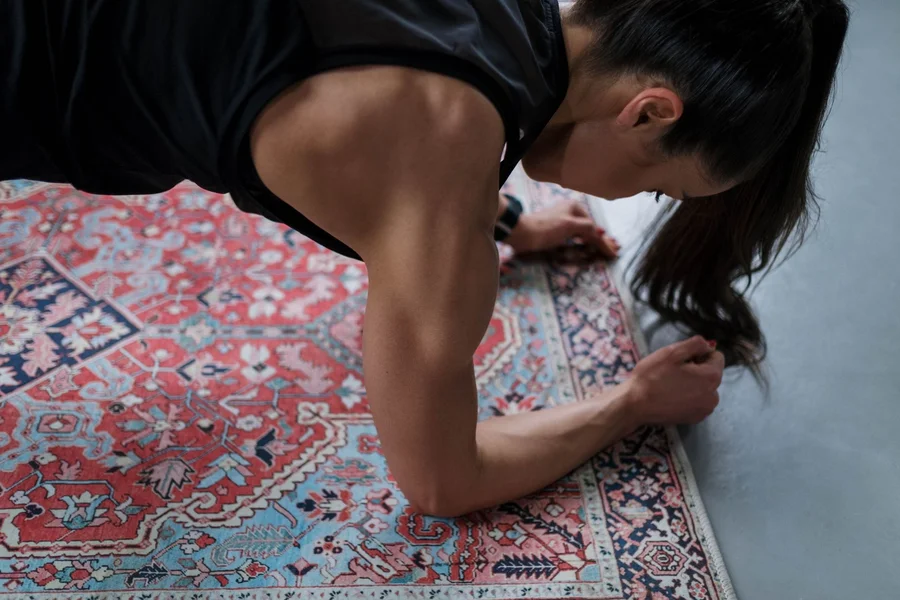
The published claims are general rather than measured. Yune describes the mat as reversible, with a soft, ridged top and a firmer, stickier bottom “for grip on any surface,” and calls it “anti-tear,” saying you can fold it “in whatever manner you want.”
None of that cites a test standard, so read it as description rather than rating. The cleaning guidance is more concrete: wipe it with mild soap and water. Yune also says the surface is moisture resistant and does not absorb germs.
Two things follow for a printed PVC mat of this kind. Printed surfaces tend to show wear first where hands and feet land repeatedly, so a towel on top helps in sweaty sessions. And because the mat is wiped rather than soaked, letting it dry fully before rolling it keeps moisture out of the rolled core.
Who Is the Ariel Trekk Best For?
On its published specifications, it suits someone who wants a full-size, cushioned, reversible mat with a distinctive print and is comfortable with PVC construction. At 5mm, it offers more padding for knees and hips than a genuinely thin travel mat would.
It is a weaker fit if you specifically need a packable mat for flying, if you want PVC-free materials, or if you need a confirmed weight before buying. For home sessions where portability is not the point, the thickness is a benefit rather than a compromise, and routines like those in our guide to nervous system regulation exercises at home work well on a mat like this. If you practise in heated rooms, our guide to infrared workouts and hot classes covers what to expect.
Frequently Asked Questions
How much does the Ariel Trekk travel yoga mat cost?
It is listed at $78.00 on Yune Yoga’s site. Every Trekk print we checked carried the same price, so the design does not change what you pay.
How thick is the Ariel Trekk mat?
Yune Yoga lists it at 5mm, with dimensions of 24 by 72 inches. That is standard full-size thickness rather than the thin construction most travel mats use.
How much does the Ariel Trekk weigh?
The listing gives two answers. The description says 2.5 lb, while the product’s own weight field records 680 grams, labelled as 1.5 lb. Ask Yune Yoga to confirm before ordering if weight is the reason you are buying it.
What is the Ariel Trekk mat made of?
PVC, according to Yune Yoga, described as free of phthalates and latex and printed with UV-cured inks. The brand’s other mats, such as the Pumice, are sold as PER instead.
Is it true that PER is a safer material than PVC?
That is how it is marketed, including by Yune Yoga. Independent testing by the Ecology Center in 2019 found that mats labelled PER were made of PVC, with a non-phthalate plasticizer. Treat PER as a phthalate-free vinyl rather than a different material.
Is Ariel a different mat from the other Trekk designs?
No. Ariel is a print. Yune sells many Trekk prints, including Pagoda, Orion, Taurus and Maple, at the same price and with the same published specifications.
Final Thoughts
The Ariel Trekk travel yoga mat is a $78, 24 by 72 inch PVC mat listed at 5mm thick, sold as one of many prints in Yune Yoga’s Trekk line. As a cushioned, reversible everyday mat with an unusual design, the specifications are reasonable.
Buy it as a full-size mat rather than a packable one. The listing contradicts itself on weight, lists the same thickness as the brand’s standard mat, and shares its product copy with that mat, so confirm the weight and folded size with Yune Yoga before ordering if travel is genuinely why you want it.