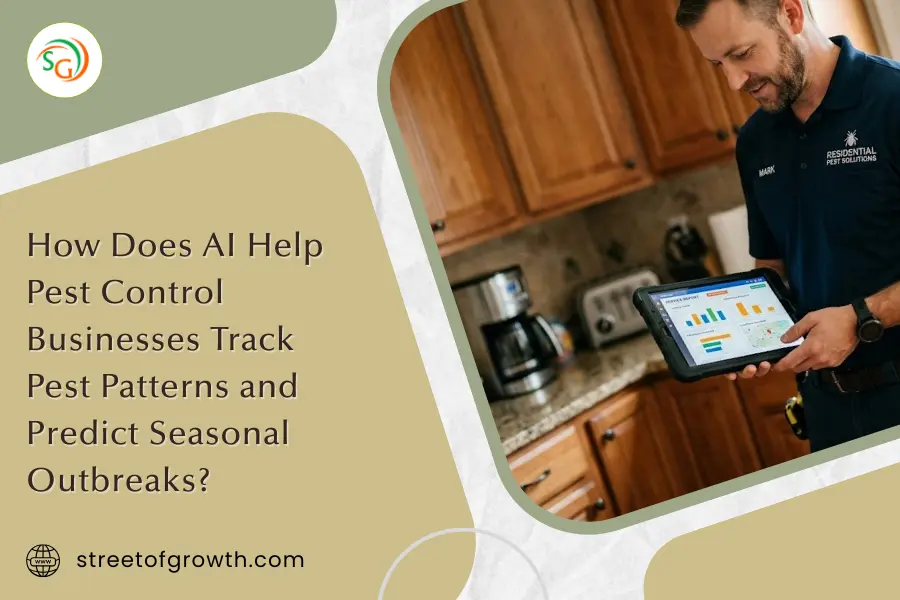
How Does AI Help Pest Control Businesses Track Pest Patterns and Predict Seasonal Outbreaks?
AI helps pest control businesses track pest patterns by collecting data from smart traps, weather stations, past service records, and environmental sensors. It then uses that data to spot trends and predict when and where seasonal pest outbreaks are most likely to happen, often weeks or months before the first signs appear.
If you run a pest control company, you know how unpredictable pest seasons can be. One spring, ants arrive two weeks early. The next winter, rodents flood into homes a full month ahead of schedule. You are left guessing, scrambling, and reacting to problems after they start.
But what if you could see those problems coming?
That is exactly what artificial intelligence (AI) does. AI is a type of computer technology that learns from large amounts of data and finds patterns humans would miss. In the pest control industry, AI is now being used to study pest behavior, track seasonal changes, and give business owners a clear picture of what to expect, before the busy season even begins.
The National Pest Management Association reports that the U.S. pest control industry generates over $27 billion in annual revenue. As weather patterns shift and customer expectations grow, the companies that plan ahead are the ones winning the most business. AI gives you the tools to do that.
Below, we walk through exactly how this works, what tools are available, and how pest control companies of every size are putting this to use right now.
What Is Pest Pattern Tracking, and Why Should Pest Control Companies Care?
Pest pattern tracking is the process of collecting and studying data about when pests appear, where they are most active, and what environmental conditions cause them to show up. It turns scattered observations into clear, repeatable trends that help pest control businesses plan ahead.
Every pest follows a behavior cycle. Ants build colonies in spring. Mosquitoes breed after heavy rain. Mice move indoors when temperatures drop below 50°F. Termites swarm when soil moisture and warmth reach certain levels. These are patterns, and they repeat year after year with some variation.
Pest control professionals have always tracked these patterns to some degree. You probably know from experience that your phone rings more in May than in January. But relying on memory or gut instinct has limits. You might remember last year, but can you compare the last five years of service calls against local rainfall and temperature data? That is where AI steps in.
AI processes thousands of data points at once, across multiple years and locations, and finds connections that no human could spot on their own. For a pest control business owner, this means fewer surprises, better planning, and more confident decision-making.
How Does AI Collect Data About Pest Behavior?
AI collects pest data from four main sources. Each one gives the system a different piece of the puzzle, and together, they create a complete picture of what pests are doing in your service area.
- Smart traps and IoT sensors: These are internet-connected devices placed in homes, commercial buildings, or outdoor areas. When a pest like a rodent or cockroach triggers the trap, the device logs the time, date, location, and frequency. Companies like Anticimex and Trapview already manufacture these sensor-based monitoring systems for the pest control industry. The data from these devices feeds directly into AI software for analysis.
- Local weather data: Temperature, humidity, rainfall, and wind speed all influence pest activity. AI pulls real-time and historical weather information from local stations and cross-references it with pest activity records. For example, if mosquito complaints spike every time humidity stays above 70% for a week, the AI will flag that pattern.
- Your past service records: Every service call your company has completed is a data point. AI looks at your records by date, location, pest type, and treatment method. It identifies which neighborhoods have recurring issues, which months are busiest for each pest type, and where new hotspots are forming.
- Satellite and environmental data: Some AI platforms pull satellite imagery to monitor vegetation density, standing water, soil moisture, and land use changes. A new construction site near a residential area, for instance, can disturb termite colonies and trigger activity in surrounding homes. AI picks up on these environmental shifts before your team would notice them in the field.
All four data sources feed into the AI system continuously. The more data it receives, the more accurate its analysis becomes over time.
Can AI Predict When Pest Outbreaks Will Happen?
Yes. AI can predict seasonal pest outbreaks weeks, and sometimes months, in advance by analyzing historical pest data alongside current weather patterns, environmental conditions, and regional trends.
The process works like this: the AI studies years of past service records and weather data to find repeating connections. It asks questions such as:
- Does ant activity increase by 30 to 40 percent every time daytime temperatures stay above 75°F for two straight weeks?
- Do rodent calls rise in neighborhoods where nighttime temperatures drop below 45°F for five or more consecutive days?
- Is there a pattern between new construction activity and termite swarms within a one-mile radius?
Once the AI finds these connections, it applies them to current conditions. If the weather forecast shows two weeks of warm, humid conditions ahead, and the AI knows from past data that this triggers mosquito breeding, it will alert you: “Expect a 35% increase in mosquito activity across your southern service routes over the next two to three weeks.”
According to research published in the journal Computers and Electronics in Agriculture, AI-based pest prediction models have achieved accuracy rates between 85% and 95% when trained on sufficient regional data. The key factor is data quality. The more complete your service records are (dates, locations, pest types, treatments), the better the AI performs for your specific area.
How Do Seasonal Pest Predictions Help a Pest Control Business Save Money?
Seasonal pest predictions help pest control businesses save money by replacing guesswork with clear forecasts. When you know what is coming, you spend less on the wrong supplies, schedule staff more efficiently, and avoid costly last-minute decisions.
How Does AI Help With Better Planning and Less Panic?
Most pest control companies operate in reaction mode. A customer calls, you send a technician, you treat the problem. The schedule is unpredictable, and the team is always catching up.
With seasonal predictions, you shift from reacting to preparing. You know which pests will spike and when. You schedule extra staff during the weeks that matter most. You order supplies before prices go up. And you reach out to customers before they even realize there is a problem.
Pest control professionals who have adopted AI-powered planning tools report that this shift alone reduces emergency scheduling by 25 to 35 percent during peak months.
Does AI Help Pest Control Companies Spend Less on Supplies?
Yes. When the AI tells you that ant activity will be higher than normal but rodent activity will be lower this spring, you adjust your orders accordingly. You buy 15% more ant bait and 10% less rodenticide. No over-ordering. No wasted product sitting on the shelf.
Over a full season, this kind of precise ordering can reduce supply waste by 15 to 20 percent, according to pest management technology providers like PestPac and FieldRoutes.
Can AI Help Win More Customers?
It can. Think about it from the customer’s side. Which company earns more trust?
Company A: Waits for you to call, then shows up three days later.
Company B: Sends you a message saying, “Ant season is about to start in your neighborhood. Want us to schedule a preventive treatment this week?”
Company B feels prepared, professional, and one step ahead. AI gives you the data you need to be Company B. Proactive outreach builds customer loyalty we, increases repeat bookings, and sets you apart from competitors who are still only reacting to calls.
Does AI Reduce Chemical Use in Pest Control?
Yes, and by a meaningful amount. When you know exactly where and when pests will appear, you treat only those areas. You stop blanket-spraying entire properties “just in case.”
Research from multiple agricultural and pest management studies suggests that targeted, prediction-based treatments can reduce pesticide usage by 20 to 30 percent without sacrificing results. This matters for three reasons: it lowers your chemical costs, it keeps your customers and their families safer, and it helps your business meet the growing federal pesticide regulations around chemical use.
What Does This Look Like for a Real Pest Control Company?
To show how this works in practice, consider this example based on common scenarios pest control professionals describe after adopting AI tools.
Sarah runs a mid-size pest control company in Texas. Her team of 12 technicians handles residential and commercial accounts across three counties. Every spring, her phone rings nonstop with calls about ants, termites, and wasps. She never has enough staff. She orders supplies in February based on guesswork. And her team is burned out by June.
After adopting an AI-powered pest management platform, things change:
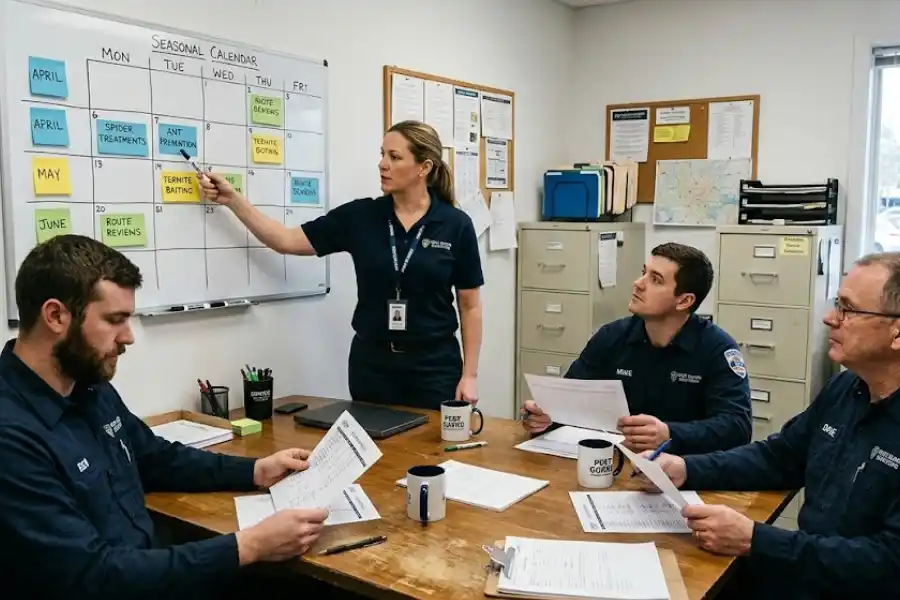
- In January, the AI reviews three years of Sarah’s service records, compares them with local weather data, and tells her that ant season will likely begin two weeks earlier than last year because of a mild winter.
- In early February, the system flags three zip codes where termite activity is expected to spike based on soil moisture levels and nearby construction projects.
- Sarah sends focused emails to customers in those zip codes, offering early-bird preventive treatments. She books 40 new appointments before the season starts.
- She adjusts her supply order to match the AI’s forecast: 15% more ant bait, 10% less rodent product.
- Her team’s schedule is balanced. No one is overworked during peak weeks. No one sits idle during slow weeks. Everyone knows what is coming and when.
By the end of spring, Sarah’s revenue is up 22%. Her chemical costs are down. Her team is less stressed. And her customers see her company as the one that is always prepared.
This is not a one-off success story. Pest control companies across the United States, from solo operators to multi-state franchises, are reporting similar results after adopting AI-based planning tools.
What AI Tools Can Pest Control Companies Use Right Now?
Several AI-powered tools are already available and designed specifically for the pest control industry. You do not need a tech background or a large budget to get started.
- Anticimex SMART System: This is a sensor-based digital rodent monitoring system. Sensors placed at key locations track rodent activity 24 hours a day, seven days a week. The data feeds into a dashboard that shows trends, hotspot locations, and predicted activity levels. Anticimex is a global pest control company based in Sweden with operations in over 20 countries.
- Trapview by Pessl Instruments: Trapview uses AI-powered pheromone traps that photograph insects automatically. The AI identifies the species and count, then generates predictions about pest spread and timing. It is widely used in agricultural pest management.
- PestPac and FieldRoutes: These are pest control business management platforms that include AI-powered scheduling, customer communication, and demand forecasting tools. They use your existing service data to predict busy periods and suggest staffing adjustments.
- Image recognition apps: Several mobile apps now let technicians photograph an insect and receive an instant AI-powered species identification. This speeds up diagnosis in the field and helps ensure the right treatment is applied from the start.
- Route planning tools: AI-based route planners calculate the most fuel-efficient paths for your technicians each day. When combined with seasonal prediction data, they help you assign the right technicians to the right areas at the right times.
Most of these tools use a monthly subscription model. Pricing typically ranges from basic plans for small companies to larger plans for multi-location operations.
What If I Am Not Tech-Savvy, or My Business Is Too Small?
These are two of the most common concerns pest control business owners raise about AI. Both are understandable, and both have straightforward answers.
“I Am Not a Tech Person. Can I Still Use AI?”
Yes. The AI tools built for pest control are designed for people who run businesses, not for software engineers. If you can use a smartphone or check a weather app, you can use these tools. The AI runs in the background. What you see are simple charts, plain-language predictions, and clear suggestions for what to do next.
“Is AI Too Expensive for a Small Pest Control Company?”
For most small companies, the savings from better planning cover the cost of the software within the first season. When you stop over-ordering supplies, reduce overtime, and book more preventive appointments, the numbers work in your favor. Even a solo operator benefits from knowing that mosquito season will peak two weeks early this year, because that means two extra weeks of revenue from proactive outreach.
“Will AI Replace My Technicians?”
No. AI does not spray, inspect, or talk to homeowners. It gives your technicians better information so they can make better decisions in the field. Think of AI as a weather forecast for pests. The forecast does not do the work for you. It just tells you what to prepare for.
How Does Climate Change Affect Pest Seasons, and Can AI Keep Up?
Climate change is shifting pest seasons in ways that make old patterns less reliable. Winters are shorter in many regions. Summers are hotter and longer. Rain patterns are changing. And pests are showing up in locations and months where they have not been common before.
AI is specifically built to handle this kind of shifting data. Unlike a printed seasonal guide or a technician’s memory of last year, AI updates its predictions continuously as new data comes in.
If this winter was unusually warm, the AI adjusts. If spring rainfall was 30% above normal, the AI factors that in. It does not rely on a single year of records. It studies multiple years of trends and weighs them against current conditions to produce the most reliable forecast it can.
The Entomological Society of America has noted that climate change is expanding the geographic range of several pest species, including certain mosquito and tick populations. For pest control companies, this means new pests in areas where they were not a concern five years ago. AI helps you spot these emerging threats early, before they catch your business off guard.
How Can a Pest Control Business Start Using AI Today?
Getting started with AI does not require a big investment or a technical team. Here is a simple five-step process that works for pest control companies of any size:
- Organize your service records. Go through your past work orders and make sure they include the date, address, pest type, and treatment used. The more complete your records are, the better the AI will perform when analyzing your data.
- Pick one tool to try first. You do not need to adopt everything at once. Start with a seasonal prediction tool or a smart monitoring system for one pest type, like rodents. See how it fits into your workflow before expanding.
- Choose a platform that fits your budget. Look for AI tools designed for pest control businesses. Read reviews from other pest control operators. Prioritize platforms that offer customer support and integrate with any software you already use.
- Train your team. A quick training session, even 30 minutes, helps your technicians understand what the AI is telling them and how to use those predictions in the field. Most platforms include training materials and onboarding support.
- Review results after one season. Compare the AI’s predictions to what happened. Were the forecasts accurate? Did you save money on supplies? Were your customers happier? Most AI systems get better each season as they learn from more data, so the first season is just the beginning.
Small steps get you started. Each season, you learn more, the AI learns more, and your business runs smoother.
Where Is AI-Powered Pest Control Headed Next?
AI in pest control is growing fast. Based on current industry trends and pilot programs already in testing, here is what pest control businesses can expect in the coming years:
- Drone-based pest monitoring: AI-equipped drones will fly over large commercial properties, farms, and municipal areas to scan for pest hotspots using thermal cameras and image recognition. This is especially useful for businesses that serve agricultural clients or manage large facility accounts.
- Instant mobile alerts: Smart traps and sensors will send real-time notifications directly to your phone the moment pest activity spikes in a specific zone. No more waiting for weekly reports or relying on scheduled inspections alone.
- Block-by-block predictions: Instead of forecasting pest trends for an entire city, AI will soon predict activity at the neighborhood level, and in some cases, down to individual buildings. This level of detail will help pest control businesses offer highly focused service packages.
- Automatic customer outreach: AI platforms will connect directly to your customer communication tools. When the system detects rising termite risk in a customer’s zip code, it will automatically send that customer a text or email offering an inspection. This is already being tested by several pest control software providers.
The pest control companies that start using AI now will be better positioned as these tools become industry standard. Early adoption means more data in your system, more accurate predictions, and a stronger reputation as the company that is always prepared.
Frequently Asked Questions About AI in Pest Control
How does AI predict pest outbreaks?
AI predicts pest outbreaks by analyzing data from smart traps, weather stations, environmental sensors, and your past service records. It identifies patterns between weather conditions and pest activity, then applies those patterns to current conditions to forecast when and where outbreaks are most likely.
Is AI pest control only for large companies?
No. Many AI platforms are built for small and mid-size pest control businesses. They are affordable, easy to set up, and designed to help companies of any size plan better, reduce supply waste, and win more customers through proactive service.
Can AI reduce pesticide use in pest control?
Yes. When you know exactly where and when pests will appear, you treat only those areas instead of spraying broadly. Studies suggest this approach can reduce chemical use by 20 to 30 percent while still delivering strong pest control results.
How accurate are AI pest predictions?
Accuracy depends on the quality and quantity of data the AI has access to. With good service records and local weather data, AI prediction models have shown accuracy rates between 85% and 95% in published research. Accuracy improves each season as the system learns from new data.
What is the cost of AI pest control tools?
Costs vary by platform and features. Most use a monthly subscription model. Plans are available for solo operators, small businesses, and multi-location companies. Many pest control operators report that the savings from smarter planning and less supply waste cover the subscription cost within the first busy season.
Will AI replace pest control technicians?
No. AI is a support tool, not a replacement for people. Technicians still perform inspections, apply treatments, and build relationships with customers. AI simply provides them with better data and clearer forecasts so they can work more effectively and make better decisions in the field.
What is the best AI tool for pest control companies?
The best tool depends on your company’s size and needs. Anticimex SMART is widely used for rodent monitoring. Trapview excels in insect identification and agricultural pest tracking. PestPac and FieldRoutes are strong choices for business management, scheduling, and demand forecasting. Start by identifying your biggest pain point, whether that is seasonal planning, pest identification, or route efficiency, and choose a tool that addresses it.
Wrapping Up
The pest control industry has always been about timing. Show up at the right moment, and you are a hero. Show up too late, and the damage is already done.
AI gives pest control businesses the ability to get that timing right, consistently. By tracking pest patterns through smart traps, weather data, and service records, and by predicting seasonal outbreaks before they begin, AI helps you plan better, spend less, serve more customers, and run a calmer operation.
You do not need to be a tech expert. You do not need a huge budget. You just need good records, the right tool, and a willingness to try something new.
The pest control companies that adopt AI-powered planning today will be the ones leading the industry tomorrow. And the ones that wait may find themselves falling behind companies that saw the shift coming and acted on it.
Start with one tool. Track one season. See what happens. That is all it takes to begin.