AI Tools for Roofing Estimates: Get Accurate Quotes in Minutes, Not Hours
AI tools for roofing estimates are software programs that use artificial intelligence and satellite imagery to measure roofs and calculate material costs automatically. Instead of spending 2 to 4 hours climbing roofs and taking manual measurements, contractors can now generate accurate estimates in 10 to 20 minutes using these digital tools.
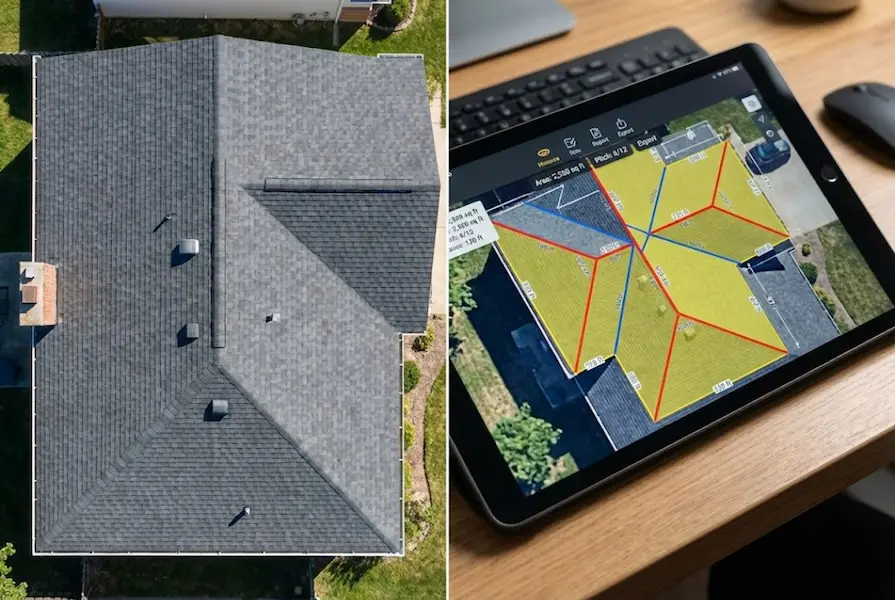
These tools work by analyzing aerial photos of properties (from satellites or drones), identifying roof dimensions, calculating square footage, and producing detailed material lists with pricing. Both roofing contractors and homeowners use them to get faster, more accurate quotes.
Why Do Roofing Contractors Need AI Estimation Tools?
Roofing contractors need AI estimation tools because manual roof measurements are time-consuming, dangerous, and prone to human error. Here’s what changes when contractors switch to AI:
Time savings: What used to take 3 hours now takes 15 minutes. Contractors can bid on 3 times more jobs each week.
Improved safety: Falls are the leading cause of death in construction, killing approximately 401 workers in 2022. AI tools let contractors measure roofs from the ground, eliminating dangerous roof climbs for estimates.
Better accuracy: Manual tape measurements have a 3% to 5% error rate. AI measurements are accurate within 1% to 2%, which means fewer material shortages and cost overruns.
Professional presentation: Instead of handwritten estimates, contractors can show customers interactive 3D models, visualize different shingle colors, and send polished digital proposals immediately.
According to a 2025 industry survey, 40% of roofing contractors now use AI measurement tools, up from just 20% in 2024. The reason? Contractors using these tools win more bids and complete them faster.
How Do AI Roofing Estimation Tools Actually Work?
AI roofing estimation tools work in five simple steps:
- Image Upload: You provide an address or upload an aerial photo of the property
- AI Analysis: The software scans the image and identifies the roof structure, measuring every section, angle, and edge
- Damage Detection: The AI looks for missing shingles, worn areas, or damage
- Material Calculation: The tool calculates exactly how many shingles, nails, underlayment, and other supplies you need
- Estimate Generation: You receive a complete quote with labor costs, materials, and pricing in minutes
The technology uses computer vision (the same AI that helps self-driving cars see the road) to understand roof shapes from photos. It measures within inches of accuracy without anyone physically touching the roof.
Most tools use satellite images from services like Google Maps, which are updated regularly and publicly available. Some contractors also use drone photos for even more detailed measurements.
Which AI Roofing Tools Are Best?
The best AI roofing tool depends on your business type and needs. Here are the top options contractors actually use:
What Is EagleView and Who Should Use It?
EagleView is a premium roof measurement service that provides insurance-grade accuracy reports using high-resolution aerial imagery and 3D modeling.
Best for: Contractors handling insurance claims or complex commercial projects
Key features:
- 99% measurement accuracy verified by third-party testing
- Reports accepted by all major insurance companies
- Autonomous drone assessment option
- Delivers detailed reports within 2 to 4 hours
Pricing: Premium tier ($$$), typically $35 to $75 per report
Real contractor feedback: “Insurance adjusters trust EagleView reports without question. That alone saves us days of back-and-forth on claims.”
What Is Roofr and Who Should Use It?
Roofr is a complete business platform combining instant AI measurements with CRM, proposal generation, and project management tools.
Best for: Small to medium roofing companies wanting one system for everything
Key features:
- Instant measurements from satellite imagery
- Customizable branded proposals
- Built-in customer relationship management
- Mobile app for field work
Pricing: Mid-range ($$), starts around $99 to $199 per month
Real contractor feedback: “We replaced 5 different software tools with just Roofr. The instant proposals help us close deals the same day we meet customers.”
What Is Hover and Who Should Use It?
Hover creates 3D property models using photos taken with a smartphone, no drone required.
Best for: Contractors who want simplicity and smartphone compatibility
Key features:
- Works with standard smartphone cameras
- Creates full 3D models in minutes
- Extremely easy to learn (most teams trained in one afternoon)
- No special equipment needed
Pricing: Mid-range ($$), approximately $50 to $150 per month
Real contractor feedback: “The easiest tool we’ve ever used. Sales reps just walk around the house with their phones and have a complete 3D model before they leave.”
What Is iRoofing and Who Should Use It?
iRoofing combines measurement tools with a powerful roof visualizer that shows homeowners what different materials will look like on their actual house.
Best for: Contractors selling premium materials who need visual sales tools
Key features:
- Real-time roof measurements
- AI visualizer showing different shingle colors and styles
- Instant material calculations
- Professional proposal templates
Pricing: Mid-range ($$), around $80 to $120 per month
Real contractor feedback: “Homeowners love seeing what their new roof will actually look like. It cuts their decision time in half.”
What Is Beam AI and Who Should Use It?
Beam AI automates commercial roof takeoffs from blueprints, with every measurement reviewed by a trained human for accuracy.
Best for: Commercial roofing contractors working from architectural plans
Key features:
- Automated blueprint analysis
- Human verification of all measurements
- Measures complex commercial systems (TPO, EPDM, metal)
- 24 to 72 hour delivery
Pricing: Premium tier ($$$), custom pricing for commercial projects
Real contractor feedback: “Saves us 80% of takeoff time on commercial jobs. We bid on way more projects now because we’re not drowning in plan tracing.”
How Much Do AI Roofing Tools Cost?
AI roofing tools cost between $50 and $200 per month for subscription plans, or $20 to $75 per individual report for pay-as-you-go options.
Budget options ($50 to $100/month): Roofr, basic Hover plans Mid-range options ($100 to $200/month): Full-featured Hover, iRoofing, comprehensive Roofr Premium options ($200+/month or per-report): EagleView, Beam AI commercial services
Most tools offer free trials (7 to 14 days) so you can test before committing. The investment typically pays for itself within the first week through time savings alone.
How Much Time Do AI Roofing Tools Actually Save?
AI roofing tools save 50% to 90% of estimation time compared to manual methods.
Real time comparison:
Traditional manual estimate: 2 to 4 hours (drive to site, climb roof, measure, calculate, write proposal) AI-powered estimate: 10 to 20 minutes (upload address, review measurements, customize pricing, send proposal)
Monthly time savings for a small roofing company:
- Manual method: 20 estimates × 3 hours = 60 hours per month
- AI method: 20 estimates × 20 minutes = 6.7 hours per month
- Time saved: 53.3 hours per month
If your time is worth $50 per hour, that’s $2,665 in monthly savings. According to the Bureau of Labor Statistics, roofing contractors earn competitive wages, making every saved hour valuable.
For medium-sized companies doing 50 estimates monthly, the savings jump to 87.5 hours and over $5,000 per month.
Are AI Roof Measurements Accurate Enough to Trust?
Yes, AI roof measurements are accurate within 1% to 2% when using quality tools like EagleView, Roofr, or Hover. This matches or exceeds manual measurement accuracy.
Accuracy breakdown:
- Manual tape measurements: 3% to 5% error rate (due to human mistakes, difficult angles, estimation errors)
- AI satellite measurements: 1% to 2% variance (depending on image quality and roof complexity)
- AI with human verification (like Beam AI): Under 1% error rate
Important caveat: AI accuracy drops if the property has:
- Heavy tree coverage blocking the roof view
- Recent construction not yet in satellite databases
- Very complex roof shapes with multiple dormers and valleys
For these situations, contractors should verify AI measurements with a physical inspection before ordering materials.
Can Homeowners Use AI Roofing Tools Too?
Yes, homeowners can use AI roofing tools to get preliminary estimates before contacting contractors. Several tools are designed specifically for homeowner use.
Homeowner benefits:
- Get instant ballpark estimates without waiting for contractor visits
- Compare multiple contractor quotes more effectively
- Understand your roof’s square footage and complexity
- See visual mockups of different shingle colors and styles
Popular homeowner tools: RoofHero, Roof Snap (homeowner version), some free basic features on contractor platforms
Important note: Homeowner estimates should be considered starting points only. Professional contractors should always do a final inspection before actual work begins to check roof condition, structural issues, and local building code requirements.
What Are the Biggest Mistakes Contractors Make With AI Tools?
The biggest mistakes contractors make with AI roofing tools are trusting AI blindly without verification, not training their team properly, and buying expensive tools they don’t actually need.
Mistake 1: Trusting AI 100% Without Human Review
AI is smart, but it’s not perfect. Always have an experienced estimator review measurements, especially for:
- Roofs with complex angles and multiple levels
- Properties with heavy tree shadows
- Older homes with unusual construction
- Any roof where the satellite image is outdated or blurry
Fix: Treat AI as your starting point, not your final answer. Spend 5 minutes reviewing each estimate for obvious errors.
Mistake 2: Buying the Most Expensive Tool Instead of the Right Tool
A small residential contractor doing 10 to 20 roofs monthly doesn’t need the same commercial-grade software as a company doing office buildings and warehouses.
Fix: Match the tool to your actual needs:
- Small residential company: Start with Roofr or Hover
- Insurance restoration focus: Invest in EagleView
- Commercial work: Consider Beam AI
- Visual sales emphasis: Choose iRoofing
Mistake 3: Not Training Your Entire Team
You bought the software, but half your sales team doesn’t know how to use it properly. This wastes the investment.
Fix: Schedule mandatory training sessions. Most software companies offer onboarding. Make sure every person creating estimates completes training and practices on 5 to 10 real properties before going solo.
Mistake 4: Ignoring the Data and Insights
These tools collect valuable information about your bidding patterns, win rates, and pricing accuracy. Most contractors never look at this data.
Fix: Review your estimates quarterly. Are you consistently underpricing certain roof types? Are steep-pitch roofs taking longer than expected? Use the data to improve your pricing.
Mistake 5: Forgetting That Technology Doesn’t Replace Relationships
AI handles measurements and calculations. It doesn’t build trust with customers or answer their concerns about warranties, timeline, or your company’s reliability.
Fix: Use saved time to spend MORE time with customers, not less. The best contractors combine AI speed with personal service.
How Do You Choose the Right AI Roofing Tool for Your Business?
Choose the right AI roofing tool by matching features to your specific business needs, budget, and technical comfort level.
Ask yourself these questions:
What Type of Work Do You Primarily Do?
Residential homes only: Roofr, Hover, or iRoofing work perfectly Commercial buildings: Beam AI or EagleView handle complex projects Mix of both: Look for flexible platforms like EagleView that cover everything Insurance restoration: EagleView is the industry standard for claims
What’s Your Realistic Monthly Budget?
Under $100/month: Roofr basic plan, Hover entry level $100 to $200/month: Full-featured versions of Roofr, Hover, iRoofing $200+/month or pay-per-use: EagleView, Beam AI, premium commercial tools
Remember: The cheapest option costs more if it doesn’t meet your needs. Calculate potential time savings against the monthly cost.
How Tech-Savvy Is Your Team?
Not very comfortable with technology: Choose Hover or iRoofing (extremely simple interfaces) Moderate tech skills: Any tool will work with proper training Tech-savvy team: Take advantage of powerful features in EagleView or Beam AI
What Do You Need Most?
Speed above all: Instant tools like Roofr or Hover Maximum accuracy: EagleView or Beam AI with human verification Visual selling power: iRoofing’s roof visualizer Complete business system: Roofr’s everything approach Mobile flexibility: Hover, iRoofing, or Roofr mobile apps
Do You Need Mobile Access?
If your sales team works entirely in the field, prioritize tools with strong mobile apps (Hover, iRoofing, Roofr). If you do most estimating from the office, desktop capability matters more (Beam AI, EagleView).
What’s Coming Next for AI in Roofing?
The next generation of AI roofing tools will predict maintenance needs before problems start, automate insurance claims completely, and provide personalized material recommendations based on local climate data.
Predictive Maintenance Is Coming Soon
Within 2 to 3 years, AI will analyze your roof’s age, material type, local weather patterns, and historical damage data to predict: “Your roof will probably need repairs in 6 to 8 months.” This lets homeowners budget and plan proactively instead of facing emergency replacements.
Insurance Claims Without the Paperwork
AI tools are getting sophisticated enough to document storm damage, match it to insurance policy coverage, and file claims automatically with all required photos, measurements, and documentation. Some tools are testing this now, with full rollout expected by 2026.
Smart Material Recommendations
Instead of just measuring, future AI will suggest optimal materials based on:
- Your local climate (heat, cold, humidity, wind)
- Average lifespan in your region
- Energy efficiency for your roof type
- Budget constraints
- Aesthetic preferences matching your home style
Voice-Powered Estimates
Imagine telling your phone: “Create an estimate for 123 Oak Street.” The AI pulls the property data, generates measurements, applies your pricing, and sends a proposal, all through voice commands. This technology exists now and will become standard within 3 years.
Integration With Smart Home Technology
Future roofing AI will connect with smart home sensors that monitor roof condition in real-time, alerting homeowners and contractors to leaks, temperature problems, or structural issues before they cause serious damage.
Do AI Roofing Tools Work for Insurance Claims?
Yes, AI roofing tools work excellently for insurance claims, with EagleView being the most widely accepted by insurance companies for damage documentation and roof replacement claims.
Insurance adjusters trust AI-generated reports because they provide:
- Precise measurements insurers can verify
- Detailed damage documentation with photos
- Consistent formatting across all claims
- Third-party verification (not just contractor estimates)
- Digital records that can’t be disputed
Best practices for insurance claims:
- Use EagleView or another insurance-approved platform
- Document all storm damage with dated photos
- Include the AI report with your claim submission
- Keep digital copies of all measurements and estimates
- Have a contractor review AI findings before filing
Many contractors report that insurance companies process claims 50% faster when supported by professional AI measurement reports compared to manual estimates.
Are AI Roof Measurements Legal and Private?
Yes, AI roof measurements are completely legal because they use publicly available satellite imagery, the same data visible on Google Maps and similar services.
Privacy considerations:
- Satellite images show only your roof from above, not inside your home
- The same images are already public and available to anyone online
- No special access or private data is used
- Tools comply with all privacy laws and regulations
Important note: While the aerial images are public, the measurements and estimates created from them belong to you or your contractor. Reputable software companies don’t share your project data with competitors or sell your information.
Some homeowners worry about aerial imaging, but these tools use less detailed imagery than what’s freely available to anyone with internet access.
Can You Use AI Tools on Mobile Devices?
Yes, most modern AI roofing tools have full-featured mobile apps for iOS and Android devices, with Hover, iRoofing, and Roofr offering the best mobile experiences.
Mobile capabilities:
- Take photos of properties with your phone camera
- Create instant measurements on-site
- Generate and send proposals while meeting with customers
- Access your full project history from anywhere
- Sync automatically with desktop versions
Mobile advantages:
- No need to return to the office to create estimates
- Close deals faster by sending proposals on the spot
- Show customers 3D models and visualizations in real-time
- Work from job sites, customer homes, or anywhere with cell service
Contractors report that mobile access increases their closing rate by 15% to 25% because customers appreciate immediate service and professional presentations.
What Safety Benefits Do AI Roofing Tools Provide?
AI roofing tools significantly improve safety by eliminating the need to climb roofs for estimation purposes, reducing fall risks that cause approximately 401 construction deaths annually according to OSHA data.
Specific safety improvements:
Eliminated fall hazards: Contractors no longer climb dangerous roofs just to measure. All measurements come from ground-level analysis of aerial images.
Reduced ladder accidents: Fewer ladder setups mean fewer opportunities for ladder-related injuries, which account for thousands of emergency room visits yearly.
Better weather safety: Traditional measuring requires good weather. AI works regardless of conditions, so contractors aren’t pressured to climb wet, icy, or unstable roofs.
Safer property assessment: Older roofs with structural problems can be evaluated without putting weight on potentially weak areas.
Team protection: Younger or less experienced team members can generate accurate estimates without exposure to fall risks while learning the business.
Insurance companies recognize this safety improvement. Some offer premium discounts to roofing companies that use AI measurement tools because they reduce workplace injury claims.
How Quickly Can You Learn AI Roofing Software?
Most people learn basic AI roofing software operation in 2 to 4 hours, with full proficiency coming within 1 to 2 weeks of regular use.
Learning timeline:
- Day 1: Understand basic interface, create first estimate (2 to 4 hours)
- Week 1: Generate estimates independently, customize pricing (5 to 10 practice estimates)
- Week 2: Use advanced features, troubleshoot unusual roofs, train others (daily use)
- Month 1: Full proficiency, optimize workflow, maximum efficiency
Easier than you think: These tools are simpler than most roofing business software. If you can use a smartphone and basic apps, you can learn these tools.
Training resources:
- Most companies provide free onboarding videos
- Live customer support during setup
- Template libraries to speed learning
- Practice mode to test without creating real estimates
The learning curve is much easier than traditional roofing software because these tools are designed for field workers, not office administrators.
What Questions Should You Ask Before Buying AI Roofing Software?
Before buying AI roofing software, ask about measurement accuracy rates, integration with your existing tools, customer support quality, contract terms, and whether they offer a free trial period.
Essential questions to ask vendors:
- What’s your actual measurement accuracy percentage? (Look for 98% or higher)
- Do you offer a free trial? (Most reputable companies offer 7 to 14 days)
- What’s included in the monthly price? (Unlimited estimates vs. pay-per-use)
- Can I cancel anytime or am I locked in? (Avoid long-term contracts initially)
- What training and support do you provide? (Look for live support, not just email)
- Does it integrate with my current CRM or accounting software? (Saves double data entry)
- Can I customize proposals with my branding? (Professional appearance matters)
- What happens to my data if I cancel? (Make sure you can export everything)
- Do insurance companies accept your reports? (Critical for restoration work)
- How often are satellite images updated? (Newer is better)
Red flags to watch for:
- Companies that won’t offer trials or demos
- Unclear pricing with hidden per-report fees
- Poor customer reviews about support quality
- Claims of “100% accuracy” (unrealistic)
- Pressure to sign long contracts immediately
Can AI Tools Handle Complex or Unusual Roof Shapes?
Yes, quality AI tools handle complex roof shapes including multiple levels, dormers, valleys, and unusual angles, though accuracy may decrease slightly on extremely complicated designs compared to simple gable roofs.
What AI handles well:
- Standard gable and hip roofs (highest accuracy)
- Multiple roof planes and levels
- Dormers and skylights
- Valley and ridge calculations
- Pitch variations across sections
- L-shaped and T-shaped homes
Where AI may struggle:
- Heavily wooded properties blocking roof view
- Victorian homes with extremely complex turrets and angles
- Recent additions not yet in satellite databases
- Very old homes with irregular, custom construction
- Properties with temporary tarps or covers
Solution for complex roofs: Use AI for the initial measurement, then verify with a physical inspection for final accuracy. This still saves 70% to 80% of measurement time while ensuring precision.
Commercial contractors working on large, complex buildings often use Beam AI or EagleView specifically because they include human verification to catch issues AI might miss.
Is AI Roofing Software Worth It for Small Companies?
Yes, AI roofing software is worth it for small companies because even saving 2 hours per estimate allows you to bid on significantly more jobs, with most contractors recovering the software cost within the first week of use.
Math for a small company:
- Software cost: $100/month
- Time saved per estimate: 2.5 hours
- Your hourly value: $50
- Estimates per month: 15
Monthly savings: 15 estimates × 2.5 hours × $50/hour = $1,875 Software cost: $100 Net monthly benefit: $1,775
Plus, you can now bid on more jobs because you’re not spending full days on estimates. Small companies report closing 20% to 40% more deals after adopting AI tools simply because they can respond faster to more inquiries.
Small company advantages:
- Compete professionally with larger companies
- Win jobs through faster response times
- Reduce reliance on expensive estimators
- Scale your business without hiring more office staff
- Present polished proposals that look enterprise-quality
The question isn’t whether you can afford the software. It’s whether you can afford NOT to use it while your competitors do.
Summary: Should You Use AI Tools for Roofing Estimates?
Yes, you should use AI tools for roofing estimates because they save 50% to 90% of estimation time, improve accuracy to within 1% to 2%, enhance safety by eliminating dangerous roof climbs, and typically pay for themselves within the first week through increased productivity.
For contractors, AI roofing tools mean:
- Bid on 2x to 3x more jobs monthly
- Close deals faster with professional presentations
- Reduce workplace injuries and insurance costs
- Eliminate math errors and material miscalculations
- Compete effectively regardless of company size
For homeowners, these tools provide:
- Same-day estimates instead of week-long waits
- Visual confidence through 3D mockups and material previews
- More accurate quotes with less chance of surprise costs
- Ability to compare multiple contractors fairly
The roofing industry is changing rapidly. Contractors who adopt AI measurement tools now have a significant competitive advantage. Those who wait risk losing market share to faster, more efficient competitors.
Start with a free trial of one tool (Roofr for versatility, Hover for simplicity, or EagleView for insurance work). Test it on 5 real estimates. Compare your time and accuracy to manual methods. The results will speak for themselves.
AI tools for roofing estimates aren’t the future anymore. They’re the present. And they’re changing how successful roofing businesses operate every single day.