
How AI Robots Clean Carpets: Smart Sensors, Auto Suction, and the Full Process
Ever watched a little robot vacuum glide across your carpet and thought, “How does this thing know what it’s doing?”
You’re not alone. Millions of homes now use AI-powered robot vacuums like the Roborock S8 MaxV Ultra, Dreame X60 Ultra, and Ecovacs Deebot X11 to keep their carpets clean every single day. But most people have no idea how these machines work under the hood.
Carpets are much harder to clean than hard floors. Dirt sinks into the fibers. Pet hair wraps around every strand. Crumbs disappear into the pile like they were never there. A regular vacuum struggles with all of this. An AI robot vacuum handles it with sensors, cameras, and machine learning that adjust to your home in real time.
This guide breaks down the full cleaning process in plain, simple English so you know exactly what’s happening every time your robot gets to work.
What Is an AI Robot Vacuum and How Is It Different From a Regular One?
An AI robot vacuum is a self-driving cleaning robot that uses artificial intelligence, sensors, and machine learning to clean your floors on its own. Unlike a regular robot vacuum that follows random paths and bumps into furniture, an AI robot vacuum maps your home, recognizes surfaces, detects dirt, and learns from every cleaning session.
Here’s exactly what makes them different:
- Smart mapping with LiDAR or cameras. AI robots use LiDAR (Light Detection and Ranging) laser sensors or VSLAM (Visual Simultaneous Localization and Mapping) cameras to scan every room. They create a precise digital floor plan and remember it for future cleans.
- Surface recognition. When the robot moves from tile or hardwood onto carpet, it detects the change using pressure, infrared, and acoustic sensors. It then adjusts its cleaning power automatically.
- Dirt detection. AI vacuums use infrared and acoustic analysis to figure out how dirty an area is. If one spot has more grime, the robot spends extra time there.
- Learning from past cleans. Each time the robot runs, its AI stores data about your home. It learns which rooms get dirtier faster, like the kitchen or the entryway, and adjusts future cleaning plans to match.
Think of it like this. A regular robot vacuum is like someone cleaning with their eyes closed. An AI robot vacuum is like a trained cleaner who remembers every inch of your house and gets better each time.
How Do AI Robots Clean Carpets Step by Step?
AI robots clean carpets through a seven-step process that involves scanning, detecting, adjusting, cleaning, and returning to their dock. Each step uses a different combination of sensors and AI software. Here’s how it works from start to finish.
Step 1: How Does the Robot Map Your Home?
Before the robot cleans anything, it scans and maps the entire room.
Most premium AI robots use a sensor called LiDAR (Light Detection and Ranging). This works by shooting tiny laser beams in every direction. When those beams bounce off walls, furniture, and objects, the robot measures how long they take to return. From that data, it builds a precise 3D map of your home.
Other robots, like some models from iRobot Roomba, use camera-based navigation called VSLAM. The robot takes pictures with an onboard camera and uses AI to identify landmarks, furniture edges, and room boundaries.
After the first scan, the map is saved. The robot knows:
- The exact layout and size of every room
- Where the furniture sits
- Where carpet begins and hard flooring ends
- Where obstacles like power cords, pet bowls, and shoes are placed
This saved map means the robot doesn’t start from scratch each time. It already knows the best route before it leaves the dock.
Step 2: How Does a Robot Vacuum Know It’s on Carpet?
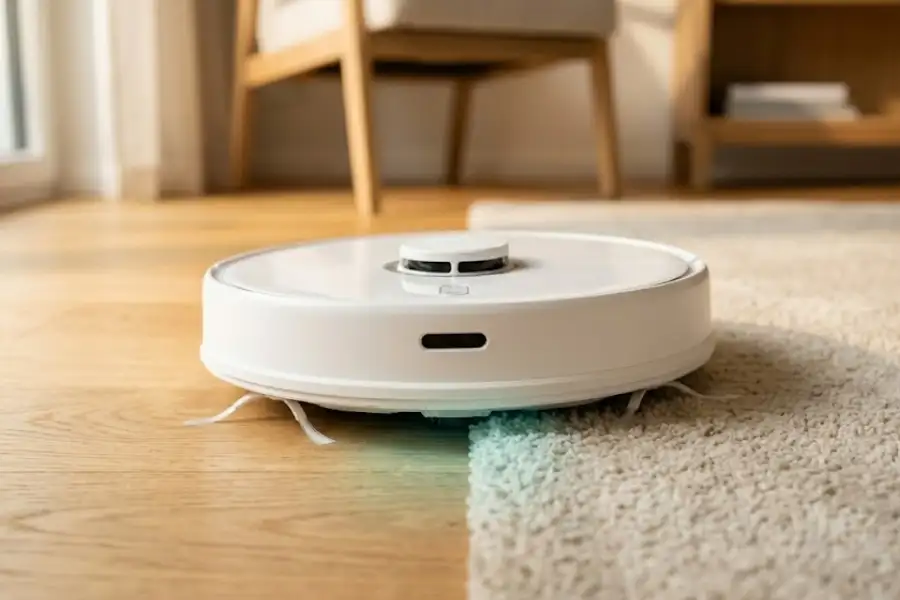
AI robot vacuums detect carpet using a combination of three sensor types located on the underside of the robot:
- Pressure sensors measure how much resistance the surface gives. Carpet pushes back differently than hard floor.
- Infrared sensors measure how light reflects off the surface. Carpet absorbs and scatters light in a pattern that’s different from tile or wood.
- Acoustic sensors listen to the sound the brushes make. Brushes on carpet sound different from brushes on a hard surface.
When these three signals combine, the robot’s AI identifies the surface within milliseconds. It then switches into carpet cleaning mode without any input from you.
Step 3: What Happens to Suction Power on Carpet?
The moment an AI robot detects carpet, it automatically increases its suction power.
On hard floors, the robot typically runs at a lower suction setting because surface dust lifts easily. But carpet traps dirt, pet dander, dust mites, and allergens between its fibers. Cleaning it requires significantly more force.
High-end AI models like the Dreame X60 Max Ultra can ramp up to 35,000 Pascals (Pa) of suction on carpet. The Ecovacs Deebot T90 Pro Omni reaches 30,000 Pa. For reference, most handheld vacuums produce around 5,000 to 10,000 Pa. So these robots are pulling with serious force.
This entire adjustment happens in under a second, with zero input from you. The AI decides when to increase power and when to lower it again once the robot moves back to hard flooring.
Step 4: How Does the Robot Choose Its Cleaning Path?
AI robots don’t wander randomly. They plan cleaning routes using their stored maps and real-time sensor data.
Most AI vacuums clean in neat, parallel lines, similar to how you’d mow a lawn. This ensures every part of the carpet gets covered without overlap or missed patches.
But the AI goes further. If the dirt detection sensors flag a heavily soiled area, the robot:
- Slows down over that section
- Makes multiple passes from different angles
- Adjusts brush speed to match the carpet pile height
Short-pile carpet gets faster brush rotation. Long-pile or shag carpet gets slower, more deliberate strokes so the brushes can reach between the fibers.
Some models, like the Roborock S8 MaxV Ultra, even take before-and-after images of stained areas to confirm the mess has been cleaned properly.
Step 5: How Does the Robot Avoid Obstacles While Cleaning Carpet?
Modern AI robots use 3D structured-light sensors, ToF (Time-of-Flight) cameras, and AI object recognition to identify and avoid obstacles in real time.
Where older robots would crash into chair legs or get tangled in charging cables, today’s AI models can recognize hundreds of common household objects and decide how to react:
- A chair leg? Go around it.
- A power cord? Steer away from it.
- A sock on the floor? Skip over it.
- Pet waste? Avoid it completely and mark the area on the map.
Brands like Roborock and Dreame have trained their AI on millions of images so their robots can tell the difference between a black sock and a power cable with over 99% accuracy.
Step 6: How Do Hybrid Robot Vacuums Protect Carpet From Wet Mopping?
Many AI robots today are hybrid vacuum-and-mop models. They vacuum and mop in a single pass on hard floors. But when they reach carpet, a wet mop would cause damage.
AI solves this with automatic mop-pad lifting. The moment the robot’s sensors detect carpet, the mop pads physically rise off the ground by several millimeters. This keeps the carpet completely dry while the robot continues vacuuming normally.
Once the robot returns to hard flooring, the mop drops back down and resumes wet cleaning. Models from Ecovacs, Roborock, and Dreame all include this feature in their premium lineups.
Step 7: What Happens When the Robot Finishes Cleaning?
When cleaning is done (or the battery drops below a set level), the robot navigates back to its charging dock automatically.
Premium docking stations in 2025 and 2026 do much more than just recharge:
- Self-emptying. The dock vacuums out the robot’s dustbin into a larger sealed bag, so you don’t touch dirt for up to 60 days.
- Mop washing and drying. The dock scrubs the mop pads with hot water and then dries them with warm air to prevent mildew and odor.
- Water and solution refilling. The dock refills the robot’s water tank and adds cleaning solution automatically.
Brands like Narwal, Dreame, and Ecovacs make some of the most capable all-in-one docking stations currently available.
What Types of Dirt Can AI Robot Vacuums Remove From Carpet?
AI robot vacuums can remove surface dust, crumbs, pet hair, fine allergens, and ground-in dirt from foot traffic on most carpet types. Here’s how each one is handled:
- Surface dust and crumbs. These sit on top of carpet fibers and get picked up easily by any AI model, even at lower suction levels.
- Pet hair. AI robots with anti-tangle brush rolls (like the Roborock Saros 10R) pull pet hair from carpet fibers without clogging. The AI also detects pet-heavy zones and gives them extra attention.
- Fine dust, pollen, and allergens. When the robot switches to carpet mode and increases suction, it reaches particles trapped further down in the fibers that a quick manual sweep would miss.
- Ground-in dirt from high-traffic areas. AI dirt detection identifies these spots and runs multiple passes. Over daily or weekly use, even embedded grime gets pulled out gradually.
Worth knowing: AI robots are excellent for daily and weekly carpet upkeep. But for old stains, liquid spills, or years of heavy buildup, a professional carpet cleaning service or a full-size carpet washer is still the right tool. AI robots are best at keeping your carpets clean between those sessions.
Can AI Robots Wash and Scrub Carpets? (2025-2026 Tech)
Yes. A new category of AI carpet-washing robots has arrived that can vacuum, wash, scrub, and dry carpets automatically. This is a major shift from earlier models that could only vacuum.
Here’s how the process works:
- Hot water injection. The robot sprays water heated up to 60°C (140°F), mixed with a cleaning solution, into the carpet fibers.
- Mechanical scrubbing. Specialized roller brushes agitate the fibers and loosen stubborn grime that vacuuming alone can’t reach.
- Dirty water extraction. The robot sucks the dirty water back out, pulling dissolved dirt and stains with it.
- Warm air drying. A built-in fan blows warm air across the carpet fibers so they dry quickly and don’t stay damp.
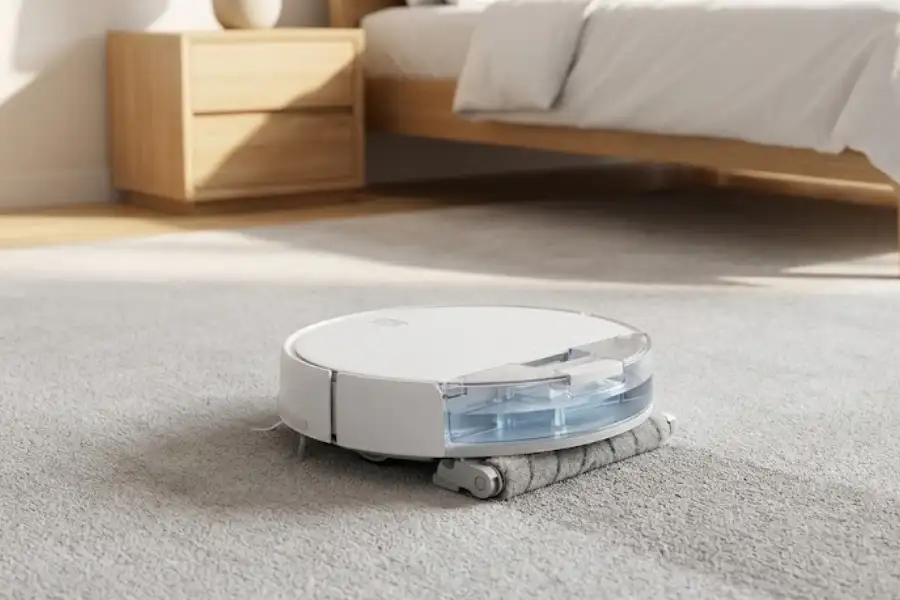
The Robotin R2 Pro, showcased at CES 2026, is one of the first modular robots built specifically for this. It uses a detachable carpet-washing module that connects to the main robot body when carpet washing is needed.
The AI controls every variable: water volume, scrub pressure, number of passes, and drying time. It adjusts all of these based on the carpet type and the level of dirt it detects.
Do AI Robot Vacuums Work on All Carpet Types?
AI robot vacuums work on most carpet types, but their performance varies depending on the pile height and material. Here’s a breakdown based on real-world testing from sources like RTINGS.com and Vacuum Wars:
- Low-pile carpet (short, tight fibers). This is where AI robots perform best. The suction reaches the base of the fibers with ease. Nearly every AI model cleans low-pile carpet very well.
- Medium-pile carpet. Mid-range and premium AI robots handle this without problems. The auto-increase suction kicks in and does a strong job.
- High-pile or shag carpet (long, fluffy fibers). This is where some robots struggle. Long fibers can slow down brush rolls or even trap the robot. If you have thick carpet, look for models with at least 20,000 Pa suction and retractable climbing wheels, like the Dreame X60 Max Ultra Complete.
- Dark-colored carpet and rugs. Some older robots have cliff sensors that mistake dark carpet for a staircase drop-off, so they avoid it entirely. Most 2025-2026 AI models have fixed this with upgraded sensors, but it’s worth confirming before you buy.
What Problems Do AI Robots Have on Carpets and How Do You Fix Them?
Even the smartest AI robot vacuums run into issues on certain carpets. Based on user reports and testing data, here are the four most common problems and their fixes.
Problem: The Robot Gets Stuck on Thick Rugs or Fringes
Thick carpet edges, raised rug corners, and decorative fringes can trap some robots.
Fix: Choose a model with retractable climbing wheels or higher ground clearance. Tuck rug fringes underneath to prevent tangling. You can also set virtual no-go zones in the robot’s app to block problem areas.
Problem: Corners and Edges Don’t Get Cleaned
Since robot vacuums have a round body, they can’t physically reach into 90-degree corners.
Fix: Models with long, extending side brushes reach closer to walls and corners. For a perfect finish, a quick pass with a handheld vacuum in corners works best.
Problem: Pet Hair Tangles Around the Brush Roll
Over time, pet hair can wrap around brush rolls and reduce cleaning performance.
Fix: Buy a model with an anti-tangle brush roll design. The Roborock Saros 10R and MOVA P50 Pro Ultra both handle pet hair well. Also, clean the brush roll once a week. It takes less than a minute.
Problem: One Pass Isn’t Enough for Very Dirty Carpet
If carpet hasn’t been cleaned in a while, one pass may not remove everything.
Fix: Set the robot to run two passes on carpet (most apps support this). Better yet, schedule daily runs so dirt never builds up in the first place.
How Do You Get the Best Carpet Cleaning Results From an AI Robot?
To get the best performance from your AI robot vacuum on carpet, follow these six tips based on manufacturer guidance and real user experience:
- Clear the floor first. Remove shoes, toys, cables, and small objects. Fewer obstacles mean better coverage and fewer interruptions.
- Run the robot daily or every other day. Frequent cleaning prevents dirt from settling into the fibers. This is the single biggest factor in long-term carpet freshness.
- Use the app to set no-go zones. Block off areas with delicate rugs, tasseled edges, or spots the robot struggles with. Every major brand (Roborock, Dreame, Ecovacs, iRobot) supports virtual boundaries.
- Keep the dustbin empty. A full dustbin reduces suction power. Even self-emptying docks need their collection bag replaced every one to two months.
- Wipe the sensors every two to three weeks. Dust buildup on LiDAR or camera lenses makes mapping and navigation less accurate. A soft, dry cloth is all you need.
- Install firmware updates. Robot manufacturers regularly push updates that improve navigation, add new cleaning modes, and fix bugs. Always keep your robot on the latest software version.
What New AI Carpet Cleaning Technology Is Coming in 2025 and 2026?
The AI robot vacuum industry is moving fast. Based on announcements from CES 2025, CES 2026, and brand roadmaps, here is what’s on the way:
- Stair-climbing robots. The Roborock Saros Rover and Dreame Cyber X have both demonstrated stair-climbing prototypes. This would let a single robot clean multiple floors without being carried.
- Robotic arms for picking up clutter. Roborock and Dreame have shown prototypes with small mechanical arms that can grab socks, small toys, and other items off the floor before vacuuming begins.
- Cloud-based object recognition. Newer models, like the Narwal Flow 2, connect to cloud AI to recognize objects far beyond a preset list. Instead of identifying 200 objects locally, these robots can recognize virtually unlimited items and get smarter as more homes contribute data.
- Full carpet washing and blow-drying. The Robotin R2 Pro showed this working at CES 2026. Expect more brands to release carpet-washing robots by late 2026.
- Predictive cleaning schedules. Future AI will track your daily routine and schedule cleaning sessions at the best time, like right after you leave home or just before guests arrive.
Frequently Asked Questions
Do AI robot vacuums really work on carpets?
Yes. Modern AI robot vacuums from brands like Roborock, Dreame, Ecovacs, and iRobot are designed to detect carpet automatically and increase suction power to clean it well. They work best on low and medium-pile carpets. High-end models with 20,000+ Pa suction can handle thicker carpets too.
Can a robot vacuum replace regular vacuuming on carpet?
For daily and weekly upkeep, yes. An AI robot vacuum keeps carpet clean between thorough cleanings. But for heavily soiled carpet or tough stains, you may still need a full-size upright vacuum or a professional carpet cleaning service from time to time.
How does a robot vacuum know it’s on carpet?
It uses pressure sensors, infrared sensors, and acoustic sensors underneath the robot. When the surface changes from hard floor to carpet, these three sensor types detect the difference within milliseconds and the AI adjusts suction and brush speed right away.
Are AI robot vacuums safe for all carpet types?
They are safe for most carpet types, including low-pile, medium-pile, and many high-pile carpets. Very thick shag carpets or rugs with long fringes can cause some robots to get stuck. Always check the manufacturer’s carpet compatibility guidelines before buying.
How often should I run my robot vacuum on carpet?
For best results, run it daily or every other day. This prevents dirt and allergens from settling into the carpet fibers. Homes with pets benefit the most from daily runs.
Do robot vacuums damage carpet fibers?
No. Under normal use, AI robot vacuums do not damage carpet. The brushes and suction levels are engineered to clean effectively without pulling or fraying fibers. Cleaning the brush roll weekly helps prevent any fiber snagging over time.
What is the best AI robot vacuum for pet hair on carpet?
The best models for pet hair on carpet include the Roborock Saros 10R, Dreame X60 Max Ultra Complete, and Shark AI Ultra. Look for at least 5,000 Pa suction, anti-tangle brush rolls, and AI dirt detection. These features ensure pet hair is picked up without clogging the machine.
How much do AI robot vacuums for carpet cost?
Prices depend on features and brand. Basic AI models with carpet detection start around $250 to $400. Mid-range models with strong suction and self-emptying docks run $500 to $800. Premium models from Roborock, Dreame, or Ecovacs with carpet washing and top-tier AI cost $1,000 to $1,500 or more.
What suction power do I need for carpet cleaning?
For low-pile carpet, 5,000 Pa is enough for daily cleaning. For medium-pile, aim for 10,000 to 15,000 Pa. For high-pile or shag carpet, you’ll want a model with at least 20,000 Pa. The strongest models on the market in 2026, like the Dreame X60 Max Ultra, offer up to 35,000 Pa.
Can AI robot vacuums clean under furniture on carpet?
Yes. Most AI robot vacuums are designed to be low-profile, typically under 10 cm tall. Some newer models feature retractable LiDAR turrets that lower the robot’s height even further, letting them slide under beds, couches, and low cabinets to clean carpet areas that are hard to reach by hand.
Got more questions about AI robot carpet cleaning? Leave a comment below and we’ll get you an answer.