

Smart Leak Detection AI Explained: How It Protects Your Home
Ever wake up to a flooded basement? Or find a surprise puddle under your water heater?
Yeah. Not fun.
Water leaks are sneaky. They hide behind walls. They drip under floors. By the time you spot them, the damage is already done. We’re talking thousands of dollars in repairs. Mold. Ruined furniture. Major headaches.
And here’s a wild stat: household leaks waste over 1 trillion gallons of water each year in the US alone, according to the EPA.
But here’s the good news: smart leak detection AI is changing the game.
This is real tech that works right now, in regular homes like yours. And in this guide, I’ll break down exactly how it works, why it matters, and whether it’s worth your money.
What Is Smart Leak Detection AI?
Short answer: Smart leak detection AI is a home monitoring system that uses sensors and artificial intelligence to find water leaks before they cause serious damage.
Think of it like a guard dog for your plumbing. It watches 24/7. It learns what’s normal. And when something looks off? It sends you an alert.
Here’s how the system works:
| Component | What It Does |
|---|---|
| Smart sensors | Placed under sinks, near water heaters, behind toilets to detect moisture and water flow |
| Hub or app | Collects data from sensors and sends it to the cloud |
| AI software | Studies your water usage patterns and spots unusual activity |
The AI doesn’t just detect water on the floor. It notices when your pipes are acting weird before they burst.
Key entities: IoT sensors, machine learning algorithms, water flow monitoring, smartphone alerts, automatic water shutoff valves.
How Does AI Detect Water Leaks?
Short answer: AI detects water leaks by tracking your home’s normal water usage patterns, then flagging anything unusual like unexpected flow at 3 AM or tiny pressure drops that suggest a hidden leak.
Here’s the step-by-step breakdown:
Step 1: It Tracks Your Water Flow
The AI watches how much water moves through your pipes every day. It learns your habits.
- Morning shower at 7 AM? Noted.
- Dishwasher runs at 7 PM? Got it.
- Toilet flushes 10 times a day? Logged.
Over time, it builds a picture of what “normal” looks like in your home.
Step 2: It Spots Unusual Activity
Here’s where it gets smart.
Let’s say at 3 AM, when everyone’s asleep, water starts flowing. Not a lot. Just a trickle.
A regular sensor might miss that. But the AI notices.
“Wait. Nobody uses water at 3 AM. Something’s off.”
It flags the issue. Sends you an alert. And in some systems, it can even shut off your water automatically to stop the damage.
Step 3: It Listens to Your Pipes (Acoustic Detection)
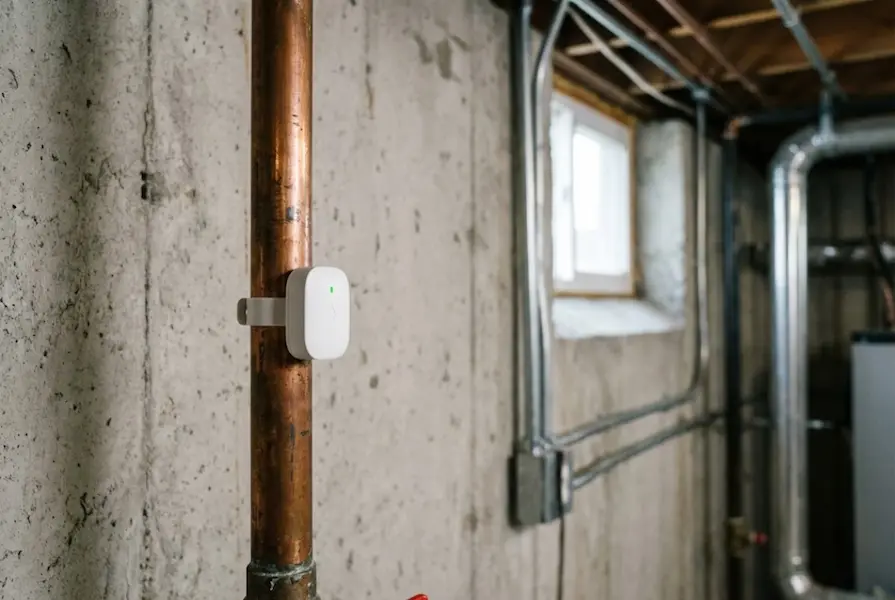
Some high-end systems use tiny microphones to “listen” to your plumbing.
Leaks have a sound signature. A healthy pipe sounds different from one with a tiny crack. The AI can pick up on these acoustic signals, even behind walls or under floors.
This is especially useful for slow leaks that build up over months.
What’s the Difference Between AI and Traditional Leak Detectors?
Short answer: Traditional leak detectors only beep when water touches them. AI leak detectors catch problems before water damage happens by monitoring patterns, pressure, and flow.
Here’s a side-by-side comparison:
| Feature | Traditional Detector | AI Leak Detection |
|---|---|---|
| Detects water on floor | Yes | Yes |
| Catches leaks early | Only when wet | Before major damage |
| Learns your usage | No | Yes |
| Sends phone alerts | Some models | Always |
| Auto-shuts water off | Rarely | Many systems do |
| Works behind walls | No | Acoustic models can |
| Reduces false alarms | Beeps at everything | Smarter filtering |
Bottom line: Traditional detectors tell you after there’s a problem. AI systems try to stop the problem before it happens.
Can AI Leak Detection Really Save You Money?
Short answer: Yes. The average water damage insurance claim in the US costs over $11,000. A smart leak detection system costs $200 to $500. Catching one leak early can save you thousands.
True story: A family in Texas installed a smart leak detection system. Just a basic one, sensors under sinks and a main water line monitor.
Three months later, the system sent an alert at 2 AM. It noticed tiny, unusual water flow in the main line. No one was awake. No faucets were on.
Turns out, a pipe joint in the wall was starting to fail. A slow drip. Nothing visible yet.
They called a plumber the next day. Fixed it for about $400.
The plumber told them: “If you’d caught this a month later, you’d be looking at $15,000 in wall damage, flooring, and mold removal.”
That’s the power of catching things early.
What Types of Leaks Can AI Detect?
Short answer: AI leak detection systems can catch slow leaks behind walls, burst pipes, running toilets, leaky water heaters, frozen pipe warnings, and appliance failures.
Here’s the full list:
- Slow leaks behind walls or under floors
- Burst pipes (instant alert + auto shutoff)
- Running toilets that waste water all day
- Leaky water heaters before they flood your basement
- Frozen pipe warnings (some systems track temperature drops)
- Appliance failures (washing machine hose bursts, etc.)
Some systems even notice if you left a faucet running and forgot about it.
How Much Does Smart Leak Detection Cost?
Short answer: Prices range from $50 for basic sensor packs to $1,000+ for whole-home systems with automatic water shutoff.
Here’s a quick price breakdown:
| System Type | Price Range | What You Get |
|---|---|---|
| Basic sensor pack | $50 to $150 | 3-5 sensors, app alerts |
| Whole-home monitor | $200 to $500 | Main line flow tracking, AI learning |
| Pro system with auto shutoff | $400 to $1,000+ | Full protection, automatic water cutoff |
Installation costs: Some are DIY. Others need a plumber for the main line install (add $100 to $300).
Monthly fees: Most don’t have them. A few premium services charge $5 to $10 per month for cloud features.
Is Smart Leak Detection Worth the Investment?
Short answer: Yes, for most homeowners. The average water damage claim costs $11,000+. A smart system costs $200 to $500. The math makes sense.
Here’s the breakdown:
- Average water damage claim in the US? $11,000+ (per insurance industry data)
- Cost of a smart leak system? $200 to $500
- Peace of mind? Priceless (yeah, I said it)
If you’ve ever dealt with water damage, you know the stress. The insurance calls. The waiting. The repairs. The smell.
A smart system won’t prevent every disaster. But it stacks the odds way in your favor.
Plus, some insurance companies now offer discounts if you have leak detection installed. The Insurance Information Institute notes that proactive water monitoring can reduce claim frequency. Worth checking with your provider.

What Features Should I Look For in a Smart Leak Detector?
Short answer: Look for phone alerts, automatic shutoff, AI pattern learning, easy installation, smart home compatibility, and battery backup.
Here’s the priority list:
- Phone alerts – You want instant notifications, not just a beeping device at home.
- Auto shutoff valve – This is the big one. If a pipe bursts, the system cuts the water.
- AI learning – Look for systems that track patterns, not just detect moisture.
- Easy install – Some clip on pipes. Others need professional setup.
- Smart home connection – Works with Amazon Alexa, Google Home, or Apple HomeKit? Bonus.
- Battery backup – Power goes out, sensor stays on.
What Are the Best Smart Leak Detection Systems?
Short answer: Popular options include Flo by Moen, Phyn Plus, Flume 2, Govee Water Sensors, and LeakBot. Each has different features and price points.
Here are a few names you’ll see when shopping:
| Brand | Best For | Key Feature |
|---|---|---|
| Flo by Moen | Whole-home protection | Auto shutoff built-in |
| Phyn Plus | AI learning | Tracks pressure changes |
| Flume 2 | Easy DIY install | Straps onto water meter |
| Govee Water Sensors | Budget buyers | Affordable basic alerts |
| LeakBot | Hidden leak detection | Acoustic pipe monitoring |
I’m not pushing any brand. Just giving you a starting point for research.
Frequently Asked Questions About Smart Leak Detection AI
Do smart leak detectors work in apartments?
Yes! You can use basic sensors under sinks and near appliances. You won’t have access to the main water line, but you can still catch leaks in your unit.
Do I need Wi-Fi for smart leak detection?
Most systems need Wi-Fi to send phone alerts. A few use cellular backup.
Will it detect leaks in my yard or sprinkler system?
Some whole-home monitors can spot unusual outdoor water use. But for sprinkler-specific issues, you’d need a separate irrigation sensor.
How long do smart leak sensors last?
Battery-powered sensors usually last 1 to 3 years before needing new batteries. Hardwired systems last longer.
Can I install smart leak detection myself?
Basic sensors? Absolutely. Whole-home main line monitors? You might want a plumber for that part.
What happens to smart leak detection if the power goes out?
Good systems have battery backup. They’ll keep monitoring even during outages.
Final Verdict: Should You Get Smart Leak Detection?
Short answer: If you own a home, have a basement, or live somewhere with cold winters, yes. It’s affordable insurance against expensive water damage.
Look, I’m not here to scare you.
But water damage is one of the most common, and expensive, problems homeowners face. And the worst part? Most of it is preventable.
Smart leak detection AI isn’t magic. It’s just smart sensors + clever software working together to watch your back.
Start small if you want. Grab a $50 sensor pack. See how it feels.
Or go all-in with a whole-home system.
Either way, you’re ahead of the game.
Your future self, and your wallet, will thank you.