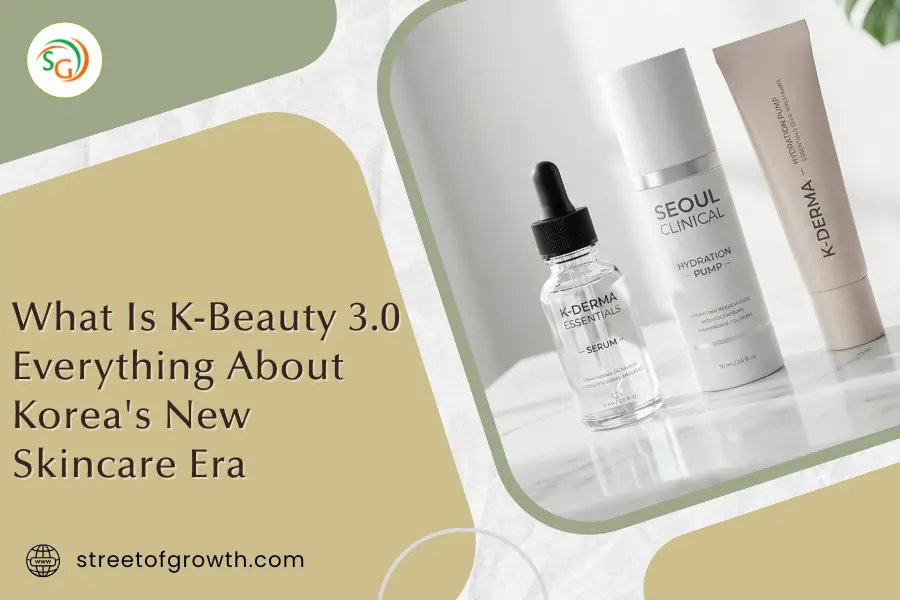
What Is K-Beauty 3.0? Everything About Korea’s New Skincare Era
Remember when Korean skincare was all about cute packaging and 10-step routines? Those days are officially over. Welcome to K-Beauty 3.0, where science beats pretty bottles, and your skin gets real results instead of Instagram moments.
If you’ve been seeing weird ingredients like PDRN and exosomes popping up everywhere, or noticed your favorite K-beauty brands suddenly looking more like pharmacy products, you’re not imagining things. The entire Korean beauty industry just hit the reset button, and what’s coming next is going to change how you think about skincare forever.
What Exactly Is K-Beauty 3.0?
K-Beauty 3.0 is the third major wave of Korean skincare, and it’s completely different from everything that came before. Think of it as Korean beauty going from fun and playful to seriously scientific.
What makes it special: Instead of focusing on cute sheet masks and elaborate routines, K-Beauty 3.0 is all about clinical-grade ingredients, proven results, and products that actually work like treatments you’d get at a dermatologist’s office.
The biggest shift? Korean brands are now putting science first. Every product needs real research backing it up. No more “this might work” ingredients. Everything has to have proof, studies, and measurable results.
The Evolution: From K-Beauty 1.0 to 3.0
To understand why K-Beauty 3.0 is such a big deal, we need to look at how we got here.
K-Beauty 1.0: The Novelty Phase (2011-2015)
This is when Korean skincare first went global. Remember BB cream? That was the start.
What it was about:
- Quirky, colorful packaging
- Fun products (think pig-shaped masks and snail slime)
- Sheet masks everywhere
- Affordable prices
- More about the experience than results
The problem: While it was exciting and Instagram-worthy, many products didn’t deliver long-term results. People tried K-beauty for fun but didn’t stick with it seriously.
K-Beauty 2.0: The Wellness Wave (2016-2024)
This wave brought us glass skin, glow recipes, and the famous 10-step routine.
What changed:
- Focus on achieving “glass skin” (super dewy, glowing skin)
- Multi-step routines became the norm
- Natural ingredients like green tea and rice water
- Influencer-driven (especially on TikTok)
- K-pop stars showing off their perfect skin
The issue: The routines were exhausting. Ten steps every night? Most people couldn’t keep up. Plus, with so many products, it was hard to know what was actually working.
K-Beauty 3.0: The Science Era (2024-Present)
This is where we are now, and it’s a completely different game. Korean beauty exports surpassed $10 billion in 2024, making South Korea the world’s third-largest cosmetics exporter. This growth isn’t from cute packaging anymore—it’s from products that actually work.
What makes it revolutionary:
- Clinical-grade active ingredients
- Scientific proof required for every claim
- Simplified routines (quality over quantity)
- Dermatologist collaboration
- Advanced technology in formulations
- Focus on skin barrier health
- Real, measurable results
The K-Beauty Evolution: At a Glance
| Feature | K-Beauty 1.0 (2011-2015) | K-Beauty 2.0 (2016-2024) | K-Beauty 3.0 (2024-Now) |
|---|---|---|---|
| Focus | Fun and novelty | Wellness and glow | Science and results |
| Packaging | Cute and quirky | Aesthetic and clean | Clinical and minimal |
| Ingredients | Basic, sometimes gimmicky | Natural and gentle | Advanced bioactives |
| Routine Steps | Varied | 10+ steps | 3-5 focused steps |
| Price Point | Very affordable | Mid-range | Premium but worth it |
| Proof | Marketing claims | Influencer reviews | Clinical studies |
| Target | Trend-followers | Beauty enthusiasts | Results-seekers |
The Star Ingredients of K-Beauty 3.0
I’m going to break down the ingredients everyone’s talking about. Don’t worry, I’ll explain them like you’re chatting with a friend, not reading a science textbook.

PDRN (Polydeoxyribonucleotide)
What it is: DNA fragments that help your skin repair itself faster.
What it does: Think of PDRN as construction workers for your skin. It helps rebuild damaged tissue, reduces inflammation, and makes your skin heal like it did when you were younger. Research shows that PDRN promotes collagen production and speeds up wound healing by activating specific receptors in your skin.
Why you want it: Great for scarring, aging skin, and overall skin repair. Korean dermatology clinics have used this for years in injectable treatments, and now it’s available in products you can buy at home. Studies in dermatology show it helps with everything from wound healing to reducing signs of aging.
Real talk: Products with PDRN aren’t cheap, but they work. If you have acne scars or aging concerns, this is worth the splurge.
Exosomes
What they are: Tiny messengers that tell your skin cells how to behave better.
What they do: They carry instructions to your skin cells, telling them to produce more collagen, fight inflammation, and stay healthy. It’s like giving your skin a firmware update.
Why you want them: Amazing for anti-aging, improving skin texture, and boosting overall skin health.
Real talk: This is next-generation technology. It’s still developing, but early results are impressive. Expect to see this ingredient explode in 2025.
Tranexamic Acid
What it is: An ingredient originally used to stop bleeding that turned out to be amazing for dark spots.
What it does: Blocks the signals that tell your skin to make extra pigment. Great for hyperpigmentation, melasma, and evening out skin tone.
Why you want it: If you have dark spots, acne marks, or uneven skin tone, this works better than most brightening ingredients.
Real talk: More effective than vitamin C for stubborn dark spots, and usually causes less irritation.
Panthenol (Dexpanthenol)
What it is: Vitamin B5 for your skin.
What it does: Deeply moisturizes, soothes irritation, and strengthens your skin barrier. It’s the friend that calms everything down.
Why you want it: Perfect for sensitive skin, helps with redness, and makes other active ingredients less irritating.
Real talk: Not flashy, but incredibly reliable. Every K-Beauty 3.0 routine should have panthenol somewhere.
EGF (Epidermal Growth Factor)
What it is: A protein that tells your skin to make new cells.
What it does: Speeds up skin renewal, helps with healing, and can reduce signs of aging.
Why you want it: Great for mature skin or anyone wanting to boost their skin’s natural repair process.
Real talk: The science behind this is solid, but quality matters. Look for products from reputable brands.
How K-Beauty 3.0 Changes Your Routine
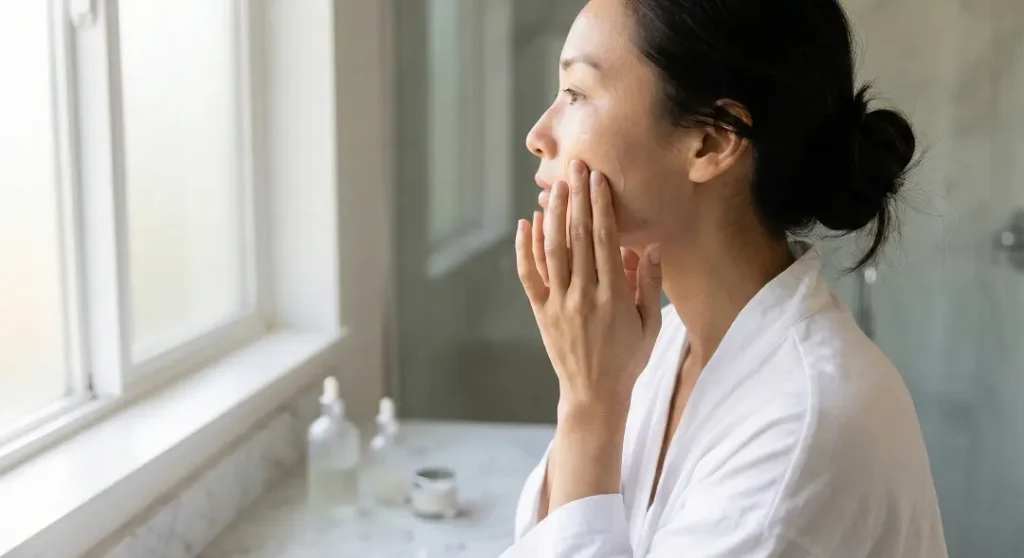
Out: The 10-Step Marathon
Remember cleansing, toning, essence, serum, ampoule, eye cream, moisturizer, sleeping mask, sunscreen, and whatever else? Yeah, we’re done with that.
In: The Smart 3-5 Step System
K-Beauty 3.0 focuses on fewer products that actually work. A modern routine looks like this:
Morning (4 steps):
- Gentle cleanser
- Treatment serum (with actives like PDRN or tranexamic acid)
- Moisturizer with panthenol
- Sunscreen (the most important step)
Evening (5 steps):
- Oil or balm cleanser (if you wear makeup/sunscreen)
- Water-based cleanser
- Treatment serum (can be different from morning)
- Repair cream
- Targeted treatment (if needed)
The philosophy: Each product has a clear job. No fillers, no redundancy, just results.
K-Beauty 3.0 Meets Technology: Devices Are In
Something wild is happening: K-Beauty 3.0 isn’t just about what you put on your skin. It’s also about using tech to make products work better.
LED Masks
Not new, but now they’re affordable and actually effective. Different light colors treat different issues. Red light for anti-aging, blue light for acne.
Microcurrent Devices
These give your face a tiny workout, helping firm skin and improve product absorption. The Medicube AGE-R Booster Pro is leading this trend (yes, Kylie Jenner uses it).
High-Frequency Devices
Help products penetrate deeper into your skin without needles. It’s like getting professional treatments at home.
Real talk: You don’t NEED devices for K-Beauty 3.0, but they make products more effective. Start with products first, add devices if you want to level up.
The New K-Beauty Companies Leading the Change
Remember when K-beauty meant Etude House and Tony Moly? Those brands are still around, but K-Beauty 3.0 has new leaders.
APR (owns Medicube, Aprilskin)
Known for viral beauty devices and effective serums. They’re killing it with their science-first approach mixed with smart marketing.
d’Alba Global
Famous for their white truffle-infused products. They prove that K-Beauty 3.0 can be both scientific AND luxurious.
Goodai Global (owns Beauty of Joseon, Tirtir, Skin1004)
These are the brands you’re seeing everywhere on TikTok. They nail the balance between accessibility and effectiveness.
What they all have in common: Young founders (born in the 1980s), science-driven products, global thinking from day one, and massive social media presence.
How to Spot Real K-Beauty 3.0 Products
Not every product claiming to be “K-Beauty 3.0” actually is. So how can you tell if something’s legit?
Look for These Signs:
Clinical Ingredients Listed First: If PDRN, exosomes, tranexamic acid, or niacinamide are in the top 5 ingredients, that’s good.
Minimal Packaging: K-Beauty 3.0 ditched the cute packaging. If it looks like it belongs in a pharmacy, that’s the vibe.
Specific Claims with Percentages: “Contains 5% niacinamide” instead of just “brightening formula.”
Dermatologist Tested: Many K-Beauty 3.0 products are developed with dermatologists or tested in clinical settings.
Higher Price Point: Real clinical-grade ingredients cost more. If it’s suspiciously cheap, it’s probably not 3.0.
Focus on Skin Barrier: K-Beauty 3.0 is obsessed with protecting and repairing the skin barrier.
Red Flags (Probably Not K-Beauty 3.0):
- Still pushing 10-step routines
- Heavy focus on packaging over ingredients
- Vague ingredient lists
- Claims without any backing
- Relying purely on cute factor
K-Beauty 3.0 on a Budget: Is It Worth It?
Being honest: K-Beauty 3.0 products are more expensive than the K-beauty you remember. But you need fewer products, and they actually work.
Cost Comparison:
Old K-Beauty Approach:
- 10+ products at $15-30 each = $150-300 for a full routine
- Replace everything every 2-3 months
- Annual cost: $600-1,200
K-Beauty 3.0 Approach:
- 4-5 products at $25-50 each = $100-250 for a full routine
- Products last 3-4 months (you use less per application)
- Annual cost: $400-800
The math: You actually save money because you’re buying fewer products that last longer and work better.
Budget-Friendly K-Beauty 3.0 Tips:
- Start with one hero product. Pick the ingredient that targets your biggest concern. PDRN for aging? Tranexamic acid for dark spots? Get one good serum first.
- Mix old and new. You don’t need to replace everything. Keep your current cleanser and moisturizer if they work. Just upgrade your treatment products.
- Watch for launches. New K-Beauty 3.0 products often launch with promotional prices.
- Sample first. Many Korean retailers offer sample sizes. Test before committing to full size.
- Focus on nighttime. Your nighttime routine is when repair happens. That’s where to invest in K-Beauty 3.0 products.
Who Benefits Most from K-Beauty 3.0?
This new wave isn’t for everyone. Who will see the biggest improvements?
You’ll Love K-Beauty 3.0 If You:
- Have specific skin concerns (aging, pigmentation, acne scars)
- Want proven results, not just trendy products
- Are tired of complicated routines
- Have sensitive skin (barrier-focused formulas are gentle)
- Are willing to invest in quality over quantity
- Want something between drugstore and luxury skincare
Stick with K-Beauty 2.0 If You:
- Are happy with your current routine
- Prefer natural, simple ingredients
- Enjoy the ritual of many steps
- Have a tight budget
- Just want basic maintenance, not treatment
The Dark Side: What K-Beauty 3.0 Gets Wrong
Being honest about the downsides:
Accessibility Issues
Not everyone can afford $40 serums. While K-Beauty 1.0 and 2.0 were super accessible, 3.0 is pricing out some people who loved K-beauty.
Overwhelming Information
The science can be intimidating. Not everyone wants to research PDRN and exosomes. Sometimes, people just want something that works without homework.
Ingredient Hype Cycles
Just like how snail mucin was everywhere in 2.0, there’s risk of ingredient trends in 3.0. Is every product that needs exosomes getting them? Or are brands jumping on trends?
Loss of Fun
K-beauty used to be joyful and playful. K-Beauty 3.0 is serious, clinical, results-focused. Some people miss the fun packaging and playful experience.
Pressure to Upgrade
If your K-Beauty 2.0 routine works fine, you don’t need to switch. But marketing makes people feel like they’re missing out.
How K-Beauty 3.0 Compares to Western Skincare
Western brands are noticing K-Beauty 3.0, but there are key differences:
K-Beauty 3.0 Advantages:
- More advanced ingredients hit the market faster
- Better at combining multiple benefits in one product
- More focus on prevention than correction
- Generally more affordable than Western clinical brands
- Innovative formats (cushion compacts, essence-serum hybrids)
Western Clinical Skincare Advantages:
- More established long-term research
- Stricter regulations (depending on country)
- Clearer ingredient concentrations listed
- More medical-grade options available
- Better for very sensitive skin with fragrance allergies
The truth: The lines are blurring. Western brands are adopting K-beauty innovations, and K-beauty is adopting Western clinical standards. By 2026, the difference might not matter much.
What Comes Next After K-Beauty 3.0?
Based on current trends, where are things heading?
Personalization Through AI
Korean brands are testing AI skin analysis that recommends specific ingredients based on your skin’s exact needs.
Microbiome Skincare
The next frontier is treating your skin’s microbiome (the good bacteria on your skin). Early products are already launching.
Sustainable Science
K-Beauty 3.0 will need to address sustainability. Expect bioengineered ingredients that are both effective and eco-friendly.
Hair and Body Expansion
K-Beauty 3.0 started with face products but is moving to hair and body care with the same scientific approach.
At-Home Professional Treatments
The gap between dermatologist office and home will keep shrinking. More professional-grade treatments will become accessible.
Your K-Beauty 3.0 Shopping List
Ready to try K-Beauty 3.0? Where to start based on your main concern:
For Anti-Aging:
- PDRN serum
- Peptide cream
- Retinol alternative (bakuchiol)
- Daily SPF
For Hyperpigmentation:
- Tranexamic acid serum
- Niacinamide product
- Vitamin C (morning)
- Gentle exfoliant
For Sensitive/Damaged Barrier:
- Panthenol serum
- Ceramide cream
- Centella product
- Fragrance-free everything
For Acne-Prone:
- BHA cleanser
- Niacinamide serum
- Panthenol for healing
- Light moisturizer with squalane
For Combination/Oily:
- Oil cleanser that emulsifies well
- Lightweight serum
- Gel moisturizer with hyaluronic acid
- Matte sunscreen
Frequently Asked Questions
Is K-Beauty 3.0 just a marketing term?
Partly, but there’s real substance behind it. The shift toward clinical ingredients and scientific validation is happening across the Korean beauty industry. Some brands are using it as marketing, but the trend itself is real.
Can I mix K-Beauty 3.0 with my current products?
Absolutely! You don’t need to replace everything. Start by adding one or two K-Beauty 3.0 treatment products to your existing routine.
How long until I see results?
With clinical-grade ingredients, expect to see initial changes in 2-4 weeks and significant results in 8-12 weeks. This is faster than traditional K-beauty but still requires patience.
Are these ingredients safe?
When used correctly, yes. Ingredients like PDRN and exosomes are already used in dermatology clinics. Start slowly, patch test, and follow product instructions.
Do I need to buy Korean brands, or are Western brands making K-Beauty 3.0 products?
Korean brands are leading the charge, but some Western brands are adopting similar approaches. The Korean brands tend to be more innovative and affordable right now.
Will K-Beauty 3.0 work for all skin types?
Yes, but you need to choose the right products for your skin type. The beauty of K-Beauty 3.0 is that it’s more personalized than previous waves.
Is the 10-step routine completely dead?
Not dead, but definitely less popular. K-Beauty 3.0 favors efficiency. If you enjoy 10 steps and it works for you, keep doing it. But it’s no longer the standard.
Where can I buy authentic K-Beauty 3.0 products?
Reputable online retailers (Olive Young, Stylevana, YesStyle), Sephora, Ulta, or directly from brand websites. Be careful with random Amazon sellers – counterfeits exist.
Are natural ingredients being completely replaced?
No. K-Beauty 3.0 often combines clinical actives with natural soothing ingredients. It’s not either/or – it’s both.
What if I have a reaction to these new ingredients?
Start with one new product at a time. Patch test on your inner arm for 24 hours before using on your face. If you’re unsure, consult a dermatologist.
The Bottom Line
K-Beauty 3.0 represents the maturation of Korean skincare. It’s no longer about being cute or trendy. It’s about real science, proven results, and smarter routines.
Should you jump on board? If you’re serious about improving your skin and willing to invest in quality products, yes. If you’re happy with basic maintenance or love the playful side of beauty, K-Beauty 2.0 products are still great.
The revolution isn’t about throwing away everything you know. It’s about upgrading to products that actually work like treatments, not just moisturizers with nice packaging.
Korean skincare went from fun experiment to serious science, and our skin is better for it. Whether you go all-in on K-Beauty 3.0 or just incorporate a few products, you’re part of the most exciting evolution in skincare we’ve seen in years.
The future of skincare isn’t in Seoul or Paris or New York. It’s wherever science meets innovation meets accessibility. Right now, that place happens to be Korea, and they’re calling it K-Beauty 3.0.
Your skin is ready. Are you?