Emotional Fitness Daily Routine – Small Habits, Big Changes
You know that feeling when your body is out of shape? When climbing stairs leaves you breathless, or when you can’t quite reach that top shelf without straining?
Your emotions work the same way.
When you’re emotionally out of shape, small frustrations feel huge. A critical email ruins your whole day. One argument with your partner keeps you awake at night. A work setback makes you question everything.
But I’ve got good news: just like physical fitness, you can train your emotional fitness. And I’m not talking about years of therapy or complicated meditation retreats. I’m talking about simple exercises you can do in minutes each day.
This guide will show you exactly how to build emotional strength, starting today.
What Is Emotional Fitness?
Think of emotional fitness as your ability to handle life’s punches without falling apart.
It’s not about being happy all the time. That’s impossible and honestly, kind of weird. It’s about bouncing back faster when things go wrong. It’s about feeling your emotions without letting them control you. It’s about staying steady when everything around you feels shaky.
When you’re emotionally fit:
- Bad news doesn’t wreck your entire week
- You can disagree with someone without losing your cool
- Stress at work doesn’t follow you home
- You sleep better because your mind isn’t racing
- You feel more confident making decisions
Sound good? I’ll show you how to get there.
Quick Self-Check: How Fit Are You Right Now?
Before we get into the exercises, I want you to figure out where you’re starting from. Answer these honestly (nobody’s watching):
In the past week:
- How many times did a small problem feel like a disaster?
- How often did you snap at someone and regret it later?
- How many nights did worry keep you awake?
- How frequently did you feel overwhelmed by your to-do list?
- How often did you feel calm and in control?
If you answered “too many times” to the first four questions and “barely ever” to the last one, you’re probably running on empty emotionally. That’s okay. Most people are. That’s why you’re here.
Your Daily Emotional Fitness Routine
What makes this guide different: I’m giving you specific practices for specific times of day. No vague “practice mindfulness” advice. Actual things you can do right now.
Morning Practices (5-10 Minutes)
Your morning sets the tone for your entire day. These practices take less time than scrolling social media.
The Two-Minute Brain Dump (2 minutes)
Before you even get out of bed, grab your phone or a notebook and write down everything on your mind. Don’t organize it. Don’t make it pretty. Just dump it out.
“Need to finish report. Worried about mom’s doctor appointment. Dog needs vet visit. Feeling anxious about presentation.”
Why this works: Your brain has been processing stuff all night. Getting it out of your head and onto paper stops it from bouncing around all day. It’s like clearing your mental browser tabs.
The Gratitude Flip (1 minute)
Now write down three things you’re grateful for. But I want you to try something: make at least one of them about yourself.
Instead of: “I’m grateful for my family.” Try: “I’m grateful that I made dinner last night even though I was exhausted.”
Why this works: Most of us are really good at beating ourselves up. Acknowledging good things you did trains your brain to notice your wins instead of only your failures.
The Breath Reset (2 minutes)
Before you start your day, do this simple breathing exercise:
- Breathe in slowly through your nose for 4 counts
- Hold for 4 counts
- Breathe out slowly through your mouth for 6 counts
- Repeat 5 times
Why this works: This activates your parasympathetic nervous system, which is your body’s natural calm-down switch. It literally changes your body chemistry.
Set Your Emotional Intention (1 minute)
Pick one emotion you want to focus on today. Not “be happy” (too vague), but something specific like:
- “I want to stay patient, even when things run late”
- “I want to feel curious instead of defensive if someone criticizes my work”
- “I want to notice when I’m stressed and take a break”
Why this works: You’re giving your brain a specific target. It’s like setting GPS before a road trip.
Midday Practices (3-5 Minutes)
By midday, stress is building. These quick practices help you reset before things spiral.
The Emotion Check-In (1 minute)
Set a phone alarm for noon. When it goes off, pause and ask yourself:
- “What am I feeling right now?”
- “Where do I feel it in my body?”
Maybe you notice your shoulders are tight (anxiety). Maybe your jaw is clenched (frustration). Maybe your chest feels heavy (sadness).
Just notice. Don’t judge. Don’t try to fix it yet.
Why this works: Most people go all day without checking in with their emotions. By the time they notice, they’re already having a meltdown. This helps you catch problems early.
The 3-3-3 Grounding Exercise (2 minutes)
If you’re feeling overwhelmed, try this:
- Look around and name 3 things you can see
- Listen and identify 3 sounds you can hear
- Move 3 parts of your body (wiggle toes, roll shoulders, stretch fingers)
Why this works: When you’re stressed, your mind races into the future (“what if everything goes wrong?”). This exercise pulls you back to the present moment, where things are usually okay.
The Power Pause (1 minute)
Before responding to that frustrating email or walking into that difficult meeting, take 60 seconds to:
- Close your eyes
- Take three deep breaths
- Ask yourself: “What would the best version of me do right now?”
Why this works: You’re creating space between feeling and reacting. That space is where emotional fitness lives.
Evening Practices (5-10 Minutes)
Your evening routine helps you process the day and set yourself up for good sleep.
The Daily Replay (3 minutes)
Think back through your day. But instead of dwelling on what went wrong, focus on three specific moments:
- One moment you handled well
- One moment you learned something
- One moment you felt good
Example: “I handled that tense conversation with my coworker calmly. I learned that taking a walk helps me think clearly. I felt good when I finished that project.”
Why this works: Your brain naturally focuses on negative stuff (it’s called negativity bias, and it’s survival instinct). This exercise retrains your brain to notice positive moments too.
The Worry Download (2 minutes)
Got things bothering you? Write them down. But I want you to try something: put each worry in one of two categories:
Can control: Things you can actually do something about Can’t control: Things completely outside your power
For “can control” items, write one small action you can take tomorrow. For “can’t control” items, literally say out loud: “I’m letting this go for tonight.”
Why this works: Your brain worries as a problem-solving mechanism. When you identify what you can’t control, you’re basically telling your brain, “Hey, you can stop trying to solve this one.”
The Body Scan (3 minutes)
Lie down or sit comfortably. Starting with your toes, mentally check each part of your body:
- Are my toes tense? (Relax them)
- How about my calves? (Let them soften)
- My thighs? My stomach? My chest? My shoulders? My jaw?
Work your way up to the top of your head.
Why this works: Stress lives in your body as tension. This practice releases it, making sleep easier.
Weekend Bonus Practice (20 Minutes)
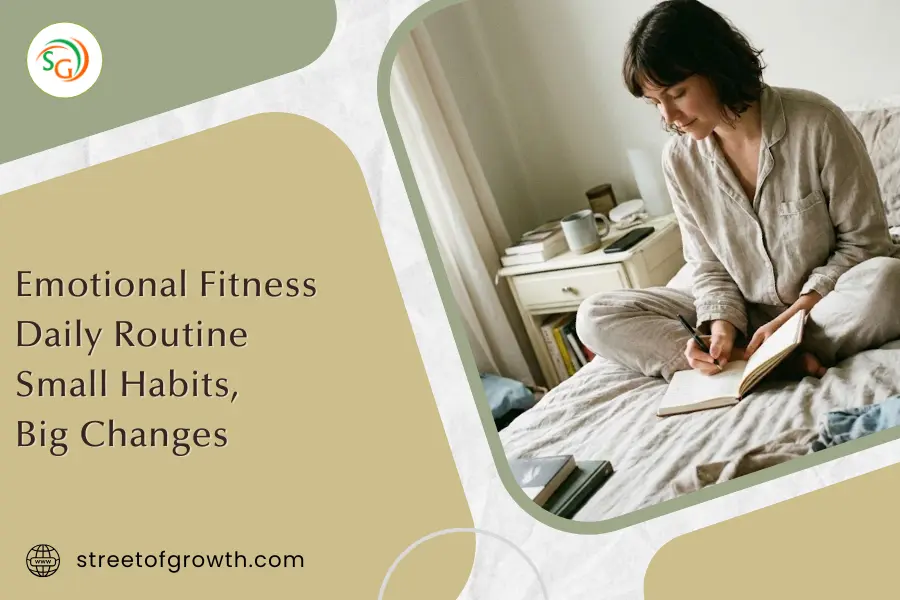
The Weekly Reflection
Once a week, spend 20 minutes journaling about these questions:
- What made me feel stressed this week?
- How did I handle it?
- What would I do differently next time?
- What small win can I celebrate?
Why this works: You’re learning from experience, which is how you get better at anything.

Emergency Toolkit: When You’re Having a Really Bad Day
Sometimes daily practices aren’t enough. When you’re in crisis mode (panic attack, overwhelming anxiety, anger about to explode), try these:
For Panic or Anxiety:
The 5-4-3-2-1 Method (2 minutes)
- Name 5 things you can see
- Name 4 things you can touch
- Name 3 things you can hear
- Name 2 things you can smell
- Name 1 thing you can taste
This forces your brain out of panic mode and into observation mode.
For Anger:
The Ice Cube Trick (30 seconds) Hold an ice cube in your hand. Focus completely on the sensation. The intense physical feeling disrupts the anger loop in your brain.
For Sadness:
The Movement Release (5 minutes) Put on a song and move your body. Dance, jump, shake, whatever feels right. Sadness gets stuck in your body. Movement helps release it.
For Overwhelm:
The One Thing Rule (1 minute) Stop. Take a breath. Ask yourself: “What’s the ONE thing I can do right now that will make me feel slightly better?”
Not ten things. One thing. Do that thing.
Common Obstacles (And How to Beat Them)
“I forget to do the practices”
Set phone alarms. Label them with the practice name. Put sticky notes on your mirror. The first two weeks, you’ll need reminders. After that, it becomes habit.
“I don’t have time”
You spent more time scrolling your phone this morning than these practices take. I’m not judging (I do it too), but we both know: it’s not about time. It’s about priority.
“These practices feel silly”
They probably do at first. Anything new feels awkward. But you know what else feels silly? Letting a bad morning ruin your whole day because you didn’t take two minutes to reset.
“I’m doing the practices but not seeing results”
Physical fitness doesn’t happen overnight. Neither does emotional fitness. But this is what usually happens: Week 1, you’ll feel slightly more aware of your emotions. Week 2, you’ll catch yourself before a meltdown once or twice. Week 4, you’ll realize you handled a stressful situation way better than you would have a month ago.
Give it time.
“I missed a few days and now I feel like I failed”
Perfection isn’t the goal. Progress is. You don’t throw away your whole fitness routine because you skipped the gym one day. Same applies here. Just start again today.
Making It Stick: Your First Week Plan
Don’t try to do everything at once. That’s overwhelming. I want you to start with this:
Days 1-2: Just do morning practices Days 3-4: Add midday check-in Days 5-7: Add one evening practice
After week one, you can build from there.
The Science
You might be wondering: does this stuff actually work, or is it just feel-good nonsense?
What happens in your brain when you practice emotional fitness:
Neuroplasticity: Your brain physically changes based on what you practice. When you repeatedly pause before reacting, you’re building stronger neural pathways for self-control. It’s like wearing a path through grass. The more you walk it, the clearer it becomes. Research from Harvard Medical School shows that consistent mental practices can actually reshape brain structure over time.
The Stress Response: When you do breathing exercises or grounding techniques, you’re literally changing your body chemistry. Your heart rate slows. Your cortisol (stress hormone) drops. Your prefrontal cortex (thinking brain) comes back online.
Emotional Regulation: Each time you name your emotions and work through them consciously, you’re training your amygdala (emotion center) to be less reactive. Think of it as teaching a hyperactive guard dog to chill out.
This isn’t magic. It’s biology.
Everyday Examples
I want to show you what emotional fitness looks like in action:
Sarah’s Story: Sarah used to explode at her kids every evening. She’d get home from work stressed, the kids would be wild, and she’d yell. Then feel guilty all night.
After three weeks of the evening body scan and daily check-ins, she started noticing her stress building during her commute. Now she does the breathing exercise in her car before walking in the door. The yelling dropped by 80%.
Mike’s Story: Mike’s anxiety kept him awake every night, spiraling through worst-case scenarios about work. The worry download practice changed everything. Now he writes down his worries, identifies what he can control, and his brain actually lets him sleep.
Jen’s Story: Jen struggled with low self-esteem. The self-gratitude practice felt stupid at first, but after a month, she started naturally noticing things she did well instead of only her mistakes. Her confidence at work improved.
These aren’t magical changes. They’re the result of small, consistent practices.
Your Personalized Starting Point
Not everyone starts at the same place. Pick your path:
If you’re dealing with anxiety: Start with breathing exercises and the worry download. Do these twice daily.
If you’re struggling with anger: Focus on the power pause and emotion check-ins. Practice catching frustration early.
If you’re feeling emotionally numb: Begin with body scans and emotion check-ins. Reconnect with what you’re feeling.
If you’re just overwhelmed: Start with the morning brain dump and the one-thing rule. Create space in your mental clutter.
If you’re already pretty stable and want to level up: Do the full routine. Add the weekly reflection. Push yourself.

Final Thoughts: Small Steps, Big Changes
Look, I get it. Life is hard. You’re busy. You’re tired. Adding one more thing to your to-do list feels impossible.
But the truth is: you’re already spending mental energy on worry, stress, and emotional chaos. These practices don’t add to your burden. They reduce it.
Ten minutes a day of emotional fitness is cheaper than therapy, faster than medication, and more effective than pretending you’re fine.
You don’t need to be perfect. You don’t need to do every single practice every single day. You just need to start.
Your emotional fitness starts with a single two-minute practice. Which one will you try first?
Start there. Start today.
Your stronger, calmer, more emotionally fit self is waiting.
The physical side of this is worth pairing with the habits, and regulation exercises you can do at home covers it. If mornings are where you have most control, start with the morning reset.
Frequently Asked Questions
How long until I see results?
Most people notice small changes within a week (feeling slightly more aware, catching themselves before reacting once or twice). Bigger changes (handling stress significantly better, sleeping better, feeling more in control) usually show up around the 3-4 week mark. Remember, you’re retraining your brain. That takes consistent practice.
Can I do these practices if I’m in therapy?
Absolutely! Think of therapy as your intensive work session and these practices as your daily maintenance. They complement each other perfectly. In fact, your therapist will probably be thrilled you’re doing this work between sessions.
What if my emotions feel too intense to handle?
These practices work for everyday stress and emotional management. If you’re experiencing severe depression, panic disorder, trauma, or suicidal thoughts, please reach out to a mental health professional. You can find immediate help through the 988 Suicide and Crisis Lifeline (call or text 988) or connect with a therapist through Psychology Today’s directory. Emotional fitness is like going to the gym. It’s great for general health, but you need a doctor for serious conditions.
Is emotional fitness the same as emotional intelligence?
They’re related but different. Emotional intelligence is about understanding and managing emotions in yourself and others. Emotional fitness is about building the strength and resilience to actually do that well, consistently, especially under pressure. Think of emotional intelligence as knowing what to do, and emotional fitness as having the strength to do it.
Do I need any special tools or apps?
Nope. A notebook or notes app is helpful for journaling practices, but that’s it. No expensive apps, no special equipment. Just you and a few minutes a day.
What if I don’t feel emotions very strongly?
Some people are naturally less emotionally expressive, and that’s okay. The emotion check-in and body scan practices can help you recognize subtle emotional signals you might be missing. If you literally feel nothing most of the time, that could be emotional numbing (often a trauma response), and talking to a therapist might help.
Can kids do these practices?
Many of these practices work great for kids, especially the breathing exercises and grounding techniques. Just simplify the language. For example, the 3-3-3 grounding exercise becomes a game: “Can you find three red things in the room?”
How is this different from meditation?
Meditation is one tool in the emotional fitness toolkit. These practices include meditation-style techniques (like body scans) but also exercises you can do with your eyes open while living your life. You don’t need to sit still for 30 minutes. You can build emotional fitness while making coffee or sitting at your desk.
What if I’m skeptical this will work?
Good! Healthy skepticism is fine. My suggestion: pick the practice that feels least weird to you and try it for one week. That’s it. Seven days. Then honestly assess: did anything improve, even slightly? If yes, keep going. If no, at least you tried.
Will this cure my anxiety/depression/anger issues?
These practices can significantly improve emotional regulation and resilience, but they’re not a cure for clinical conditions. They’re more like exercise and good nutrition. Excellent for general health and prevention, and helpful as part of treatment, but not a replacement for professional help when you need it.