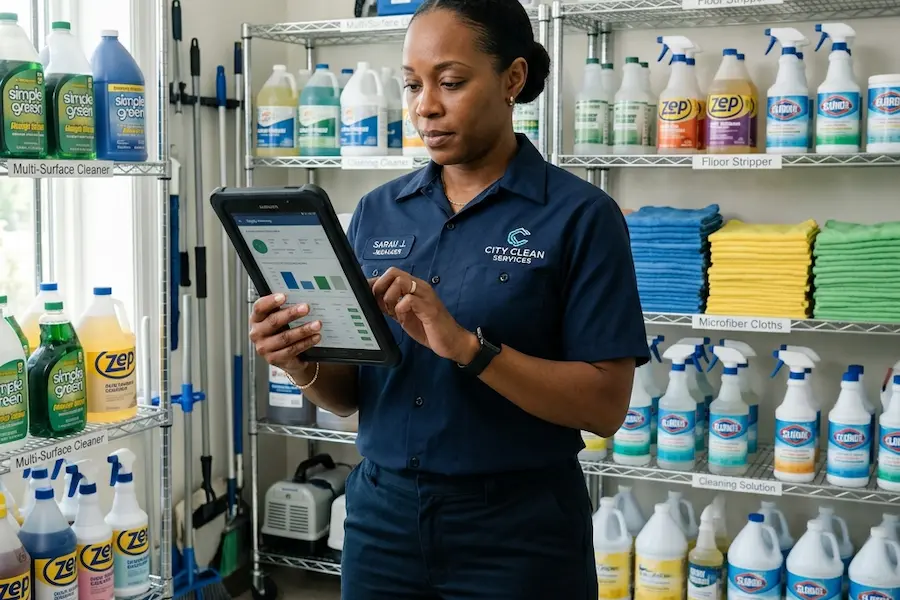
AI Inventory Management for Janitorial Services
Picture this. It’s 9 PM on a Tuesday. Your cleaning crew shows up at a client’s office, and they’re out of floor finish. Someone has to race to a 24-hour store, pay double the price, and the job starts an hour late.
If that sounds familiar, you’re not alone. Supply chaos is one of the biggest profit killers in the cleaning business. And most owners just live with it.
But you don’t have to. AI inventory management for janitorial services is changing how cleaning companies track, order, and use their supplies. It predicts what you’ll need before you run out. It orders for you. And it watches every supply closet across every job site, all without spreadsheets or guesswork.
This guide covers how it works, what it costs, when it’s worth it, and how to get started, even if your team has never used anything fancier than a group text.
What Is AI Inventory Management, and Why Does It Matter for Cleaning Companies?
AI inventory management is software that uses artificial intelligence to track cleaning supplies, predict when stock will run low, and trigger reorders before a shortage happens. It replaces manual counting and guesswork with a system that learns from your usage data and makes supply decisions on its own. For janitorial services, the businesses that provide commercial cleaning for offices, schools, hospitals, and other buildings, this means fewer stockouts, less waste, and lower supply costs.
The software watches how fast your crews use trash liners, disinfectant, paper towels, and floor chemicals at each site. Over time, it learns patterns. Then it starts making smart choices for you.
Why does this matter? Because cleaning companies run on thin margins. According to industry data published by CleanLink, supply costs eat up 5% to 15% of total revenue for most janitorial businesses. On a $500,000-a-year company, that’s $25,000 to $75,000 going to supplies alone.
Even a small fix in how you manage those supplies puts real money back in your pocket.
How Is AI Inventory Tracking Different from a Spreadsheet?
A spreadsheet records what already happened. AI prevents future problems. That’s the core difference, and it’s the reason AI saves cleaning companies money while spreadsheets don’t.
A spreadsheet counts what you have right now, but only if someone types the numbers in by hand. It can’t warn you before you run out. It can’t predict a seasonal spike. It can’t catch unusual usage at one site.
An AI system does all of that. It sends alerts when stock gets low. It learns that your hand soap usage jumps 35% every January during flu season. It flags when one building suddenly uses three times its normal amount of trash liners. And it can place orders for you automatically.
In short: a spreadsheet waits for you to look at it. AI watches your inventory and acts on its own.
How Much Does Poor Supply Management Cost Janitorial Businesses?
Poor supply management costs most janitorial businesses thousands of dollars each year in emergency purchases, wasted products, and lost crew time. The reason this drain goes unnoticed is that most owners never sit down and add up all the small losses. But when you do, the numbers are often shocking.
One mid-sized cleaning company running 30 sites found their team was making 3 to 4 emergency store runs per week. Each run cost about $40 extra in retail markup plus 45 minutes of paid labor. That’s roughly $600 to $800 per month, or over $8,000 a year, just from not knowing what they had in stock.
Pain Points That Drain Your Profits
- Emergency buys at retail prices. When you run out mid-job, you pay 30% to 50% more than your normal supplier rate, plus the labor time for the trip.
- Over-ordering “just in case.” Fear of running out leads to overstocking. That ties up cash, fills storage space, and some chemicals expire before you use them.
- No visibility across sites. You’ve got 25 supply closets across town, but you don’t know which are full and which are empty until someone texts you in a panic.
- Wasted crew time. Every minute a cleaner spends hunting for supplies is a minute they’re not cleaning, and you’re still paying them.
- Undetected waste and theft. Without usage data by site, you can’t tell the difference between a location that genuinely uses more and one where product walks out the door.
- Inaccurate client billing. If you can’t track what each site uses, you can’t bill right. Some clients end up subsidizing others.
According to AuxilioBits, a research firm that publishes benchmarks on AI adoption and operational efficiency, companies that switch to AI-powered inventory management typically see operational cost reductions of 15% to 25%. For a company spending $60,000 a year on supplies, that’s $9,000 to $15,000 saved, every single year.
If you’re unsure where your biggest supply costs are hiding, start by tracking your supply costs by job site. That one step alone can reveal surprising waste.
How Does AI Inventory Management Work for Cleaning Companies?
AI inventory management works by collecting data about your supply usage, finding patterns in that data, and then making predictions and taking action based on those patterns. The system handles four core jobs: forecasting demand, reordering supplies, tracking stock across sites, and catching unusual usage. This works because the AI gets smarter over time as it learns from your specific data.
Predictive Demand Forecasting
Predictive demand forecasting is when the software uses your past usage data to estimate what you’ll need in the future. This matters because it removes guesswork from your ordering process and prevents both shortages and over-buying.
It goes beyond simple averages. It factors in things like time of year, day of the week, and the type of building. So when cold and flu season hits in January and your hand soap usage spikes 35% across medical offices, the system already expected it, because it saw the same thing last year.
Think of it like this: you already know in your gut that winter means more sanitizer. AI does it with math, across every product and every site, without you having to remember a thing.
Hands-Free Reordering
Hands-free reordering means the system places supply orders for you when stock gets low, without you having to check or remember anything. You set a minimum stock level for each item. This is called a reorder point, which is the exact count where you want the system to step in. When stock drops to that number, the system either sends you an alert or places a purchase order with your supplier on its own.
No more mental math. No more “I think we’re getting low on liners.” The system knows down to the unit count and acts before there’s a problem.
Live Multi-Site Tracking
Live multi-site tracking gives you a single screen that shows the stock level of every supply closet, vehicle, and storage area across all your job sites at once. This is where AI shines for janitorial companies, because most cleaning businesses work across dozens of locations: offices, schools, clinics, and stores.
Your crews update what they use from their phones. You see it all on one screen: which sites are stocked, which are low, and which are burning through product faster than they should.
No more calling crew leaders to ask “how are we on paper towels at the bank building?”
Usage Anomaly Detection
Anomaly detection is when the AI spots supply usage that falls outside of what’s normal for a specific site. The reason this matters is that it catches problems like waste and theft that humans almost always miss.
The AI learns what “normal” looks like for each location. When something breaks the pattern, say one office suddenly uses triple its usual trash liners, the system flags it.
Maybe there was a special event. Maybe there’s waste. Maybe supplies are being taken home. You won’t know until you look into it, but at least now you know to look. Without this feature, these patterns stay hidden for months.
Example in Action: What AI Looks Like in a 40-Site Cleaning Operation
To show how AI inventory management plays out in a real business, here’s a composite scenario based on common industry patterns. It walks you through what a mid-sized janitorial company would see month by month after switching from spreadsheets to AI-powered tracking.
Note: This example is based on documented industry benchmarks and typical operational patterns, not one specific company.
Imagine you run a commercial cleaning company with 40 client sites. You have 6 supply closets, 3 vehicles carrying backup stock, and 22 crew members. You’ve been tracking supplies with a shared Google Sheet that gets updated maybe twice a week.
Month 1: You go digital. You switch to a janitorial management platform like Swept, a popular app built for commercial cleaning companies that connects supply tracking with crew scheduling in one place. Your crews start logging supply use from their phones after each shift. It’s messy at first. Some forget, some log wrong amounts. But data starts flowing.
Months 2 to 4: Patterns show up. The system reveals that Site #12 (a medical clinic) uses 4 times more hand soap than similar-sized offices. That makes sense for a clinic. But Site #27 (a small law firm) uses more trash liners than your largest office building. That makes no sense.
You look into it and find out the evening crew has been double-bagging every can. A quick training fix saves $180 per month at that one site.
Month 5: Automation kicks in. You set reorder points for your top 15 supplies. The system auto-creates purchase orders when stock drops below threshold. Emergency store runs drop from 3 to 4 per week to almost zero.
Month 6 and beyond: AI forecasting goes live. The system now has enough data to predict demand. It tells you to order 35% more disinfectant in November for flu-season schedules. You place the bulk order early and save $2,200 by avoiding rush pricing.
At year’s end, you’ve saved roughly $14,000 through less waste, no rush orders, and smarter buying. On a $600,000 business, that’s a real lift, especially when net margins in this industry typically sit between 10% and 28%.
What Are the Biggest Benefits of AI Inventory Management for Janitorial Services?
AI inventory management helps cleaning companies save money, prevent supply shortages, and spend less time on paperwork. The reason it makes such a difference is that it catches problems and patterns that manual tracking can’t. Here are the five biggest payoffs.
- Lower supply costs. AI cuts over-buying and emergency purchases, the two biggest supply cost drivers. AuxilioBits data shows inventory holding costs can drop by up to 25% after switching to AI-powered tracking.
- Zero stockouts and emergency runs. Auto-reorder alerts make sure your crews always have what they need on site. Nothing kills client trust faster than a crew that can’t finish the job.
- Full visibility across every job site. One dashboard shows every supply closet, vehicle, and location. You see in seconds which sites are stocked and which need attention. This alone saves hours of phone calls and texts each week.
- Smarter budgeting and billing. When you know your exact cost-to-serve, which is the total supply cost you spend on each client site, you can price contracts accurately and show clients clear data at renewal time.
- Less time on admin work. AI handles stock checks, alerts, and reorders on its own. That frees up hours each week for client relationships and growing your business.
One cleaning company owner put it this way: “The first month we had zero emergency runs, I thought the system was broken. It just worked.”
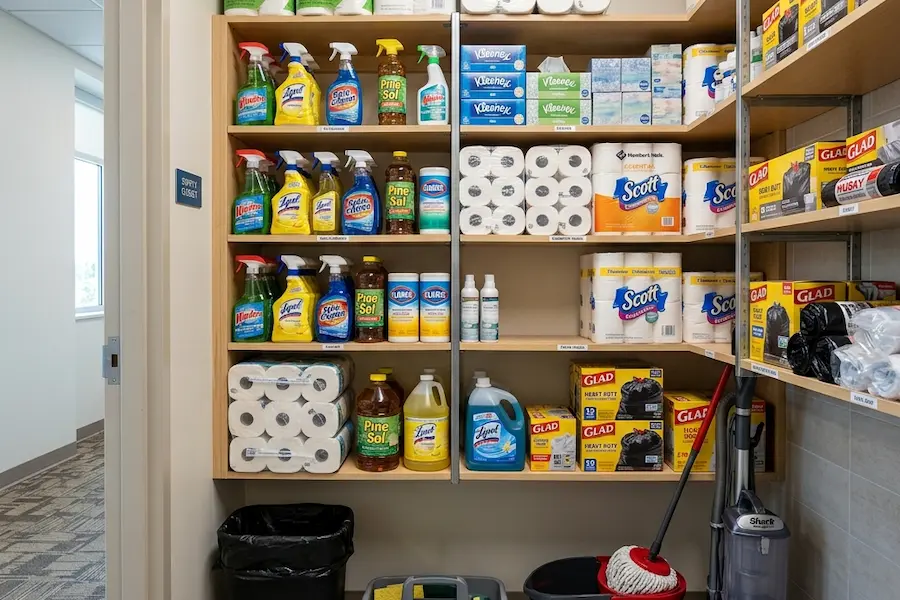
If you’re looking to tighten up your pricing, learn how to price janitorial contracts for profit. Knowing your true supply costs per site is step one.
When Should a Cleaning Company NOT Use AI Inventory Management?
AI inventory management is not the right move for every cleaning company at every stage. If your business is small, your data is messy, or your team isn’t on board, you’re better off waiting. The reason is that AI needs a foundation of clean, consistent data to deliver results, and forcing it too early usually leads to wasted money.
You’re Too Small (For Now)
If you manage fewer than 15 to 20 client sites, your inventory probably isn’t complex enough to justify AI. A simple digital tracking app, like Sortly or even a well-built spreadsheet, can handle the volume just fine.
In my opinion, the sweet spot for AI adoption starts around 20 to 25 active sites. Below that, start with basic digital tracking and grow into AI when you’re ready.
Your Data Isn’t Ready
AI learns from data. If your team isn’t logging what they use, or if your records live in texts, sticky notes, and someone’s memory, the AI has nothing to learn from. The rule is simple: garbage in, garbage out.
Before you pay for AI features, spend 3 to 6 months building a clean digital record. Log every purchase. Track usage by site. This prep work is not optional.
Your Team Needs Buy-In First
The best software in the world fails if your crew won’t use it. If your team pushes back on new tools, start small. Give them a simple phone-based supply request app. Let them see it makes their lives easier, with fewer last-minute runs and supplies always where they need them.
Once they trust the basics, adding AI on top feels natural instead of forced.
Honest take: Rushing to adopt AI without a solid foundation is one of the most common, and most expensive, mistakes in this space. Walk before you run. The tech will be there when you’re ready.
How Do You Get Started with AI Inventory Management?
The best way to get started is a phased rollout in three stages: first digitize your tracking, then set up auto-reordering, and finally turn on AI forecasting. This works because each stage builds the data and habits that the next stage needs to succeed.
- Digitize your current setup. Replace paper logs with a basic inventory app like Sortly, CountControl, or the supply module in your janitorial platform. Log every purchase, assign items to sites, and have crews request supplies through the app instead of group texts.
- Set up auto-reordering and alerts. Pick your top 10 to 20 supplies and set reorder points (minimum stock levels) for each. When stock drops below those levels, the system sends alerts or places orders for you.
- Turn on AI forecasting. After 3 to 6 months of clean data, activate AI features in your platform. The system starts predicting demand, suggesting order amounts, and flagging unusual usage patterns.
Each stage takes roughly 1 to 2 months to settle in. Here’s a closer look at what each one involves.
Stage 1: Go Digital
Goal: Get every supply transaction into a digital tool.
- Replace paper logs with an inventory app (Sortly, CountControl, or the supply module in your janitorial platform)
- Log every purchase and assign items to specific sites
- Have crews request supplies through the app instead of group texts
- Focus on consistency. Even imperfect data entered every day beats perfect data entered once a month.
Timeline: 1 to 2 months to build the habit.
Stage 2: Turn On Auto-Reordering
Goal: End stockouts and emergency purchases.
- Set reorder points (minimum stock levels) for your top 10 to 20 supplies
- Turn on automatic alerts or auto-generated purchase orders when stock hits those levels
- Check a simple dashboard once a week to spot trends
Timeline: 1 to 2 months after Stage 1 is steady.
Stage 3: Activate AI Forecasting
Goal: Move from reacting to predicting.
- With 3 to 6 months of clean data, turn on AI features in your platform
- Let the system predict seasonal spikes, suggest order amounts, and flag unusual usage
- Review AI suggestions monthly. Trust but verify, especially in the first few months.
- Use cost-per-site reports to adjust contract pricing and grow your margins
Timeline: Ongoing from month 6 and beyond.
If you need help choosing the right tool for Stage 1, check out our guide to the best janitorial management software.
What Should You Look for in AI Inventory Software?
The right AI inventory tool for a cleaning company should be built for field service work, not warehouses or retail stores. This matters because janitorial crews work at night in client buildings, not at a desk, so the software needs to match how your team works in the field.
Features You Need
- Mobile app for field crews. Your cleaners work at night in client buildings, not at desks. The app needs to be simple, fast, and able to work offline.
- Multi-site tracking. You need stock levels per location, not one big total.
- Auto-reorder alerts. The system should notify you, or order for you, when stock hits your minimums.
- Usage reports by site. This shows your cost-to-serve per client and helps you spot waste or theft.
- Predictive forecasting. The system should learn from your data and look ahead, not show history alone.
- Accounting software connection. Supply orders should sync with accounting tools like QuickBooks, or Xero. No double-entry.
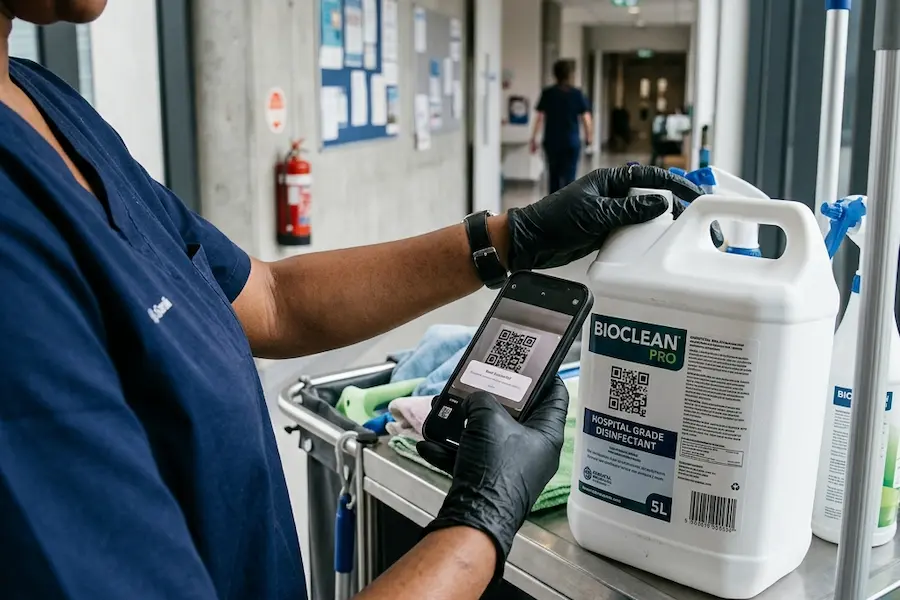
- Barcode or QR scanning. Your crew scans a product, the system logs it. Fast and accurate.
Red Flags to Watch Out For
- No mobile app (or a bad one). If your crews can’t use it in the field, they won’t use it at all.
- Made for warehouses, not field services. Warehouse tools think in bins and zones. You need tools that think in sites, closets, and vehicles.
- No free trial. Any vendor that won’t let you test first is a risk.
- Lock-in contracts. You want the freedom to switch if the tool doesn’t deliver. Avoid long-term commitments, especially with newer AI features.
Platforms worth looking at include Swept (strong for multi-site cleaning operations), Janitorial Manager, a platform known for closet-level tracking and purchase orders, Deelo (modern AI-assisted workflows), CountControl (AI-first with mobile cycle counts), and inFlow (thorough inventory control for supply-heavy businesses). This is not an endorsement. Test each one against your own needs.
Frequently Asked Questions
How much does AI inventory software cost for a small cleaning company?
Most AI inventory software for cleaning companies costs between $50 and $300 per month. This price depends on the number of active users and job sites you manage. Basic standalone tools can start as low as $25 per month, and most vendors offer a free trial period.
Does AI inventory tracking require a constant internet connection in client buildings?
No, the software does not need a constant internet connection to track supplies in the field. Mobile apps are designed to work offline, meaning crew members can scan items in basement closets or steel-reinforced buildings. The app saves the data locally and syncs automatically once the device reconnects to cellular data or Wi-Fi.
Is it true that AI inventory software completely replaces physical count audits?
No, AI software does not eliminate the need for occasional physical inventory checks. You still need to run manual cycle counts every 30 to 90 days to catch unlogged leaks, broken bottles, or spills that the software cannot see. However, the system reduces the time you spend on these counts by up to 75% because it tells you exactly what should be on the shelf.
What is the difference between safety stock and a reorder point?
Safety stock is the emergency backup supply you keep to prevent shortages, while a reorder point is the active stock level that triggers a new order. For example, if you want a buffer of 2 cases of glass cleaner as your safety stock and it takes 3 days to get a shipment, your reorder point might be 4 cases. We explained how to set these up in our Stage 2 roadmap guide above.
Can AI inventory tools help me win new commercial cleaning contracts?
Yes, using AI inventory software can help you win bids by showing prospective clients that you manage costs efficiently. Showing clients a live dashboard of their building’s supply usage builds trust and proves you have operational control. Many business owners report that supply visibility helps justify their pricing during competitive bid processes.
Will my cleaning crews resist using inventory tracking apps?
Some crew members may resist new apps initially, but clear training usually solves this problem within two weeks. Most field workers adapt quickly once they realize the app stops frustrating supply shortages and emergency runs. As we discussed in the team buy-in section above, starting with a simple supply request feature makes the transition easier.
Where This All Leaves You
AI inventory management for janitorial services isn’t science fiction. It isn’t only for Amazon-sized warehouses. It’s a tool that solves a very real, very costly problem that cleaning companies deal with every day: tracking hundreds of supplies across dozens of sites with teams that work nights and weekends.
The technology is ready right now, in 2026. Platforms built for cleaning companies already exist. And the numbers are clear: businesses that switch to AI-powered inventory management are cutting supply costs by 15% to 25%, ending stockouts, and freeing up hours of management time every week.
But here’s the honest truth. It only works if you build the foundation first. Digitize your tracking. Get your team comfortable with a simple app. Build clean data for a few months. Then add the AI.
The U.S. janitorial industry has over 1.25 million businesses as of 2026, according to industry reports from IBISWorld, a market research company that tracks industry data across the U.S. economy. Competition is fierce and margins are tight. The companies that figure out smarter supply management now will have a serious edge. The ones that don’t will keep making midnight store runs.
Ready to take the first step? Start by digitizing your supply tracking today. Even going from paper to a simple app will change how you run your business.
Your move.