How AI Helps Phone Repair Technicians Diagnose and Fix Devices Faster
A customer walks into your phone repair shop with a smartphone that randomly restarts. You could spend 45 minutes running manual tests on the battery, motherboard, and software, or you could plug the device into an AI diagnostic platform that scans performance logs, battery health data, and component status in under 2 minutes and tells you the restart is caused by a degraded power management IC. That’s how AI helps phone repair technicians: it replaces time-consuming guesswork with data-driven diagnosis that identifies the exact failing component before you ever pick up a screwdriver.
How Does AI Diagnose Phone Problems Faster Than Manual Testing?
AI diagnoses phone problems faster by scanning dozens of hardware and software parameters simultaneously and comparing the results against failure pattern databases containing millions of documented cases for each device model. Manual testing checks one component at a time. AI evaluates the complete device health picture in seconds.
Traditional phone repair diagnostics follow a sequential process. The technician checks the screen, tests the battery, runs a software scan, checks the charging port, and works through components one by one until they find the problem. Each test takes 3 to 10 minutes, and the total diagnostic process averages 30 to 45 minutes for complex issues. If the first diagnosis is wrong, the process starts over after the initial repair fails.
AI diagnostic platforms like PiceaOnline, Phonecheck, and manufacturer-specific tools run a full scan in 60 to 120 seconds. They test the display, touchscreen responsiveness, battery capacity and charge cycles, all sensors including accelerometer, gyroscope, and proximity, WiFi and cellular connectivity, speakers, microphones, cameras, and internal storage health. The AI then cross-references any anomalies against known failure patterns for that specific device model and firmware version.
Diagnostic software vendors report large cuts in bench time, typically describing a scripted scan that runs a battery of hardware and software checks in a couple of minutes where a manual pass takes considerably longer. Those numbers come from the companies selling the tools, and we could not find an independent study measuring the saving across shops, so treat the size of it as unverified.
The direction is easier to trust than the figure. A scripted scan checks battery voltage, charging behaviour, digitiser response, sensors and radios in a fixed order every time, and it does not skip step four because the shop got busy. That consistency is the real gain, and it matters most for the intermittent faults a quick manual check tends to miss.
What Specific Tasks Does AI Handle for Phone Repair Technicians?
AI handles five core tasks for phone repair technicians: automated fault detection, parts authenticity verification, repair guidance with augmented reality, customer-facing condition reports, and predictive failure analysis for preventive repairs.
- Automated fault detection: AI scans all device components and flags failures or degradation. It doesn’t just identify binary pass/fail results. It detects subtle issues like a battery at 78% health that will likely fail within 2 months or a display with minor dead pixels that indicate early backlight deterioration.
- Parts authenticity verification: Tools like Phonecheck use AI to detect non-original components in a device. This matters when buying used phones for refurbishment or when verifying that a previous repair used genuine parts. The AI compares component serial numbers, performance signatures, and calibration data against manufacturer specifications.
- AR-guided repair: Platforms like iFixit’s FixBot overlay augmented reality schematics onto the device’s internal components through a technician’s tablet or phone camera. The AI identifies each component, shows the correct disassembly sequence, and highlights the specific part that needs replacement.
- Customer condition reports: AI generates professional condition reports with scored ratings for each component. These reports build customer trust by showing objective data rather than just telling a customer “your battery is bad.” The report shows the exact charge cycle count, current capacity percentage, and expected remaining lifespan.
- Predictive failure analysis: By analyzing usage patterns and component wear data, AI can identify devices at risk of future failures. This enables repair shops to offer preventive services like battery replacement before the phone starts shutting down unexpectedly.
From what we’ve seen in repair shops adopting AI tools, the parts authenticity feature alone pays for the platform subscription. A single non-genuine battery that causes a device fire or a counterfeit screen that fails within weeks creates liability exposure and reputation damage that far exceeds the cost of verification software.
How Does AI Solve the “No Fault Found” Problem in Phone Repair?
AI solves the “no fault found” problem by analyzing historical device performance data and intermittent behavior logs that capture issues even when the phone appears to be working normally during the diagnostic window.
The “no fault found” scenario is one of the most frustrating situations in phone repair. A customer brings in a phone that crashes randomly or loses signal intermittently, but when the technician tests it, everything works perfectly. Traditional diagnostics can only test what’s happening right now. If the fault isn’t active during testing, it won’t be detected.
AI diagnostic platforms address this by pulling historical usage data from the device’s internal logs. They analyze crash reports, voltage fluctuations during charging, signal strength patterns over time, and app performance metrics to identify issues that occurred in the past but aren’t currently manifesting. For example, the AI might find that the device experienced 15 thermal throttling events in the past week, each preceded by a specific CPU usage spike, pointing to a particular IC that overheats under load.
One thing most guides miss is the value of AI in distinguishing between hardware and software causes for the same symptom. Random restarts can be caused by a failing battery, a loose connector, a corrupted firmware module, or a rogue app. A technician running manual tests might replace the battery first as the most common cause, only to discover the restarts continue because the actual problem was a software conflict. AI analyzes the crash logs and identifies whether the restart pattern matches hardware failure signatures or software crash signatures, saving the customer from paying for an unnecessary battery replacement.
How Much Can AI Diagnostic Tools Increase a Repair Shop’s Revenue?
Suppliers put the revenue uplift at 15% to 30%, attributing it to faster turnaround, higher first-fix rates, less wasted stock and new service offerings like device health reports and preventive maintenance packages.
The math works like this. If a technician currently completes 8 repairs per day with an average diagnostic time of 35 minutes, reducing that diagnostic time to 8 minutes with AI frees up approximately 3.5 hours per day. At a conservative billing rate of $50 per repair, those additional repairs represent $200 to $350 in daily revenue per technician. For a shop with 3 technicians, that’s $600 to $1,050 per day or $15,000 to $26,000 per month in additional capacity.
First-fix rate improvement adds another revenue layer. When the traditional 25% to 30% callback rate drops to under 10% with AI diagnostics, each avoided callback saves the shop $30 to $60 in labor and parts that would have been used on a misdiagnosed first attempt. Over a month, those savings compound into thousands of dollars recovered.
We’ve noticed that the most profitable AI-enabled repair shops also monetize the diagnostic report itself. Offering a full device health check for $15 to $25 creates a new service category that didn’t exist before. Customers appreciate knowing their battery health, storage condition, and overall device status. Many opt for preventive repairs based on the report, generating additional revenue from services the customer didn’t originally come in for.
Repair shops looking to streamline their customer intake alongside diagnostics can connect AI tools with AI-powered customer service chatbots that handle appointment booking, status updates, and repair quotes automatically.

What AI Tools Are Available for Phone Repair Technicians?
The main AI diagnostic tools available for phone repair technicians in 2026 include PiceaOnline for full device testing, Phonecheck for authenticity verification, iFixit FixBot for AR-guided repairs, and manufacturer-specific platforms from Apple and Samsung for authorized service providers.
Here’s what each platform does best:
- PiceaOnline: Connects to devices via USB and runs a full hardware diagnostic covering 30 or more test points. Its AI analyzes historical usage data to identify intermittent faults and hidden hardware conflicts. Pricing starts at approximately $100 to $200 per month per workstation.
- Phonecheck: Focuses on device certification and authenticity. It detects non-original parts, checks IMEI blacklist status, verifies factory reset completeness, and generates certified condition reports. Popular with refurbishment operations and used device resellers. Plans start around $50 to $100 per month.
- iFixit FixBot: Uses computer vision and AR to guide technicians through complex repairs step by step. The camera recognizes the device’s internal layout and overlays repair instructions in real time. Particularly valuable for training new technicians and handling unfamiliar device models.
- Apple GSX and Samsung Knox: Manufacturer-specific platforms available to authorized service providers. They provide the deepest diagnostic access including component-level serial number verification and direct manufacturer repair data. Limited to authorized repair networks.
A common myth is that AI diagnostic tools only work for newer smartphones. In reality, most platforms maintain diagnostic databases going back 6 to 8 years of device models. An iPhone 11 or Samsung Galaxy S10 is just as well-supported as a current-generation model, which matters because older devices represent a significant portion of repair shop volume.
What Mistakes Do Phone Repair Shops Make When Adopting AI Tools?
The biggest mistake is treating AI diagnostics as infallible and skipping manual verification of the AI’s findings before starting a repair. AI provides the most likely diagnosis, not a guaranteed diagnosis. Experienced technicians use the AI result as a starting point and confirm it with targeted manual testing before replacing components.
One mistake we see repair shops make is buying multiple overlapping AI platforms without understanding what each one does best. A shop that subscribes to PiceaOnline for diagnostics doesn’t also need Phonecheck unless they do significant used device resale. Evaluate which specific capability your shop needs most, diagnostic speed, parts verification, or AR repair guidance, and start with one platform that addresses your biggest pain point.
Another pitfall is failing to integrate AI diagnostic data into the shop’s workflow system. The diagnosis is only useful if it connects to your parts inventory, repair ticketing system, and customer communication tools. Running an AI scan and then manually typing the results into a separate system defeats the efficiency purpose. The best implementations use AI-powered business automation to flow diagnostic results directly into repair tickets, parts orders, and customer notifications without manual data entry.
According to the Repair Association, the right-to-repair movement has expanded independent technicians’ access to manufacturer diagnostic tools and service documentation. AI platforms that aggregate this data give independent shops diagnostic capabilities that previously required manufacturer authorization, leveling the playing field between independent and authorized repair providers.
Desktop and laptop work has followed the same path, which computer diagnostic tools in 2026 covers in detail. For the physical side of a repair, augmented reality overlays are what shorten the bench time.
Frequently Asked Questions
Can AI diagnose water damage in phones?
AI can detect symptoms consistent with water damage, such as erratic sensor behavior, charging inconsistencies, and corrosion indicators in diagnostic logs. However, confirming water damage typically requires visual inspection of internal liquid contact indicators and physical examination of the circuit board for corrosion, which AI cannot perform remotely.
How accurate are AI phone diagnostics compared to manual testing?
AI diagnostic platforms achieve 88% to 95% accuracy in identifying the primary failing component. Manual testing by an experienced technician averages 75% to 85% accuracy on the first diagnosis attempt. The accuracy gap is largest with intermittent faults and multi-component failures where AI excels at pattern correlation.
Do AI diagnostic tools work on both iPhones and Android devices?
Most third-party platforms like PiceaOnline and Phonecheck support both iOS and Android devices. However, iOS diagnostics may have some limitations compared to Android due to Apple’s more restricted access to internal hardware data. Manufacturer-specific tools like Apple GSX provide the deepest iOS diagnostic access but require authorized service provider status.
Is it true that AI will replace phone repair technicians?
No. AI handles diagnostics and provides repair guidance, but the physical repair work, micro-soldering, screen replacement, battery installation, and reassembly, requires human dexterity, judgment, and craftsmanship that AI cannot replicate. AI makes technicians faster and more accurate, not obsolete.
How much do AI diagnostic tools cost for a small phone repair shop?
Entry-level AI diagnostic subscriptions start at $50 to $100 per month for a single workstation. Mid-tier platforms with full diagnostics, parts verification, and reporting cost $100 to $200 per month. Enterprise solutions for multi-location operations range from $200 to $500 per month. Most platforms offer free trials to test compatibility with your workflow.
Can AI help with micro-soldering and board-level repairs?
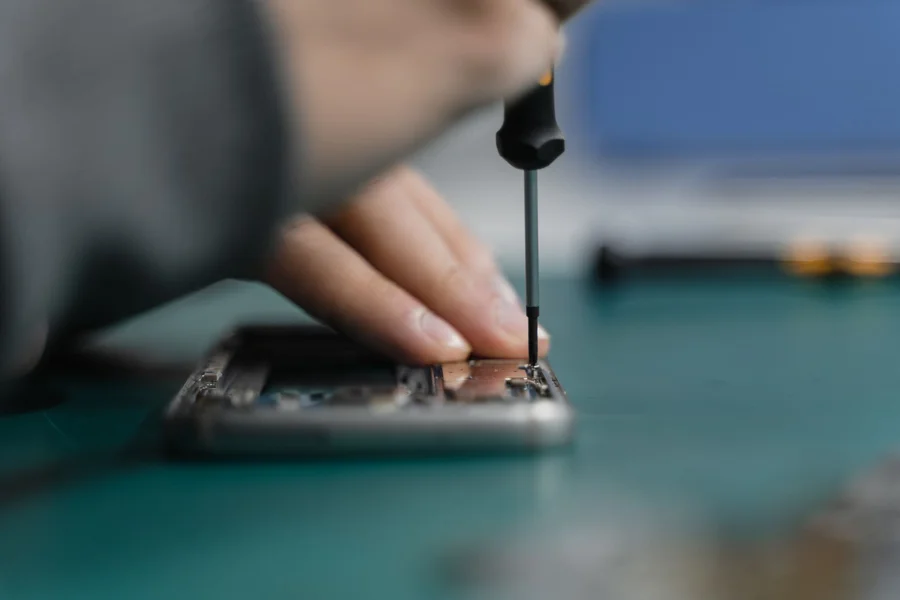
AI can identify which specific chip or component on the board is likely failing based on diagnostic data and failure pattern analysis. AR-guided platforms can overlay schematics showing the component’s exact location. However, the actual soldering work requires manual skill, specialized equipment, and training that AI cannot replace.
Let AI Handle the Diagnosis So You Can Focus on the Repair
How AI helps phone repair technicians comes down to one simple shift: spending less time figuring out what’s wrong and more time actually fixing it. Whether you run a one-person repair kiosk or a multi-location service operation, vendors report that AI diagnostic tools cut diagnostic time by around 75% and roughly halve misdiagnosis, and they open up new revenue streams through device health reports and preventive maintenance. Pick the platform that matches your shop’s biggest need, start with one workstation, and let the time savings prove the value.